A colloidal route to detection of organic molecules based on surface-enhanced Raman spectroscopy (SERS) using nanostructured substrate derived from aerosols
Hybrid Aerosol-Colloid SERS (HAC-SERS) Method
>> Jpn. J. Applied Physics, 2011 (Abstract, Full Text PDF)
Our collaborated works with:
Plant Ecochemicals Research Center (Eniwa, Hokkaido) and Kanagawa Industrial Technology Center (Ebina, Kanagawa)
ナノ粒子の構造化による基板(チップ)形成を行い、ラマン散乱分光を用いた微量な成分の検出精度を向上させた。
玄大雄(東京農工大学・修士課程)、
角田英男((社)植物情報物質研究センター(北海道))、
上元好仁(神奈川県産業技術センター)、
ウレット・レンゴロ(東京農工大学)
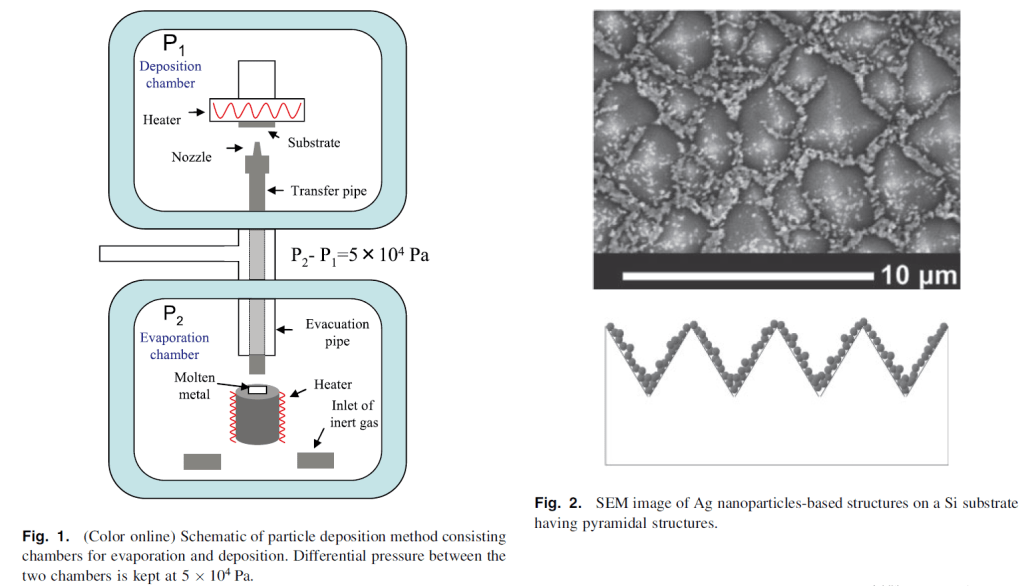
A detection method based on the surface-enhanced Raman spectroscopy (SERS)-active substrate derived from aerosol nanoparticles and a colloidal suspension for detecting organic molecules of a model analyte is proposed. This approach can detect the molecules of the derived from its solution with the concentration levels of ppb. For substrate fabrication, a gas-phase method is used to directly deposit Ag nanoparticles on to a silicon substrate having pyramidal structures. By mixing the target analyte with a suspension of Ag colloids purchased in advance, clotianidin analyte on Ag colloid can exist in junctions of co-aggregated Ag colloids. Using (i) a nanostructured substrate made from aerosol nanoparticles and (ii) colloidal suspension can increase the number of activity spots. 表面増強ラマン分光法(SERS)を利用したエアロゾルナノ粒子とコロイド懸濁液に由来する活性基質を用いて、モデル分析対象物の有機分子を検出する方法を提案する。本アプローチは、有機分子を溶液からppbの濃度で検出することが可能である。基板作製では、気相法により、ピラミッド構造を持つシリコン基板上にAgナノ粒子を直接堆積させる。あらかじめ購入したAgコロイドの懸濁液に標的分析物を混合することで、Agコロイド上のクロチアニジン分析物が、凝集したAgコロイドの接合部に存在することができます。エアロゾルナノ粒子から作られたナノ構造基板とコロイド懸濁液を使用することで、活性スポットの数を増やすことができます。
学会発表
日本農薬学会第38回大会(2012年3月14日~16日、筑波大学)14:30 B215 銀微粒子構造体とラマン分光法を用いたネオニコチノイド系農薬の検出
玄 大雄,角田英男,上本好仁,Wuled Lenggoro( 農工大院・BASE, 植物情報物質研究セ, 神奈川県産技セ,農工大院・工)


Can a Tiny Silver Trap Help Save Bees and Keep Food Safer?
Bite into an apple from your lunchbox. It looks clean, tastes fine, feels perfectly ordinary. But what if the surface carried traces of chemicals so vanishingly small that no human sense could ever register them?
Now picture a bee drifting toward a flower a few meters away. The same kind of invisible residue — perhaps drifted there from a nearby field — could quietly scramble its navigation, and it might never find its way back to the hive.
This is the hidden ledger of modern agriculture: pesticide residues so dilute they border on the philosophical, yet potent enough to matter enormously for human health and the delicate webs of ecosystem life. Solving the detection problem, it turns out, means learning to think at a scale that makes a human hair look like a motorway.
The Invisible Challenge
Pesticides are essential tools — without them, crop losses to insects and disease would be catastrophic. But they leave footprints. Tiny ones. Residue concentrations on produce can fall to just a few parts per billion, the chemical equivalent of a single drop of dye dissolved into an Olympic swimming pool.
Traditional detection relies on laboratory workhorses like chromatography systems: precise, dependable, and thoroughly impractical for anyone hoping to test a basket of strawberries before the market opens. The equipment is bulky, the preparation is painstaking, the solvents are hazardous, and the results arrive long after the moment of decision has passed. Real-time, field-ready monitoring has remained stubbornly out of reach.
So a different question started circulating among researchers: rather than building ever-larger, ever-more-powerful detection machines, what if you redesigned the material itself to make the molecules shout instead of whisper?
A Trap Built from Light and Silver
The answer came from marrying two nanotechnology strategies into something that works a bit like a microscopic amplifier — or, more evocatively, a trap.
Scientists began by fabricating a silicon chip etched with arrays of pyramid-shaped structures, each one invisibly small. They then blasted the surface with pure silver nanoparticles using a high-speed aerosol technique, leaving an exquisitely rough metallic coat. So far, so elegant. But the real ingenuity came next.
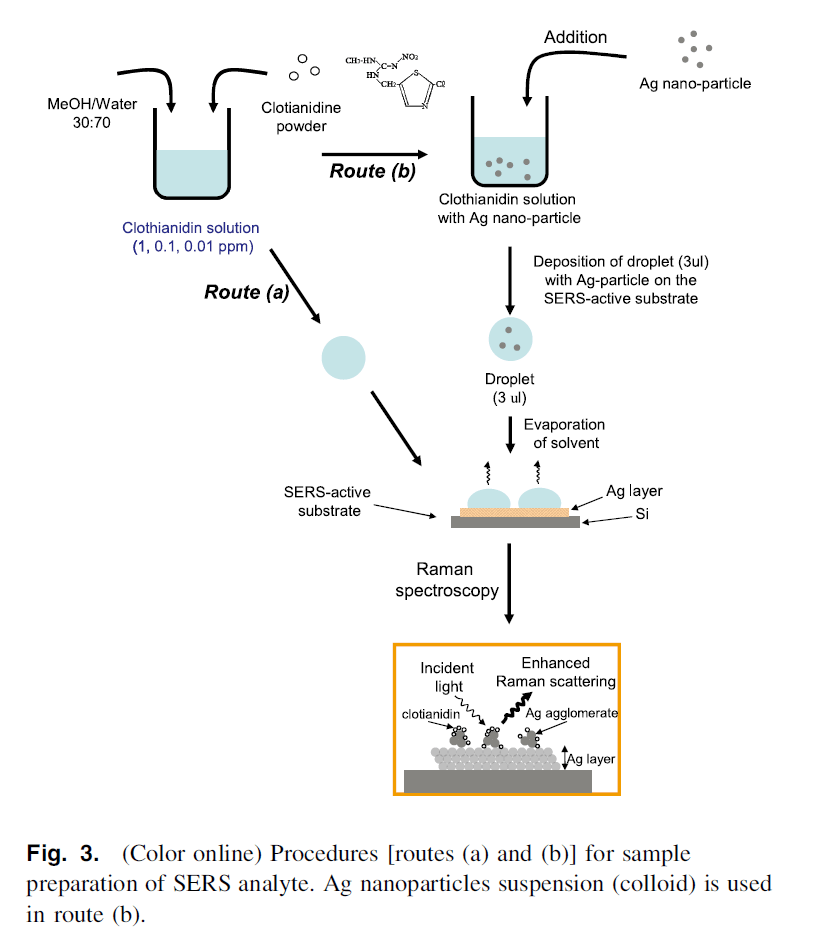
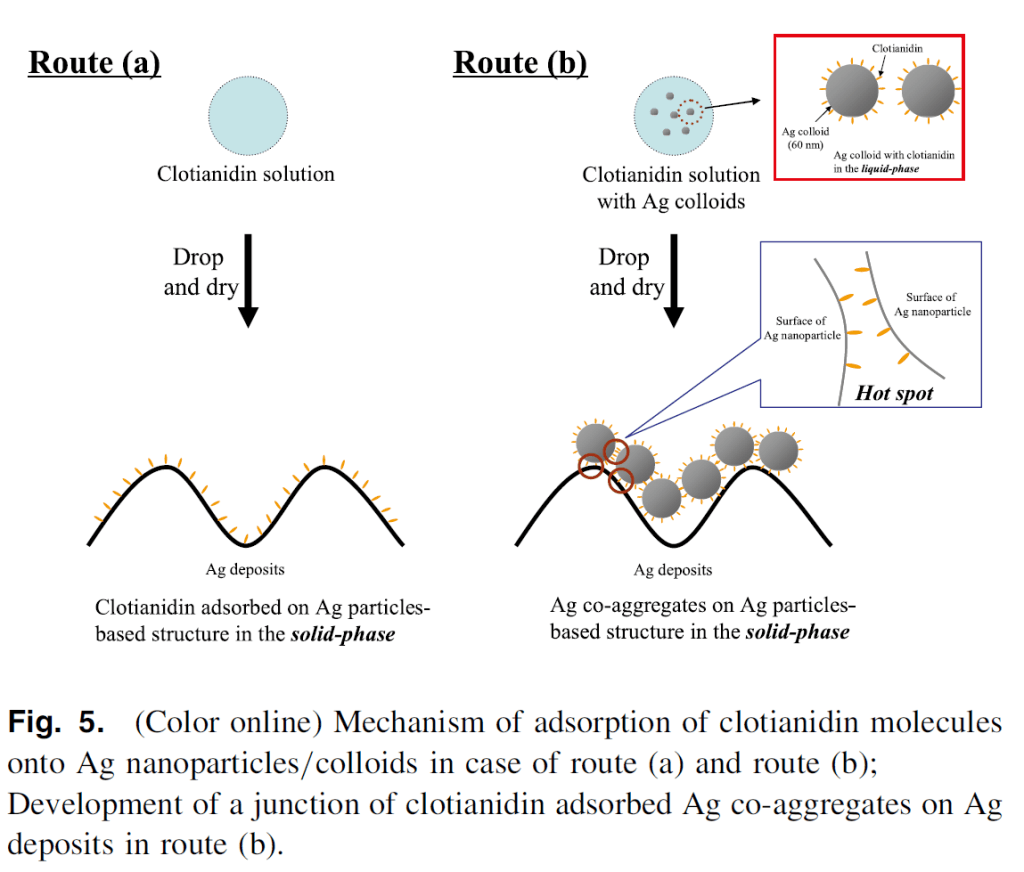
Instead of placing pesticide molecules — specifically clothianidin, a widely used neonicotinoid — directly onto the chip, the researchers suspended them in a liquid already seeded with floating silver nanoparticle clusters. When that liquid dried on the chip’s surface, geometry did the rest.
The drifting silver clusters settled into the valleys between the silver-coated pyramids, creating gaps of almost unimaginable smallness. These are what physicists call hot spots — points where incoming laser light gets squeezed and concentrated into intensities far beyond what the beam alone could achieve. Any molecule unlucky enough to wander into one of these gaps finds itself caught in a blaze of focused energy.
Under that concentrated light, a pesticide molecule that would normally produce a signal too faint to measure suddenly broadcasts a clear, readable fingerprint. The technique behind this is called Surface-Enhanced Raman Spectroscopy, or SERS — and in this experiment, it detected clothianidin at parts-per-billion concentrations, almost instantaneously.
The silver pyramids didn’t just hold the molecules. They made them visible.
Why the Shape of Nothing Matters
Here is where the story gets philosophically interesting, and why this research matters beyond its immediate application.
At the scale of everyday life, a rough surface versus a smooth one is a minor aesthetic detail. At the nanoscale, that same distinction becomes the difference between darkness and floodlight. The gaps between the silver pyramids and the drifting clusters are so precisely sized that they govern the behavior of light itself — concentrating photons the way a lens concentrates the sun onto a single scorching point.
The deeper insight, then, is not simply that silver can detect pesticides. It’s that the deliberate architecture of matter at the nanoscale lets scientists bend light to their will — and use it to read chemistry that would otherwise remain invisible forever.
That is the promise nanotechnology keeps making, and slowly, experiment by experiment, beginning to keep.
From Lab Chip to Open Field
The practical implications radiate outward from that silicon chip in several directions at once.
For food safety, rapid SERS-based sensors could one day sit at the point of packaging or even at farm gates, flagging residue levels before produce ever reaches a consumer’s hands. For pollinator protection, portable monitors placed at the edges of fields could build real-time maps of pesticide drift — giving conservationists the data they need to intervene early. For the environment more broadly, the approach demands a fraction of the chemical solvents that conventional analysis consumes, nudging laboratory science toward a smaller footprint.
And further ahead, as the hardware miniaturizes, imagine a sensor small enough to clip to a drone or embed in soil — continuously reading the chemical signature of a living landscape.
None of this arrives overnight. But every transformative technology begins somewhere modest: in this case, a chip about the size of a thumbnail, dusted with silver pyramids, quietly trapping light.
小さな銀の「わな」が、食べものとミツバチを守る?
お弁当に入っているリンゴを一口かじります。見た目はきれいで、味も普通。何も変わったところはありません。でも、その表面に、人間の感覚では絶対に気づけないほど微量の化学物質が残っていたとしたら、どうでしょう。
すぐ近くの花に、ミツバチが飛んできた場面を想像してみてください。近くの農地から漂ってきたかもしれない、同じような微量の化学物質。それが、ミツバチの帰巣本能を静かに狂わせ、巣に戻れなくさせてしまう可能性があるのです。
現代農業には、こうした「見えない問題」が潜んでいます。農薬の残留量はあまりに微量で、その存在を証明すること自体が難問です。それでも人体や生態系への影響は決して無視できない。この検出問題を解くカギは、人間の髪の毛さえ「巨大」に見えてしまうほどの世界で考えることにありました。
見えないものを見つける難しさ
農薬は、害虫や病気による甚大な被害から作物を守るために欠かせないものです。ただ、その「痕跡」は残ります。しかも、ごくわずかに。農産物に残留する農薬の濃度は「ppb(10億分の1)」レベルに達することがあり、これはオリンピックサイズのプールにインクを1滴垂らしたようなイメージです。
これまで残留農薬の検出には、クロマトグラフィーをはじめとする大型分析装置が使われてきました。精度は高いのですが、現場での即時利用には向きません。装置は大きく、前処理には熟練の手と時間が必要で、有害な有機溶媒も大量に消費する。市場が開く前にイチゴの安全性を確かめたいと思っても、結果が出るころには手遅れです。「その場ですぐ測定できる」技術は、長らく夢のままでした。
そこで研究者たちは発想を変えました。「装置をより大きく、より高性能にするのではなく、分子のほうを見つけやすくできないか?」と。
光と銀で作った「分子トラップ」
この発想から生まれたのが、ナノテクノロジーの二つの戦略を組み合わせた、まるで超精密な「増幅器」のような仕組みです。
まず、シリコン基板の表面に、肉眼では見えないほど小さなピラミッド構造を無数に刻みます。そこへ高速の気流に乗せた純粋な銀のナノ粒子を吹き付け、表面に精緻な凹凸のある銀の層を形成します。ここまでも十分に巧妙ですが、真の独創性は次のステップにありました。
研究チームは農薬(ネオニコチノイド系のクロチアニジン)を基板に直接置かず、銀のナノ粒子クラスターが浮遊する液体に溶かし込みました。その液体を基板の上で乾燥させると、自然の力が仕事を引き受けます。
漂っていた銀のクラスターが、銀コーティングされたピラミッドの谷間に入り込み、想像を絶するほど小さな「すき間」を形成するのです。これが物理学者の言う「ホットスポット」——レーザー光がそこへ流れ込むと、強度がけた違いに集中する特別な場所です。そのすき間に迷い込んだ分子は、まるで真昼の太陽の焦点に置かれたかのように、鮮明なシグナルを発します。
通常なら測定できないほど微弱な信号が、くっきりとした「分子の指紋」として読み取れるようになる——これが「SERS(表面増強ラマン分光法)」の原理です。今回の実験では、ppbレベルという極めて低い濃度のクロチアニジンを、ほぼリアルタイムで検出することに成功しました。
銀のピラミッドは、分子を捕まえただけでなく、見えるものにしたのです。
「何もない空間の形」がなぜ重要なのか
ここで、この研究が持つ本当の面白さが浮かび上がります。
日常のスケールで考えると、表面がザラザラかツルツルかは、見た目の違いにすぎません。でもナノスケールでは、その違いが「光が見えない」か「光が洪水のように溢れる」かを決定します。銀のピラミッドと浮遊クラスターのすき間は、光そのものの振る舞いを制御できるほど精密に設計されています。レンズが太陽光を一点に集めて焦がすように、光のエネルギーを一カ所へ絞り込むのです。
だから、この研究の核心は「銀が農薬を検出できる」という事実ではありません。ナノスケールで物質の構造を意図的に設計することで、光を思い通りに制御し、永遠に見えないままだったかもしれない化学物質を「見える化」できる——そこにあります。
これこそが、ナノテクノロジーが繰り返し示してきた可能性であり、一つひとつの実験を積み重ねながら、着実に実現されつつある未来です。
研究室のチップから、広大な農地へ
あの親指ほどのシリコン基板から、可能性は四方に広がっています。
食の安全という観点では、SERSを応用した小型センサーがいつの日か包装工場の入り口や農場の出荷場に置かれ、消費者の手に届く前に残留農薬を確認できるようになるかもしれません。ミツバチなどの花粉媒介者の保護においては、農地の周囲に設置した携帯型モニターが農薬の飛散をリアルタイムでマッピングし、生態系保護に必要なデータを素早く届けてくれるでしょう。環境への負荷という面でも、従来法と比べてはるかに少ない溶媒で済むため、より「クリーンな科学」への道が開けます。
さらに先を見れば、装置の小型化が進むにつれ、ドローンに装着したり土壌に埋め込んだりできるセンサーが、生きた農地の化学的な「声」を絶え間なく聴き続ける未来も、決して夢物語ではありません。
もちろん、こうした未来はすぐには訪れません。しかしすべての革新的な技術は、どこかささやかな場所から始まります。今回の場合、それはサムネイル大のチップの上——銀のピラミッドに覆われ、静かに光を捕まえているあの小さな表面から、でした。

