マレーシアMARA工科大学が中心となった共同研究では、微粒子工学を農業に展開する研究の一環として、キトサン(Chitosan)を活用した種子プライミング技術の開発を進めています。2025年から2026年にかけて発表された一連の論文により、発芽率を劇的に向上させるための「濃度・時間・界面」の最適条件を体系化しました。As part of a series of studies expanding particle engineering into agriculture, Univ. Tek. MARA with ITB (Dr. Anca Sembada) and TUAT (Lenggoro Lab) has been developing seed priming technologies using Chitosan. In a series of publications (2025–2026), we have systematically decoded the “Three Keys”—Concentration, Duration, and Interface—required to drastically improve germination rates.
🔬 2025–2026:キトサン・ナノ粒子の研究ロードマップ
(The Chitosan-Nanoparticle Research Roadmap)
当研究室では「スス(Soot)」や「シリカ(Silica)」など様々な素材を研究していますが、本プロジェクトではキトサンで安定化させた酸化鉄ナノ粒子(CS-FeNPs)に焦点を当て、以下の3要素を確立しました。
1. 濃度の最適化 (Optimal Concentration)
最も安定性が高く、発芽促進効果が最大となる濃度は 1 ppm であることを特定。 (Nanotechnology for Environmental Engineering, 2025)
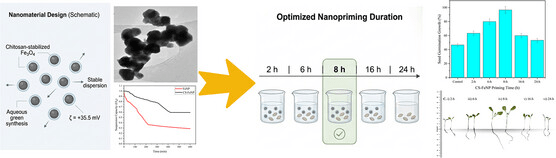
2. 処理時間の体系化 (Optimal Duration)
実装に不可欠な「種子を溶液に浸す時間」の最適条件を決定。 (Chemistry & Biodiversity, 2026)
3. 界面制御とキトサンの分子量 (Interfacial Tuning) [NEW]
2026年4月の論文では、粒子を保護するキトサンの分子量を制御することで、種子の表面へのアクセスを最適化。発芽率を 約92% まで向上させることに成功しました。 (Discover Nano, 2026)
📖 詳細な論文情報 (Detailed Publication List)
- [2026/04] Molecular Weight & Interfacial Tuning
- Title: Nano-priming of lettuce seeds using Chitosan Stabilized iron oxide nanoparticles with tunable interfacial properties
- Journal: Discover Nano (Springer Nature) doi.org/10.1186/s11671-026-04594-7
- Key Findings: Proved that low-molecular-weight chitosan ensures superior nanoparticle accessibility at soft, hydrated interfaces.
- [2026/01] Priming Duration Optimization
- Title: Optimizing Nanopriming Duration: Chitosan-Stabilized Iron Oxide Enhances Lettuce Seedling Performance and Cost-Effectiveness
- Journal: Chemistry & Biodiversity (Wiley)
- DOI: 10.1002/cbdv.202502426
- [2025/08] Green Synthesis with Chitosan
- Title: Green synthesis of chitosan-stabilized iron oxide nanoparticles using Christia vespertilionis extract for sustainable nano-priming…
- Journal: Environmental Research (Elsevier)
- DOI: 10.1016/j.envres.2025.122644
- [2025/06] Concentration Effects
- Title: Concentration-driven interactions of chitosan-stabilized iron oxide nanoparticles in seed nano-priming…
- Journal: Nanotechnology for Environmental Engineering (Springer Nature)
- DOI: 10.1007/s41204-025-00443-7
🌍 グローバルな研究プラットフォーム
本研究は、マレーシア(UiTM)およびインドネシア(ITB)との国際共同研究により実施されました。微粒子工学の「界面を制御する力」が、国境を越えて食料生産や環境保全に貢献しています。This project was conducted through an international partnership with UiTM (Malaysia) and ITB (Indonesia). Our ability to engineer particle interfaces is contributing to global food security and environmental conservation.
Background
農業生産性の向上は重要な課題です。種子の発芽と初期成長を促進する技術として、種子プライミング(Seed Priming)があります。これは、種子を水や特定の溶液に浸すことで、発芽直前の生理状態に準備させる前処理技術です。https://en.wikipedia.org/wiki/Priming_(agriculture)
近年、このプライミング技術の進化形として、ナノ粒子プライミング(Nanoparticle Priming)が注目されています。これは、ナノ粒子が持つ高い表面積対体積比、反応性、および細胞構成要素とナノスケールで相互作用する能力を利用し、水の吸収、栄養素の取り込み、ストレス耐性を高めることで種子の性能を向上させます。
With the increasing global population, improving agricultural productivity is a critical challenge. Seed priming is a pre-sowing treatment that involves hydrating seeds in water or specific solutions to bring them to a physiological state just before germination, thereby enhancing their potential for uniform germination and growth.
More recently, an advanced form of this technique, nanoparticle priming, has gained prominence due to the remarkable properties of nanoparticles (NPs). Nanoparticles, with their high surface area-to-volume ratio, enhanced reactivity, and ability to interact with cellular components at the nanoscale, can improve seed performance by enhancing water uptake, nutrient absorption, and stress resistance in plants.
Institutions
- Institution: EMZI-UiTM Nanoparticles Colloids & Interface Industrial Research Laboratory (NANO-CORE) Faculty of Chemical Engineering, Universiti Teknologi MARA, Cawangan Pulau Pinang, Permatang Pauh Campus, 13500, Permatang Pauh, Pulau Pinang, Malaysia;
- School of Life Sciences and Technology, Bandung Institute of Technology, Jl. Ganesa No. 10, Bandung, 40132, Indonesia; Research Center for New and Renewable Energy, Inter-University Center, Bandung Institute of Technology, Bandung, 40132, Indonesia;
- Department of Applied Physics and Chemical Engineering, Graduate School of Bio-Applications and Systems Engineering, Tokyo University of Agriculture and Technology, 2-24-16 Nakacho, Koganei, Tokyo, 184-8588, Japan
Previous studies (by TUAT) using SiO2 and soot particles for germination (priming):
Sembada AA, Lenggoro IW (2024) Nanopriming of Tomato (Solanum lycopersicum) Seeds Against Heavy Metal Stress During Germination and Seedling Formation. In: BIO Web of Conferences (Vol. 91, p. 01005). EDP Sciences., https://doi.org/10.1051/BIOCONF/20249101005.
Sembada AA, Maki S, Faizal A, Fukuhara T, Suzuki T, Lenggoro IW (2023) The role of silica nanoparticles in promoting the germination of tomato (Solanum lycopersicum) seeds. Nanomaterials 13(14):2110. https://doi.org/10.3390/NANO13142110
Sembada AA, Lenggoro IW (2023) Comparative analysis of germination performance from several species of seeds under influence of silica nanoparticles. In: IOP Conference Series: Earth and Environmental Science (Vol. 1271, No. 1, p. 012085). https://doi.org/10.1088/1755-1315/1271/1/012085.
Sembada AA, Fukuhara T, Suzuki T, Lenggoro IW (2024) Stem cutting: A novel introduction site for transporting water-insoluble particles into tomato (Solanum lycopersicum) seedlings. Plant Physiol Biochem 206:108297. https://doi.org/10.1016/J.PLAPHY.2023.108297
Sembada AA, Harada R, Maki S, Fukuhara T, Suzuki T, Lenggoro IW (2024) Candle soot colloids enhance tomato (Solanum lycopersicum) seed germination and seedling quality. Discov Agric 2(1):1. https://doi.org/10.1007/S44279-024-00011-8
Short URL of this website: https://wp.me/p10HOa-8jw