Journal Impact Factor vs. Paper Citation Count
日本語版は下記にあります。
散布図は、ジャーナルのインパクトファクターが高いことが必ずしも個々の論文の引用数の増加に繋がるわけではないことを示しており、論文のパフォーマンスがジャーナル全体の権威に及ぼす影響にはばらつきがあることを強調しています。This note is based on an analysis of my own publications indexed in Google Scholar (Lenggoro, July 2025). The scatter plots below illustrate a simple but important point: a higher journal impact factor (IF) does not necessarily lead to a higher citation count for an individual paper. In other words, the performance of a paper varies widely, regardless of the journal’s overall prestige.
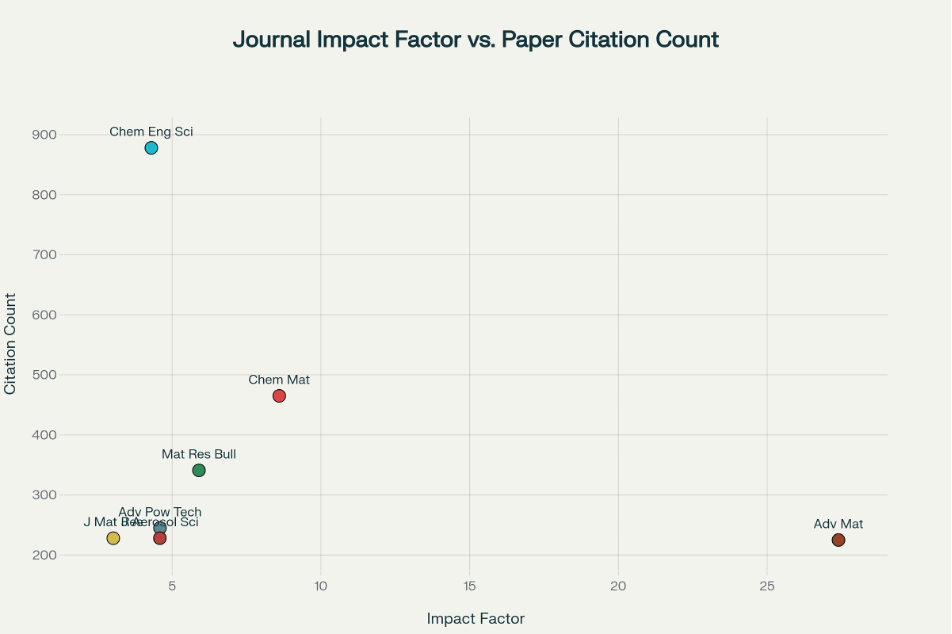
Scatter plot of journal impact factor (in 2025) vs. citation count for “top” 10 papers
図に示した「Chem. Eng. Sci.」誌の論文は、招待講演に基づく特別な論文です。上図は掲載時のインパクトファクターではなく、最新版(2025年)の値を使用しています。
Example: Top 10 Papers
The scatter plot of my top 10 most-cited papers shows no clear upward trend between journal IF and citation count.
Note:
The paper published in Chemical Engineering Science is a perspective article based on an invited talk. The impact factor used here (2025 value) is not the value at the time of publication.
Larger Dataset (100 Papers)
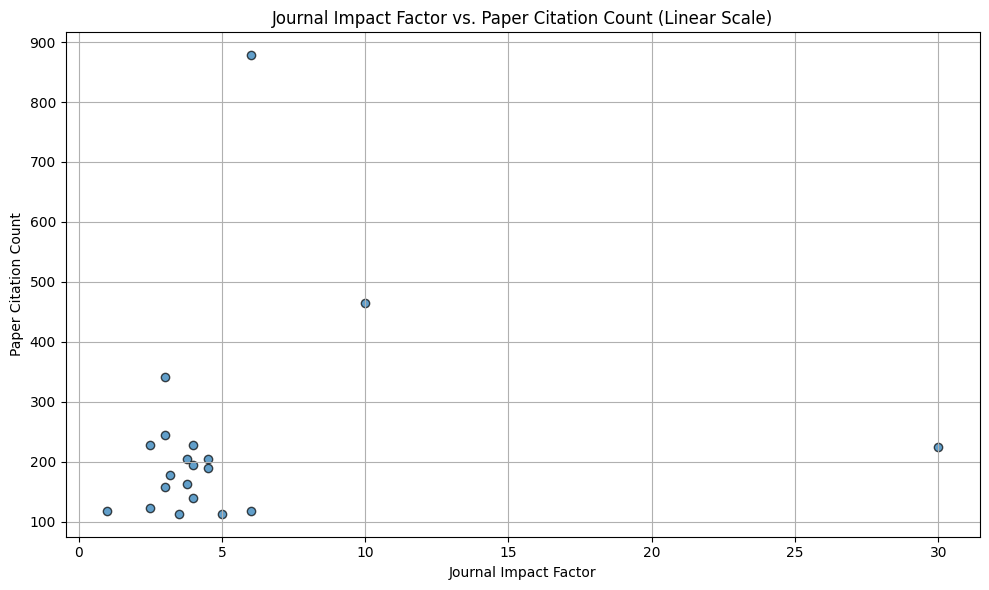
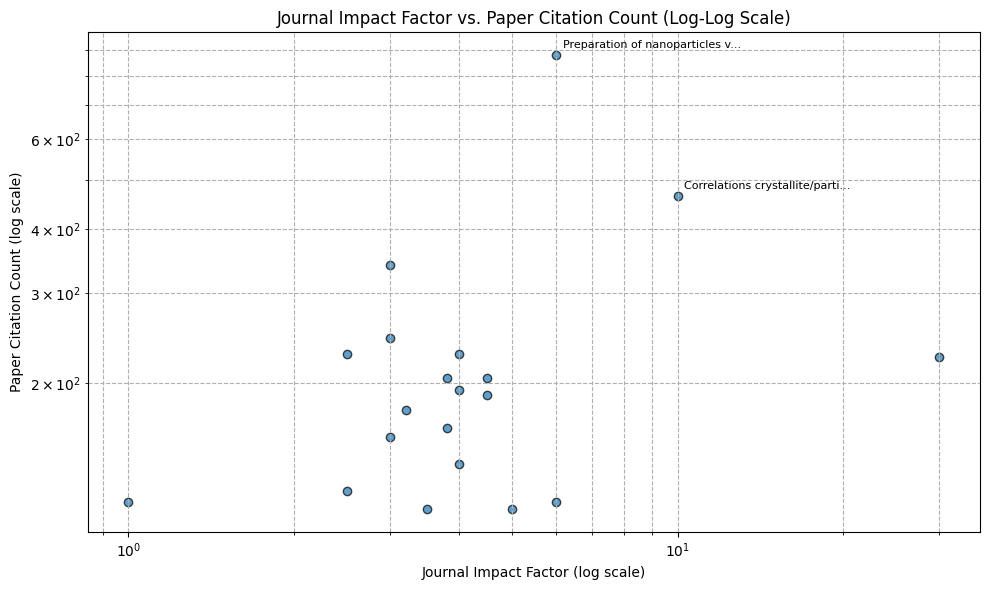
Expanding the dataset to my 100 most-cited papers, using the impact factor at the time of publication, the same conclusion holds:
There is no strong correlation between journal impact factor and citation count.
If impact factor were a reliable predictor, we would expect a clear positive trend.
Instead, the result is a highly scattered distribution.
Does a High-Impact Journal Guarantee a High-Impact Paper?
My publication record suggests: No.
Researchers are often encouraged to aim for high-impact journals under the assumption that:
higher IF → higher visibility → more citations
While this logic is understandable, the data shows that the relationship is weak at best.
Examples from My Own Work
- Most-cited paper:
Preparation of nanoparticles via spray route
→ 878 citations
→ Published in Chemical Engineering Science
→ IF ~1.8 (2003), ~4.3 (2025) - Highest-IF publication:
Salt-assisted aerosol decomposition (Advanced Materials)
→ 225 citations
→ IF ~8.1 (2001), ~26.8 (2025)
Despite being published in a much lower-IF journal, the first paper has nearly four times more citations.
Additional examples reinforce this pattern:
- Chemistry of Materials (IF ~5.1) → 465 citations
- Materials Research Bulletin (IF ~0.9) → 341 citations
- Advanced Powder Technology (IF ~0.7) → 245 citations
In several cases, papers in journals with IF < 1.0 have outperformed those in journals with IF > 8.0.
A Common Misconception: Rising Impact Factor
This raises a key question:
Does a high impact factor make papers successful, or do successful papers raise the impact factor?
My interpretation is that it is largely the latter.
A journal’s reputation is not created in isolation; it is built over time through the accumulation of impactful papers.
For example, a highly cited paper contributes directly to the citation metrics that determine impact factor.
Thus, the impact factor is often a lagging indicator, not a causal force.
What Really Drives a Paper’s Impact?
The long-term influence of a paper depends on factors beyond journal ranking:
- Quality and novelty
Breakthrough ideas or useful methods are cited regardless of journal - Relevance of the topic
Widely studied or timely topics naturally attract more attention - Accessibility and audience
A paper in the “right” community may outperform one in a broader but less targeted journal - Time scale of impact
Some papers grow steadily (“slow burn”), while others gain short-term attention (“flash in the pan”)
→ Journal IF (2-year metric) cannot capture this
Looking Beyond Impact Factor
This analysis reinforces a simple but important conclusion:
Journal impact factor is a limited and often misleading indicator of a paper’s true impact.
It remains one piece of information, but it should not be overinterpreted.
For researchers—especially early-career scientists—the priority should be:
- to pursue meaningful questions
- to produce rigorous and clear work
- to contribute something genuinely useful to the field
Ultimately, the impact of research is determined not by the journal in which it appears,
but by how it influences thinking, methods, and practice over time.
高IFジャーナルを目指すのは、もうやめよう(2025/7)
研究者なら誰もが気にする「インパクトファクター(IF)」。IFが高いトップジャーナルに論文を載せることが、優れた研究者の証であるかのように語られます。しかし、それは本当なのでしょうか?
今回、私自身のGoogle Scholarの論文データを分析したところ、興味深い事実が明らかになりました。結論から言えば、論文一本の価値は、掲載されたジャーナルのIFとは必ずしも関係ありません。
データが語る
私の論文の中で、最も多く引用されているのは「Preparation of nanoparticles via spray route」で、引用回数は878回です。この論文が掲載された学術誌の当時(2003年)のIFは、約1.8でした。
一方で、IFが8.1もある超一流ジャーナル(2025年にIFが26.8)に掲載された別の論文「Novel route to nanoparticle synthesis by salt‐assisted aerosol decomposition」の引用数は225回です。素晴らしい数字ですが、IFが4分の1以下のジャーナルに載せた論文の引用数には遠く及びません。
この事実は、何を物語っているのでしょうか?
「掲載後にIFが上がったジャーナルはどう考えますか?」
これは、まるで「鶏が先か、卵が先か」という問いに似ています。つまり、「ジャーナルのIFが上がったから論文の価値が上がったのか」、それとも「価値ある論文が掲載されたからIFが上がったのか」という問題です。
私の答えは、圧倒的に後者です。
ジャーナルの評価は、自然に上がるわけではありません。そのジャーナルに掲載された、一つ一つの質の高い論文が評価され、引用されることによって、レンガを一つずつ積み上げるように築かれていくものです。
例えば、私の論文が掲載されたことで、そのジャーナルのIF算出に貢献したはずです。つまり、価値ある論文が先に存在し、その結果としてジャーナルの評価が後からついてきたのです。
ですから、IFの上昇は、過去の論文の価値を後から高める魔法の力ではありません。むしろ、そのジャーナルが「価値ある研究を見出す力があった」ということを証明する「後付けの指標」に過ぎないのです。
結局のところ、主役はジャーナルのスコアではなく、私たち自身の研究そのものなのです。
論文の価値を決めるのは?
論文の価値を決めるのは、掲載誌の「格」ではありません。それは、研究の「質」です。
- その研究は、本当に新しいか?
- その研究は、誰かの課題を解決するか?
- その研究は、次の研究への扉を開くか?
私の論文がIFに関係なく引用されたのは、その研究が当時のコミュニティにとって「必要」とされ、「役に立った」からに他なりません。良質な研究は、たとえ掲載誌のIFが低くても、必ずや必要とする研究者の元に届き、正しく評価されます。
若手研究者の皆さんへ
インパクトファクターの数字に一喜一憂するのは、もうやめましょう。IFはあくまで指標の一つであり、あなたの研究の価値を決定づける絶対的なものではありません。
信じるべきは、ジャーナルの権威ではなく、あなた自身の研究の力です。
世界中の誰かの役に立つ、質の高い研究を追求すること。それこそが、私たち研究者にとって最も大切な使命であり、本当の「インパクト」を生み出す唯一の道なのです。

