(English follows Japanese)
“Sub‑100 nm particles from 5–10 μm droplets via a one-step process”
液滴を熱い板の上に吹き付けると、単に乾燥するだけではありません。
この研究は、学部4年生の卒業研究として、
「スプレー法で粒子膜を作れないだろうか?」
という問いから始まりました。
金属塩前駆体水溶液(酢酸亜鉛や硝酸亜鉛)の液滴を加熱板に噴霧したところ、予想していた(サブミクロン)粒子膜だけでなく、
100 nm 以下の超微粒子
が形成されることを発見しました。
もともとの液滴サイズは 5〜10 μm 程度です。
つまり、
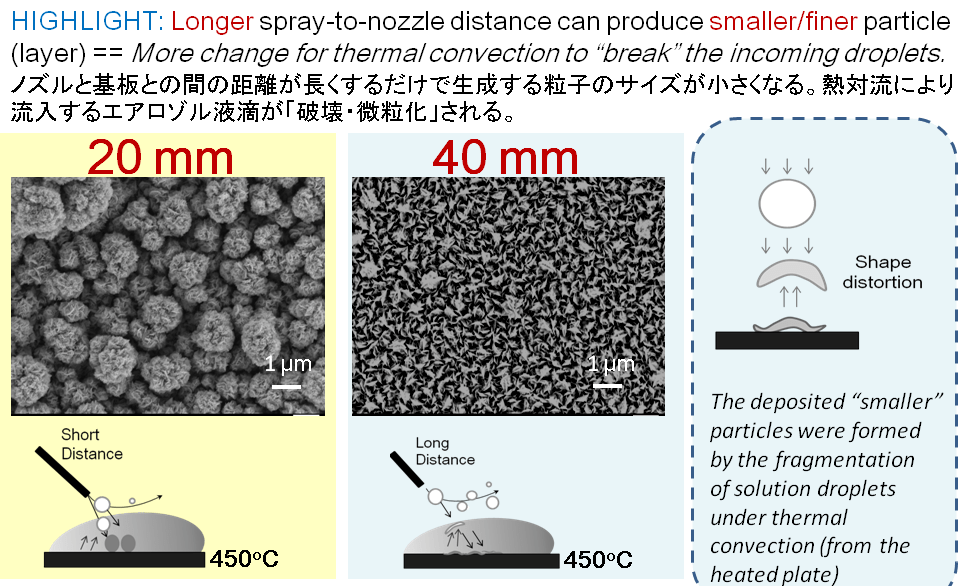
噴霧液滴が「破裂」しながら、蒸発し、熱分解するだけで、100 nm以下の粒子への微細化が一段階で実現した
ことになります。
通常、粒子を小さくするには液滴サイズを小さくするなどの「特別」工程が必要です。
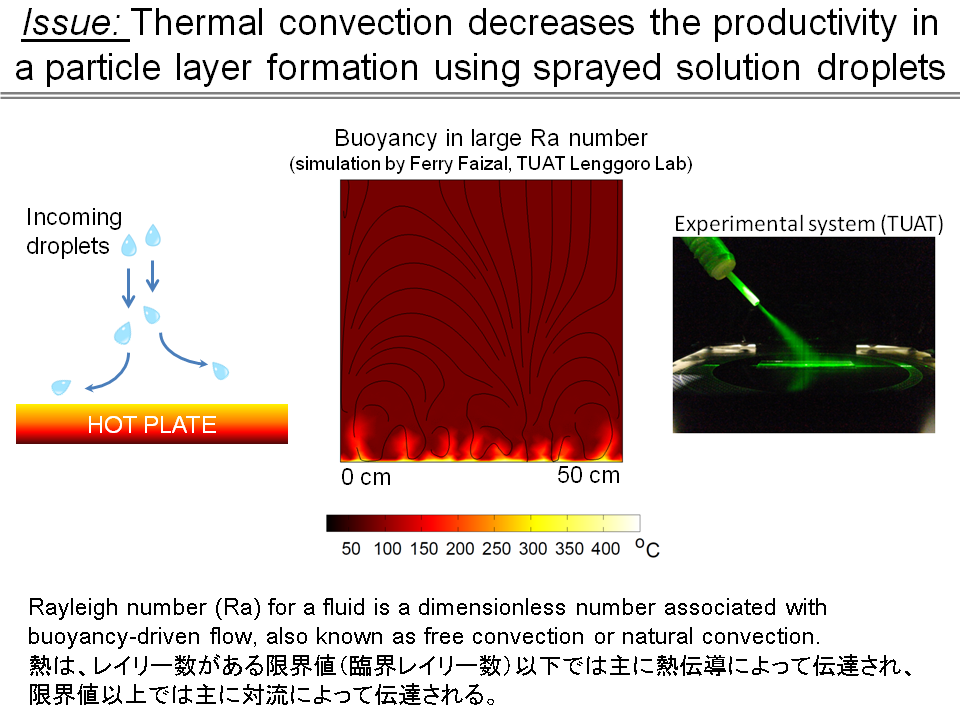
しかし本研究では、熱い板の上に生じる熱対流や噴霧の流体「不安定性」によって、予想を超えて微細な粒子が形成されました。実験と数値解析から、この粒子形成が加熱板周囲の流れ場と密接に関係していることを明らかにしました。
本研究は、
熱対流を利用した新しい微粒子合成法の可能性
を示した研究です。
When solution droplets are sprayed onto a hot plate, they do not simply dry.
This study originated from an undergraduate graduation project that started with a simple question:
“Can a particulate film be fabricated using a spray process?”
To explore this idea, aqueous precursor droplets containing zinc acetate or zinc nitrate were sprayed onto a heated plate.
Unexpectedly, the experiments produced not only particle layers but also
particles smaller than 100 nm
even though the original droplets were approximately 5–10 μm in diameter.
In other words,
a one-step refinement process from micrometer-sized droplets to nanoparticles occurred without any additional process.
This result was not anticipated at the beginning of the study.
Experimental observations and numerical simulations revealed that thermally generated convection and flow (of the sprayed droplets) instability above the heated plate strongly influenced particle formation.
The work demonstrated that thermal convection is not merely a “disturbance” during spray deposition but can serve as a mechanism for producing nanoparticles.
The study provided an early foundation for a new route toward nanoparticle synthesis by combining aerosols, thermal decomposition, and thermally driven flow in a simple open-plate reactor.
🔍 Highlights
- 学部4年生の卒業研究から始まった研究
- 5–10 μm液滴から100 nm以下の粒子を形成
- 機械的粉砕等を用いない一段階微細化プロセス
- 熱対流と流体不安定性が粒子形成を支配
- Started from an undergraduate student’s graduation project
- Produced sub‑100 nm particles from 5–10 μm droplets
- One-step particle refinement without additional (milling) process
- Particle formation governed by thermal convection and flow instability
📄 Journal Paper
Decomposition of solution droplets under the influence of thermal convection over a heated horizontal plate. Advanced Powder Technology https://doi.org/10.1016/j.apt.2017.10.026
RELATED TOPICS:
PAPER: A “green” synthesis route to battery material. 電池用粉末「省資源」合成法
PAPER. Silica-coated magnetite particles by electrooxidation, 電解酸化で磁性粒子の合成
PAPER. Thermal stability of magnetite particles made by an electrochemical method, 電気化学法で合成した磁気粒子の熱安定性



One Comment
Comments are closed.