「エアロゾル研究」に投稿した原稿(2016年)English follows Japanease
「井伊谷賞その後」2005年受賞 : エアロゾル科学技術への静電噴霧の展開
W. レンゴロ
Report Post-Iinoya Award: Applications of electrosprays to aerosol science and technology
Wuled LENGGORO
1.はじめに
液中物質から数10nmのエアロゾルを生成する手法の一つである静電噴霧法(Lenggoro and Okuyama, 2005)を開発したのは1997年頃からでした。発表時に静電噴霧法の優位性をアピールしたことを今でも覚えています。発表当日(2005年8月)に紹介した内容については,その後ナノ材料の集積法(Lenggoro et al., 2006)と熱分析法(Lenggoro et al., 2007)に関する論文としてまとめることができました。2007年に広島大学から東京農工大学に異動し,新たに研究室を立ち上げた時には静電噴霧法から離れようと考えた時もありましたが,新たな展開を見つけたことにより,現在も静電噴霧法に関連した研究を継続しています。本原稿では主に東京農工大学に着任してから展開した静電噴霧法の関連研究について紹介します。
2.静電噴霧法を用いた研究の展開
2.1 植物成長におけるエアロゾル沈着の影響
東京農工大学で,畠山教授と出会ったことをきっかけに,畠山教授総括の科学研究費・新学術領域研究「粒子人間植物影響(略称)」プロジェクト(2008年~2013年)の立ち上げ時から関わることができました。1~2年間をかけて成長していく植物に対して,大気汚染モデル微粒子(ブラックカーボンと水溶性の硫酸アンモニア)を暴露する装置を設計・製作することになり,エアロゾル散布法の一つとして静電噴霧法を選択しました。実験室外での暴露に適した静電噴霧装置を新たに試作しました。太陽光や湿度など厳しい条件で安定して動作する装置の開発は大変でした。また、同大学の神谷教授や農学研究院の伊豆田教授などと連携しながら,エアロゾル沈着を受ける側の植物の葉表面の数々の課題を勉強したことから,研究室の方針を軌道修正し,微粒子の発生と同時に沈着される「表面」に関するテーマにも着手しました。当時博士後期課程のNaim氏(現:Putra Malaysia大)が葉のモデルとして化学処理した金属表面において,静電噴霧法による形成された帯電微粒子の沈着効率の評価を行いました (Naim et al., 2010)。さらに植物葉表面上にある有機物の「構造」における新たな研究課題を整理しながら,Kusdianto氏(2014年博士後期課程修了,現Sepuluh Nopember工科大学・広島大学)が金属表面に異なる親水性レベルをもつ複数の部位(表面上の領域)を作製しました。この研究により,より親水性レベルの高い表面では正に帯電した微粒子が多く沈着されることがわかりました(Kusdianto et al., 2014a)。実際の植物の葉における研究として,数年後には本学農学研究院の(船田・半)グループと共同で葉上の有機物(ワックス)構造と任意に沈着した微粒子の「分布」との関係を検討しました(Nakaba et al., 2016)。将来,葉表面のより詳細な親水性マップができれば,特定の植物におけるエアロゾルの沈着の機構が明らかにされると期待しています。葉にある数μmの気孔への微粒子の導入をモデル化した研究も試み,静電噴霧法で形成した1μmの帯電粒子を5μmの穴(深さ120μm以上)に導入させることができました(Kusdianto et al., 2014b)。この研究発表は金沢で開催されたAsian Aerosol 会議(2015)でポスター賞をいただきました。
2.2 環境中の微量成分の高密度検出に向けたセンシング技術
神奈川県主催の地域講演会で話をした時に林主税氏(1981年の新技術開発事業団ERATO「超微粒子プロジェクト」総括責任者)とお会いしました。林氏は2010年に亡くなるまで,常に「微粒子と植物」について暖かい助言をくださいました。林氏の紹介で(社)植物情報物質研究センター・角田氏と連携し,環境中の微量成分に関する研究を開始しました。角田氏には植物のエアロゾル微粒子暴露チャンバー設計の際にもいくつかヒントをいただきました。微量成分センサーの研究は当時卒論生の玄氏が担当しました。任意の表面に散布された有機分子の「分布パターン」に対して,静電噴霧により後から集積させた銀ナノ粒子とラマン分光法との組み合わせにより,有機分子のパターンが可視化できるようになりました (Gen and Lenggoro, 2015)。玄氏(2014年博士課程修了,現City Univ. Hong Kong)は現場の微量成分検出の課題に向けたアイデアを発表し,2013年度の井伊谷賞を受賞しました。
2.3 ゲル材料と食品系材料の微粒化
静電噴霧法は粘度の高い液体でも微粒化できることから,東京農工大学・徳山准教授の研究室と一緒に,ハイドロゲル粒子(粒径が約1mmのビーズ)の新たな製造方法として静電噴霧法を活用しました。ゲルの前駆体の液滴をシリコンオイルに落下させる間にフリーラジカル重合をおこすことができました(Tokuyama et al., 2015)。この研究で従来の「反応」や「分離」等からなる製造プロセスの工程数を削減できる可能が見出されました。
一方,当研究室の博士後期課程のSaallah氏(マレーシアSabah大Biotech研究所のスタッフ)は,デンプンから環状オリゴ糖の一種であるシクロデキストリンへの転換を行う酵素を対象材料として,静電噴霧法による酵素の微細化を行いました(Saallah et al., 2014)。約100 nm の酵素粒子が生成できたこと,静電噴霧法の特有の課題である高電圧が酵素の活性にあまり影響を与えないことがわかり,本手法はsoft-ionization法であることを改めて実感しました。
3.終わりに
賞をいただいた時は広島大学に助手として勤務して7年目のときでした。本技術の開発のきっかけをくださった広島大学・奥山喜久夫教授とYale大学・Juan Fernandez de la Mora教授,実験を一緒に行った当時広島大学学生の飯盛杏子氏と三宅雅士氏に感謝します。東京農工大学に異動した2007年以降も,研究室の博士後期課程学生らが静電噴霧法の長所を活かした多様なテーマで研究を行い,それを論文にまとめたことで,研究と教育の場においても本技術が広い範囲をカバーできることを体験できました。研究室単位と国内外機関との連携で,今後もエアロゾル技術を活用しながら人材育成の活動を実施できれば幸いです。
References
Gen, M. and Lenggoro, I. W.: Probing a dip-coated layer of organic molecules by aerosol nanoparticles sensor with sub-100 nm resolution based on surface-enhanced Raman scattering, RSC Adv., 5, 5158-5163 (2015)
Kusdianto, K., Gen, M. and Lenggoro, I. W.: Area-selective deposition of charged particles derived from colloidal aerosol droplets on a surface with different hydrophilic levels, J. Aerosol Sci., 78, 83–96 (2014a)
Kusdianto, K., Gen, M., Tsukada, M. and Lenggoro, I. W.: Insertion of presynthesized particles in the pores of a honeycomb structure by an aerosol process (Short Communication) , J. Soc. Powder Tech. Jpn., 51, 759-764 (2014b) (in Japanese)
Lenggoro, I. W. and Okuyama, K: Application of electrosprays to synthesis and measurement of nanoparticles, J. Aerosol Res., 20, 116-122 (2005) (in Japanese)
Lenggoro, I. W., Lee, H. M. and Okuyama, K: Nanoparticle assembly on patterned “plus/minus” surfaces from electrospray of colloidal dispersion, J. Colloid Interface Sci., 303, 124-130 (2006)
Lenggoro, I. W., Widiyandari, H., Hogan, C. J., Biswas, P. and Okuyama, K.: Colloidal nanoparticle analysis by nanoelectrospray size spectrometry with a heated flow, Anal. Chim. Acta, 585, 193-201 (2007)
Naim, M. N., Bakar, N. F. A., Iijima, M., Kamiya, H. and Lenggoro, I. W.: Electrostatic deposition of aerosol particles generated from an aqueous nanopowder suspension on a chemically treated substrate, Jpn. J. Appl. Phys., 49, 06GH17 (2010)
Nakaba, S., Yamane, K., Fukahori, M., Nugroho, W. D., Yamaguchi, M., Kuroda, K., Sano, Y., Lenggoro, I. W., Izuta, T. and Funada, R.: Effect of epicuticular wax crystals on the localization of artificially deposited submicron carbon-based aerosols on needles of Cryptomeria japonica, J. Plant Res. (in press)
Saallah, S., Naim, M. N., Mokhtar, M. N., Bakar, N. F. A., Gen, M. and Lenggoro, I. W.: Transformation of cyclodextrin glucanotransferase from aqueous suspension to fine solid particles via electrospraying, Enzyme Microbial Tech., 64-65, 52-59 (2014)
Tokuyama, H., Katsuno, A., Lenggoro, I. W. and Kanazawa, R.: Preparation of poly (N-isopropylacrylamide) hydrogel beads by sedimentation polymerization combined with electrostatic atomization, Polymer Bull., 72, 1603-1610 (2015)
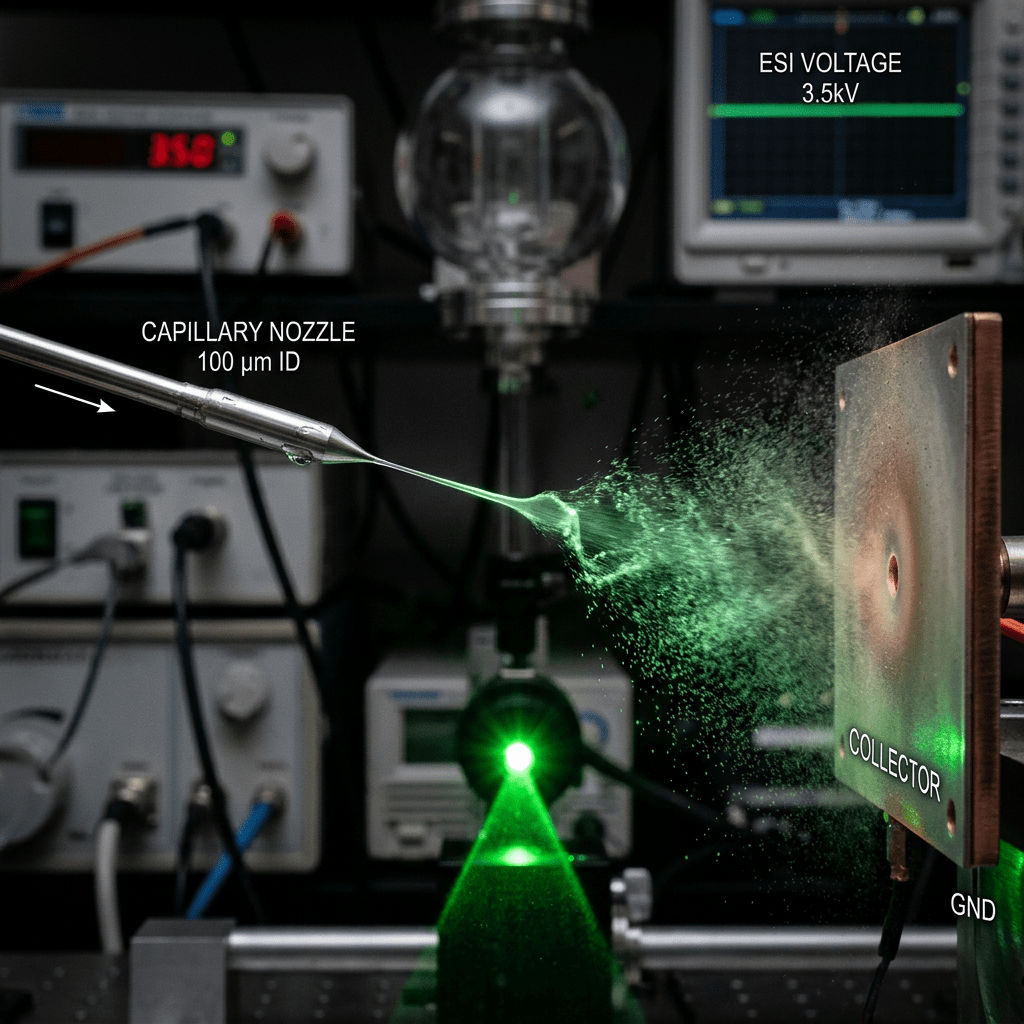
Fig. 1 Applications of electrospray in environmental- and food-related technologies (by Lenggoro Lab., Tokyo Univ. Agr. & Tech., 2008-2016) with resources for research and education networks. Dotted lines are unpublished works.
Report after the Iinoya Award (2005)
Applications of Electrosprays to Aerosol Science and Technology Wuled LENGGORO
1. Introduction
I began developing an electrospray method around 1997 as a technique to generate aerosols in the tens of nanometers range from liquid-phase materials. I still recall emphasizing the advantages of electrosprays at the time of the presentation (Iinoya Award) in August 2005. The topics introduced on that day were later consolidated into papers on nanomaterial deposition methods and thermal analysis. After moving from Hiroshima University to Tokyo University of Agriculture and Technology in 2007 and establishing a new lab (research group), I briefly considered moving away from electrospray research. However, new avenues of development emerged and I have continued research related to electrosprays. This manuscript mainly reviews the electrospray–related research that has developed since my appointment at Tokyo University of Agriculture and Technology (TUAT).
2. Development of Research Using Electrosprays
2.1 Effects of Aerosol Deposition on Plant Growth
At TUAT I met Professor Hatakeyama (the President, JAAST) and became involved from the outset in the KAKENHI New Frontier Areas project led by Professor Hatakeyama on particle impacts on humans and plants, running from 2008 to 2013. For plants that grow over one to two years, we designed and built an exposure system to expose them to model atmospheric particles, specifically black carbon (soot) and water‑soluble ammonium sulfate. We selected electrospray as one of the aerosol dispersion methods and prototyped an electrospray device suitable for outdoor exposures. Developing equipment that operates stably under harsh conditions such as sunlight and humidity proved challenging.
Working with Professor Kamiya (Faculty of Engineering) and Professor Izuta (Faculty of Agriculture), we studied many issues concerning the surfaces of plant leaves that receive aerosol deposition. This led us to shift my lab’s focus and to begin investigating themes related to the receiving surfaces that are simultaneously exposed during particle generation. At that time, doctoral student (D) Nazli Naim evaluated the deposition efficiency of charged particles generated by electrospray onto chemically treated metal surfaces used as leaf models. Later, (D) Kusdianto created multiple regions on metal surfaces with differing hydrophilicity levels. That study showed that more hydrophilic regions accumulated a greater number of positively charged particles. As an actual-plant study, several years later we collaborated with the Faculty of Agriculture (Funada) group to examine the relationship between organic surface structures on leaves, such as waxes, and the distribution of intentionally deposited particles. If detailed hydrophilicity maps of leaf surfaces can be produced in the future, the mechanisms of aerosol deposition on specific plant species are expected to become clearer. We also attempted modeling particle introduction into stomata of a few micrometers in size and succeeded in introducing 1 μm charged particles formed by electrospray into 5 μm holes with depths exceeding 120 μm. This work received the best poster award at the Asian Aerosol Conference held in Kanazawa in 2015.
2.2 Sensing Technology for High‑Density Detection of Trace Environmental Components
At a regional lecture hosted by Kanagawa Prefecture (2008) I met Dr. Hayashi Chikara, who had led the ERATO Ultrafine Particle Project in 1981. Until his passing in 2010, Dr. Hayashi kindly offered advice on particles and plants. Through his introduction I began collaborating with Dr. Kakuta of the Plant Ecochemicals Research Center (Eniwa, Hokkaido) and started research on trace environmental components. Dr. Kakuda also provided several useful hints during the design of the aerosol exposure chamber for plant experiments. Undergraduate student Gen led the trace component sensor research. By combining silver nanoparticles accumulated by electrospray with Raman spectroscopy, we were able to visualize distribution patterns of organic molecules deposited on arbitrary surfaces. Gen (as a Master-course student, then Doctoral student) presented ideas addressing on‑site trace detection challenges and received the Iinoya Award in 2013.
2.3 Micronization of Gel and Food‑Related Materials
Because electrospray can atomize highly viscous liquids, we collaborated with Professor Tokuyama (Chemical Engineering Dept.) to apply electrospray to produce hydrogel particles roughly 1 mm in diameter. We achieved free‑radical polymerization while droplets of gel precursor fell into silicone oil. This approach suggested the possibility of reducing the number of process steps compared with conventional manufacturing processes that require separate reaction and separation stages.
In another project, doctoral candidate Suryani Saallah worked on micronizing enzymes that convert starch into cyclodextrins. Electrospray produced enzyme particles around 100 nm in size, and we found that the high voltages characteristic of electrospray had little effect on enzyme activity. These results reinforced our view that electrospray functions as a soft‑ionization method.
3. Conclusion
When I received the award (2005) I had been a research associate (assistant professor) at Hiroshima University (HU) for seven years. I am grateful to Professor Kikuo Okuyama of Hiroshima University and Professor Juan Fernandez de la Mora of Yale University for initiating the development of this technique, and to HU students Kyoko Iimori and Masashi Miyake who conducted experiments with me at that time. After my move to Tokyo in 2007, doctoral students in my lab pursued diverse themes that leveraged the strengths of electrospray, and their work was published. Through laboratory activities and collaborations with other institutions, I experienced how broadly this technique can be applied in both research and education. I hope to continue training researchers while applying aerosol technologies in future collaborative efforts.
Acknowledgments I thank the colleagues and students mentioned above and the collaborators who contributed to the projects summarized here.

