Aug.2026: Featured at ISIS Neutron and Muon Source (Rutherford Appleton Laboratory, Science and Technology Facilities Council, UK) https://www.isis.stfc.ac.uk/science-highlights/adding-nanoparticles-to-lettuce-seeds-to-help-them-germinate-and-using-neutron-imaging-to-find-out-why/

Time-Resolved Neutron Computed Tomography of Hydration Kinetics in Nanoprimed Seeds Using Chitosan-Stabilized Iron Oxide Nanoparticles/ キトサン安定化酸化鉄ナノ粒子を用いたプライミング種子の水和反応速度論の時間分解中性子計算断層撮影 doi.org/10.1016/j.apradiso.2026.112637 Applied Radiation and Isotopes, July 2026
種の中で、水はどう動くのか?中性子で“見えた”ナノ材料が導く発芽のしくみ Watching Water Move Inside a Seed: Neutron Imaging Reveals How Nanomaterials Accelerate Germination
もし、種の内部で起きている「水の動き」を、壊さず、時間を追って観察できたら――。本研究は、その問いに中性子イメージングという独自の方法で挑戦しました。What happens to water inside a seed before a root emerges? This study answers that question by applying time‑resolved neutron computed tomography (NCT) to visualize internal hydration during seed germination.
1)背景:発芽を決める“最初のトリガー”
植物の発芽は、最初に水が種の中へ均一に行き渡ること(吸水・水和)が決定的に重要です。しかし、従来の測定方法では、種を切ったり壊したりする必要があり、内部で水がいつ・どこへ・どのように移動するかを連続的に捉えることは困難でした。近年、微量のナノ材料で種を前処理するナノ(粒子)プライミングが発芽促進に有効と報告されてきましたが、その“内部メカニズム”はよく分かっていませんでした。
2)発見:中性子で水の通り道を可視化
本研究では、キトサンで被覆した酸化鉄ナノ粒子(CS‑FeNP)でレタス種子を処理し、中性子コンピュータ断層撮影(NCT)を用いて、120時間にわたる吸水過程を非破壊・3次元・時間分解で観察しました。中性子は水素に特に敏感なため、水の分布を明瞭に捉えられます。その結果、CS‑FeNP 処理種子では、胚軸に沿った水の分布が早く・広く・均一に広がることが明確に示されました。これに対応して、発芽率は95%以上、根や芽の成長も早く進みました。重要なのは、ナノ粒子自体は直接見えなくても、水の分布という“結果”から、その機能が構造的に裏付けられた点です。
3)なぜ重要か:持続可能な農業への示唆
この研究は、ナノ材料が単なる“栄養供給”ではなく、水の動きを設計する材料インターフェースとして機能することを示しました。さらに、NCTは生体内部の水輸送を定量的に捉えられる新しい評価手法として、農業だけでなく材料科学や生命科学にも応用可能です。極低濃度(1 ppm)で効果が得られる点も、環境負荷を抑えた次世代農業技術として重要な意味を持ちます。
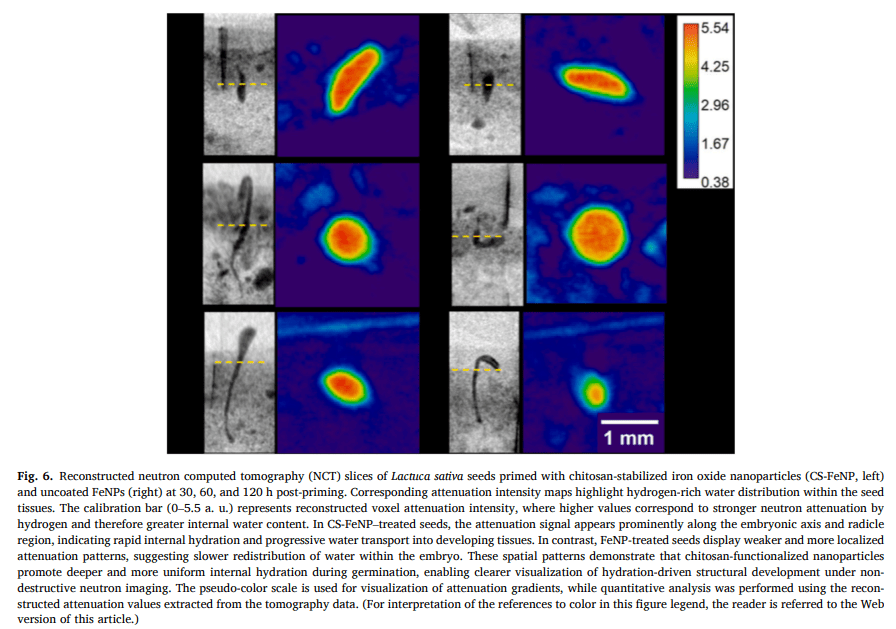
図6|中性子CTで見えた、種の中の「水の動き」。キトサン被覆ナノ粒子(CS‑FeNP)で処理した種子では、水(白~赤色)が胚軸に沿って早く広がり、発芽が加速している。一方、未被覆粒子では水の広がりが遅く、発芽も遅れる。(明るい色ほど水分が多いことを示す)Fig.6 |Neutron CT visualization of water movement during germination. Seeds primed with chitosan‑stabilized nanoparticles show faster and more uniform internal water distribution, leading to earlier germination compared with uncoated nanoparticles. (Brighter colors indicate higher water content.)
Background
Seed germination depends critically on how water penetrates and redistributes inside the seed. Although nano‑priming with engineered nanoparticles has been shown to enhance germination, the internal hydration mechanisms behind this effect have remained unclear because conventional methods cannot observe water movement non‑destructively.
Discovery
Here, lettuce seeds were primed with chitosan‑stabilized iron oxide nanoparticles (CS‑FeNPs) and imaged over 120 hours using NCT, a technique highly sensitive to hydrogen and thus to water. The images revealed that CS‑FeNP‑treated seeds exhibited earlier, more homogeneous, and spatially extended internal hydration, particularly along the embryonic axis. These hydration patterns correlated with earlier radicle emergence and >95% germination success, compared with uncoated nanoparticle treatments.
Why it matters
This work provides the first direct, structural evidence that nano‑priming modifies germination by reshaping internal water distribution, rather than acting only at the seed surface. It also establishes neutron tomography as a powerful, non‑destructive tool for studying water‑driven biological processes. Because the effects were achieved at very low nanoparticle concentrations, the findings offer promising insights for sustainable, precision agriculture and broader material–biological interface research.
本研究はマレーシア側が主導し、本研究室の関係者は分野間連携の形成およびレビューを通じて参画しています。This work was led by the Malaysian team, with TUAT contributing through interdisciplinary connection and review.
EMZI-UiTM Nanoparticles Colloids & Interface Industrial Research Laboratory (NANO-CORE), Faculty of Chemical Engineering, Universiti Teknologi MARA, Cawangan Pulau Pinang, Permatang Pauh Campus, Permatang Pauh, Pulau Pinang, 13500, Malaysia
ISIS Facility, Science and Technology Facilities Council, Rutherford Appleton Laboratory, Chilton, OX11 0QX, UK
Graduate School of Bio-Applications and Systems Engineering, and Department of Applied Physics and Chemical Engineering, Graduate School of Engineering, Tokyo University of Agriculture and Technology, 2-24-16 Nakacho, Koganei, Tokyo, 184-8588, Japan
Faculty of Chemical Engineering, Universiti Teknologi MARA, Shah Alam, Selangor, 40450, Malaysia

