プラスチックに代わる持続可能な素材として、古来の天然素材「絹(シルク)」が再び注目されています。私たちは、従来の繭を溶かすプロセスを一切使わず、カイコの体から絹タンパク質の生産器官「絹糸腺」を直接”自動的に”取り出す産業規模の手法を開発しました。東京農工大学とペンタリンク株式会社の共同特許として出願され、2025年5月に公開されています。🐛🧵
As a sustainable alternative to petroleum-based plastics, the ancient natural material silk is drawing renewed attention. We’ve developed an industrially scalable method that extracts the silk gland — the organ where silk protein is produced — directly from the silkworm’s body, bypassing the conventional cocoon-dissolution process entirely. Filed as a joint patent by Tokyo University of Agriculture and Technology and Pentalink Co., Ltd., the technology published in May 2025.
What we did / 手法概要
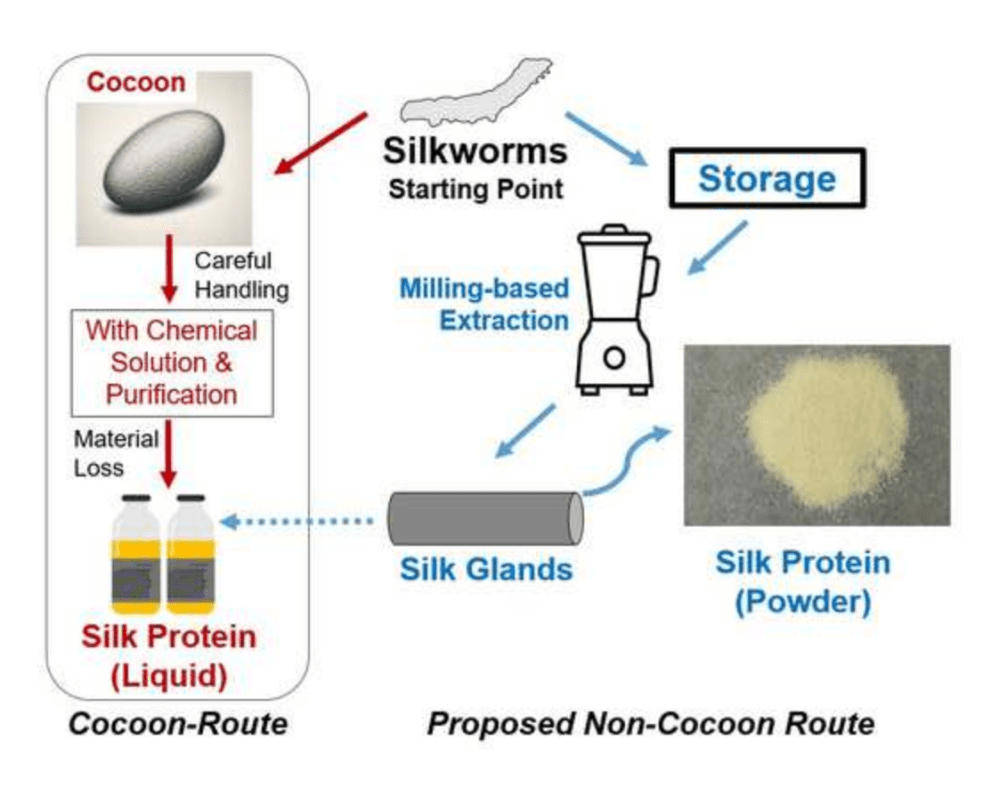
従来、絹タンパク質(フィブロインやセリシン)を得るには、繭を煮て解き、化学薬品で溶解する工程が不可欠でした。本手法では、エタノール処理または冷凍処理を施したカイコを湿式粉砕し、比重分離と組み合わせることで、絹糸腺の内容物を高純度・”自動的”に回収します。
Conventionally, obtaining silk proteins (fibroin and sericin) required boiling and unraveling cocoons, then dissolving them with chemical solvents. In our method, silkworms are pretreated with ethanol or freezing, then wet-milled and separated by specific gravity — recovering silk gland contents with high purity, without manual processing.
What we found / 成果
前処理法によって最終素材の性質を制御できることも分かりました。エタノール処理では柔軟なゲル状の絹糸腺が、冷凍処理では多孔質で結晶性の高い構造が得られます。また、前処理済みのカイコは必要になるまで保存できるため、オン・デマンドでの生産も可能です。
We also found that the pretreatment method controls the resulting material’s properties: ethanol treatment yields soft, gel-like silk glands, while freeze treatment produces porous, highly crystalline structures. Because pretreated silkworms can be stored until needed, the process also enables on-demand production.
Why it matters / 意義
繭処理を経ずに絹糸腺を直接抽出できるこの技術は、生分解性・非石油系の絹素材を産業スケールで製造する道を開くものです。医療、光学、包装など幅広い分野でのプラスチック代替が現実味を帯びてきます。
By extracting silk glands directly — without cocoon processing — this technology opens a path to industrial-scale production of biodegradable, non-petroleum silk materials, making plastic replacement realistic across medical, optical, and packaging applications.
Researcher spotlight / 研究者紹介
本研究を主導したのは、当時博士課程に在籍していた吉田氏(現・ペンタリンク株式会社)です。吉田氏は本特許をコアに博士論文をまとめ、2025年に博士(農学)を取得。在学中にペンタリンク株式会社に入社し、自ら開発した技術を同社のコア技術として育て続けています。研究室での発見を社会実装へとつなげた、リアルなキャリアパスです。
The research was led by Norihiro Yoshida, a doctoral student in the lab at the time (now at Pentalink Co., Ltd.). He completed his PhD (Agriculture) thesis based on this patent in 2025, joined Pentalink during his studies, and continues to develop the technology as a core researcher there — a direct path from academic discovery to industrial application.
“Method and System for Purifying Natural Protein Raw Materials” 天然蛋白質原料精製方法及び天然蛋白質原料精製システム
Application No. 2023-193403 (Applicants: TUAT, Pentalink Co., Ltd.) / JP2025080323 (A) — Published 2025-05-26, Priority date: 2023-11-14
https://patents.google.com/patent/JP2025080323A/ja
https://jglobal.jst.go.jp/en/detail?JGLOBAL_ID=202503002825785216
Related: Norihiro Yoshida PhD Thesis, 2025, and journal publication in Advanced Powder Technology (2025): https://wp.me/p10HOa-7QX — “Sustainable Development of a Non-Cocoon Bombyx mori Silk Gland Route for Scalable Silk Material Fabrication” (持続可能な非繭シルク生産:カイコ絹糸腺からの素材製造)
“Method and System for Purifying Natural Protein Raw Materials” 天然蛋⽩質原料精製⽅法及び天然蛋⽩質原料精製システム
出願番号:2023-193403(出願者:東京農工大学・ペンタリンク株式会社)Applicant: PENTALINK CO LTD, and TOKYO UNIV. AGRIC. & TECHNOL.
JP2025080323 (A) ― 2025-05-26 Priority date: 2023-11-14
https://patents.google.com/patent/JP2025080323A/ja
https://jglobal.jst.go.jp/en/detail?JGLOBAL_ID=202503002825785216

