Has the Tenure-Track System Changed the University?
Twenty Years of Experience at TUAT
Date: November 13, 2026
Author: Wuled Lenggoro
Director, Tenure-Track Promotion Organization / Professor, Institute of Engineering, Tokyo University of Agriculture and Technology (TUAT)
Event: 20th Anniversary Symposium of the Tenure-Track System at TUAT
In January 2007, I joined Tokyo University of Agriculture and Technology (TUAT) as one of the 22 young researchers recruited through Japan’s first cohort of tenure-track (TT) faculty members.
Twenty years later, now serving as Director of the Tenure-Track Promotion Organization, I revisited a simple but important question:
Has the tenure-track system changed the university?
Looking back over two decades of institutional evolution, talent development, and interdisciplinary collaboration, my answer is yes.
However, the most important outcome of the TT system is not the number of faculty members who obtained tenure.
Its greatest achievement is the formation of a university-wide network of independent principal investigators (PIs) that now supports research, education, university governance, and Agri-Engineering collaboration.
テニュアトラック制度は大学を変えたのか
東京農工大学20年の経験
公開日: 2026年11月13日
執筆: W・レンゴロ(東京農工大学 テニュアトラック推進機構長・工学研究院教授)
概要:
2026年11月13日に開催された「東京農工大学テニュアトラック制度発足20周年記念シンポジウム」における招待講演をもとに再構成した記事。
はじめに
2006年度(2007年1月)、私は日本の国立大学で最初に本格導入されたテニュアトラック制度の第1期教員22名の一人として東京農工大学に着任しました。
それから20年。
現在はテニュアトラック推進機構長として制度運営にも関わる立場から、改めて一つの問いを考えています。
テニュアトラック制度は大学を変えたのか。
20年間のデータ、組織文化の変化、農学と工学を結ぶ共同研究を振り返ると、その答えは明確です。
本制度の成果は単なる人数や比率ではありません。研究・教育・大学運営・農工連携を支える独立PI同士の人的ネットワークを形成したことにあります。
1. Bold Institutional Design from Day One (2005–2006)
1. 制度設計(2005–2006年)
Japan’s national tenure-track initiative officially started in FY2006 with nine selected universities.
Among them, TUAT implemented a bold university-wide reform by recruiting 22 tenure-track faculty members simultaneously, corresponding to approximately 5% of all faculty positions.
More than 800 applications were received through international advertisements, including those published in Nature.
日本のテニュアトラック制度は、2006年度に文部科学省事業として全国9大学から始まりました。
その中で東京農工大学は、全常勤教員約400名のうち5%に相当する22名のテニュアトラック教員を全学同時採用するという大胆な挑戦を行いました。
国際公募には Nature 誌等を通じて800名を超える応募が集まりました。
Key Design Principles
- Guaranteed tenure positions for all fellows who met the criteria
- “Competing with oneself” rather than competing against peers
- Real PI independence from the first day
- Startup funding and laboratory space
- Mentorship and external evaluation
- Cross-disciplinary interactions between Agriculture and Engineering
制度設計の特徴
- 全員分のテニュアポストを事前に確保
- 「他人との競争」ではなく「自分自身との競争」
- 着任初日から独立PI(Real PI)
- スタートアップ資金と研究室の確保
- メンター制度と外部評価
- 農学・工学を横断した交流機会
2. Twenty Years of Growth, Retention, and Talent Circulation 20年間の成長と人材循環
Since 2006:
- 124 TT faculty members have been recruited
- 102 obtained tenure
- 91 remain at TUAT
- 11 moved to leading universities and research institutes in Japan and abroad
Including active TT faculty members, approximately 120 out of 400 full-time faculty members (about 29%) have experienced the tenure-track system.
2006年以降、
- TT採用者:124名
- テニュア取得者:102名
- 現在も本学在籍:91名
- 他大学・研究機関へ転出:11名
となりました。さらに現役のTT教員を加えると、約120名(常勤教員の約29%)
がTT経験者となっています。
Talent Circulation
Former TT (and tenured) faculty members are now active at:
- The University of Tokyo (Assistant to the President and other)
- Kyoto University (Director of a center and others)
- Tohoku University (Vice-Dean of Agriculture)
- Osaka University
- Hokkaido University
- Nagoya City University
- Leibniz Centre for Agricultural Landscape Research (ZALF), Germany
Many continue collaborating with TUAT through joint research projects and visiting appointments.
人材循環
農工大のTT(Tenured)経験者は現在、
- 東京大学(総長補佐、他)
- 京都大学(研究センター長、他)
- 東北大学(農学研究科・副研究科長)
- 大阪大学
- 北海道大学
- 名古屋市立大学
- ドイツ・ZALF
など国内外で活躍しています。これは単なる人材流出ではなく、
農工大を起点とした人材循環と人的ネットワークの拡大
と考えています。
3. From 22 Isolated Fellows to an Agri-Engineering Network「孤立した22名」から農工連携ネットワークへ
In 2006, many of us felt like isolated fellows, each assigned to a different department.
Twenty years later, those isolated nodes have become an interconnected human network spanning the entire university.
2006年当時、各学科に数名ずつ配置された私たちは、いわば
“isolated fellows”
でした。しかし20年後、
その孤立した点は大学全体を覆う人的ネットワークへと発展しました。
Examples of Agri-Engineering Collaboration
Precision Engineering × Agricultural Production
Development of selective pollination technology for strawberries using surface acoustic wave devices.
Yuta Kurashina (Engineering) × Sakura Takahashi (Agriculture)
Reproductive Engineering × Life Sciences × Applied Physics
Development of an artificial-womb system for next-generation livestock production.
Satoshi Sugimura × Junki Miyamoto × Daisuke Yoshino
Vehicle Dynamics × Agricultural Safety Engineering
Development of a tractor driving simulator based on nonlinear dynamics.
Masao Watanabe × Pongsathorn Raksincharoensak
Mori Technology Award (2026)
Nanoparticle Engineering × Plant Science
Silica nanoparticles and airborne Bacillus bacteria promote seed germination and vigor.
Toshiyuki Fukuhara × Takeshi Suzuki × Wuled Lenggoro
A doctoral student from this project has since become a faculty member (Life Science and Technology) at Institut Teknologi Bandung (ITB), Indonesia.
Key Lesson 重要な教訓
The TT system itself did not directly produce these outcomes.
Rather, they emerged from networks formed among independent principal investigators (PIs).
TT制度そのものが直接成果を生んだのではない。
独立PI同士のネットワークが成果を生み出したのである。
4. Looking Toward the Next Twenty Years 次の20年に向けて
Over the last twenty years, TUAT’s tenure-track system has created six enduring assets:
- Talented people
- Entrepreneurial institutional culture
- Agri-Engineering collaboration
- Internationalization
- Research networks
- University leadership
過去20年間で、本学のTT制度は
- 人材
- 組織文化
- 農工連携
- 国際化
- 研究ネットワーク
- 大学運営人材
という6つの財産を生み出しました。
Going forward, we must preserve:
- Real PI autonomy
- Mentorship
- International openness
- Agri-Engineering collaboration
while strengthening:
- support for early-career researchers
- diversity
- talent circulation
- interdisciplinary collaboration
今後は、
- Real PI の理念
- メンター制度
- 国際性
- 農工連携
を継承しながら、
- 次世代研究者支援
- ダイバーシティ
- 人材循環
- 学際融合
をさらに発展させていく必要があります。
Conclusion
The achievements of the tenure-track system extend beyond the cultivation of early-career researchers.
After two decades, its true accomplishment lies in the formation of the human networks that sustain research, education, university governance, and Agri-Engineering collaboration.
テニュアトラック制度の成果は、若手研究者を育成したことだけではありません。
20年を経て、その真の成果は、研究・教育・大学運営・農工連携を支える人的ネットワークを形成したことにあると考えています。
This article is based on an invited presentation delivered at the Symposium Celebrating the 20th Anniversary of the Tenure-Track Program at Tokyo University of Agriculture and Technology on November 13, 2026.
本稿は、2026年11月13日に開催された東京農工大学テニュアトラック制度発足20周年記念シンポジウムでの招待講演をもとに再構成したものである。
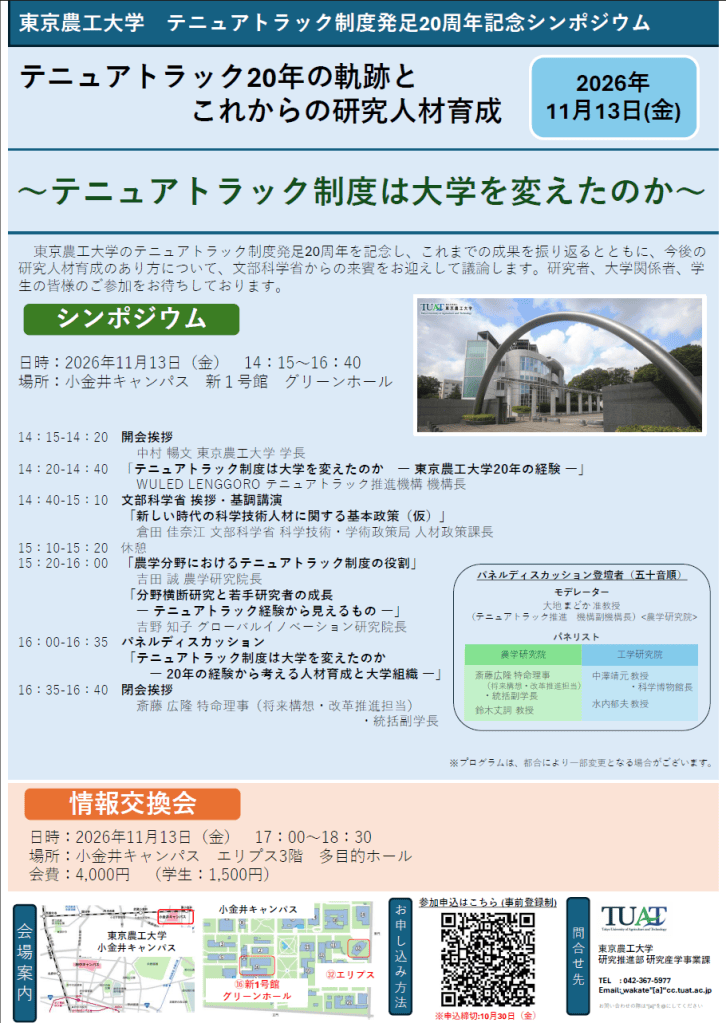
東京農工大学のテニュアトラック制度発足20周年を記念し、これまでの成果を振り返るとともに、今後の研究人材育成のあり方について、文部科学省からの来賓をお迎えして議論しました。
日時 令和8年11月13日(金)
14時15分~16時40分 シンポジウム 小金井キャンパス グリーンホール
17時00分~18時30分 情報交換会 エリプス3階多目的ホール
情報交換会参加費 4,000円(学生 1,500円)
開催場所 東京農工大学 小金井キャンパス グリーンホール(対面開催)
Symposium on Human Resource Development and Institutional Transformation
On 13 November 2026, Tokyo University of Agriculture and Technology (TUAT) will host a symposium marking the 20th anniversary of the university’s tenure-track system. The event will bring together university leaders, tenure-track alumni, current faculty members, and representatives from the Ministry of Education, Culture, Sports, Science and Technology (MEXT) to reflect on two decades of experience and discuss the future of research talent development in Japan.
Event Theme
Has the Tenure-Track System Changed Universities?
The symposium will explore a broader question than simply whether the tenure-track system has helped young researchers. Instead, it will examine how the system may have influenced:
- Human resource development
- University governance
- Interdisciplinary collaboration
- Organizational culture
- Research leadership
at TUAT over the past twenty years.
Program Highlights
Opening Remarks
The symposium will be opened by Nobufumi Nakamura, President of TUAT.
Lecture by the Director of the Tenure-Track Promotion Organization
Wuled Lenggoro (Former Tenure-Track Faculty)
“Has the Tenure-Track System Changed Universities? Twenty Years of Experience at TUAT”
Keynote Address from MEXT (Ministry of Education, Culture, Sports, Science and Technology)
Kanae Kurata, Director of the Human Resources Policy Division, MEXT
“Fundamental Policies for Science and Technology Human Resources in a New Era” (tentative title)
Invited Talks
Makoto Yoshida, Dean of the Faculty of Agriculture (Former Tenure-Track Faculty)
“The Role of the Tenure-Track System in Agricultural Research”
Tomoko Yoshino, Director of the Institute of Global Innovation Research (Former Tenure-Track Faculty)
“Interdisciplinary Research and the Growth of Young Researchers: Lessons from the Tenure-Track Experience”
Panel Discussion
“Has the Tenure-Track System Changed Universities?
Human Resource Development and Institutional Transformation over 20 Years”
Moderator:
- Madoka Ohji, Deputy Director, Tenure-Track Promotion Organization (Former Tenure-Track Faculty)
Panelists:
- Hirotaka Saito, Special Executive Advisor and Executive Vice President (Former Tenure-Track Faculty)
- Takeshi Suzuki, Professor (Institute of Agriculture) (Former Tenure-Track Faculty)
- Yasumoto Nakazawa, Professor and Director of the Nature and Science Museum (Former Tenure-Track Faculty)
- Ikuo Mizuuchi, Professor (Institute of Engineering) (Former Tenure-Track Faculty)
Why This Event Matters
Since its introduction in 2006, the tenure-track system at TUAT has produced more than 80 tenured faculty members and has become an important component of the university’s academic development.
The symposium aims to examine not only the careers of individual researchers but also broader institutional impacts, including:
- interdisciplinary collaboration between agriculture and engineering,
- internationalization of research,
- leadership development,
- and the emergence of researchers who later became deans, directors, and university executives.
Rather than serving as a commemorative reunion, the event is intended as a forum for considering how tenure-track systems can contribute to the next generation of university development.
Event Information
Date: 13 November 2026
Symposium: 14:15–16:40
Venue: Green Hall, New Building 1, Koganei Campus, TUAT
Networking Reception: 17:00–18:30
Venue: Ellipse Hall, Koganei Campus
“The symposium will ask not only what the tenure-track system has achieved over the last twenty years, but also what it should enable over the next twenty years.”

