Open article:
TRANSPORT AND ASSEMBLY OF LIQUID-PHASE NANOPARTICLES VIA GAS-PHASE
An open article, by Wuled Lenggoro (2008, 2009)
* Possible applications
– For Environment & Energy: Selective-deposition method for liquid-phase nanoparticle
– For Healthcare – Measuring the non-spherical nanoparticles in the gas-phase
* Potential impact on the environment :
– Development of the “world-first” and “the only” thermal analysis method for nanoparticle
– Direct assembly method of nanoparticle layer with high-crystallinity
– Direct-patterning of nanoparticle without using a vacuum system
* Expected impact on society

Transport and Assembly of Liquid-Phase Nanoparticles via the Gas Phase
Wuled Lenggoro — an open article, originally written in 2008
Current technological state of the art
The properties of nanoparticles (i.e., particles smaller than 100 nm), such as photocatalytic activity and quantum-dot efficiency, are highly size-dependent, so accurate deposition/assembly techniques and high-resolution size measurement are critical. Particles with well-controlled size and chemical composition are strongly required for advanced/functional devices. Among the synthesis methods (gas-, liquid-, and solid-state), liquid-phase (wet-chemical) routes such as sol–gel and micro-emulsion methods are useful for fabricating small particles, and they have been used to prepare metals, oxides, and non-oxides (e.g., sulfides).
To use liquid-phase nanoparticles in further applications, we have developed a spray method (electrospray) for dispersing them into the gas phase without agglomeration. The individual (non-agglomerated) or agglomerated particles derived from liquid-phase nanoparticles can be used for (i) high-resolution size measurement, (ii) novel thermal analysis of colloidal nanoparticles, (iii) assembling nanostructures or particle layers from highly charged nanoparticles, and (iv) studying the health effects of nanomaterials.
Technological benefits of the innovative characteristics of the work
For colloidal (liquid-phase) nanoparticles, particle size is often measured by transmission electron microscopy (TEM) or laser-based dynamic light scattering (DLS). TEM measurements are time-consuming, because the size of a statistically significant number of particles typically has to be measured manually, and the samples must be dried on a suitable medium for viewing. DLS allows in situ measurement of the size distribution, but individual particles are not measured directly: fluctuations in the intensity of scattered light are correlated with the diffusion coefficient of the particles, and fitting algorithms are needed to determine the size distribution.
Here, to size liquid-phase nanoparticles, we used a gas-phase (aerosol) technique: the differential mobility analyzer (DMA). A DMA in series with a particle counter has been used by the aerosol science community for several decades for rapid and accurate measurement of particle size distributions in the 1–500 nm range. DMAs act as particle-size filters, just as quadrupole mass spectrometers act as mass filters; they differ from quadrupoles in electrode configuration, and they are typically operated at atmospheric pressure using only a DC voltage difference between electrodes. Because of this, particle motion within the instrument is governed by a balance between the electrical force and the drag force on the particle, and DMAs can therefore separate particles by electrical mobility.
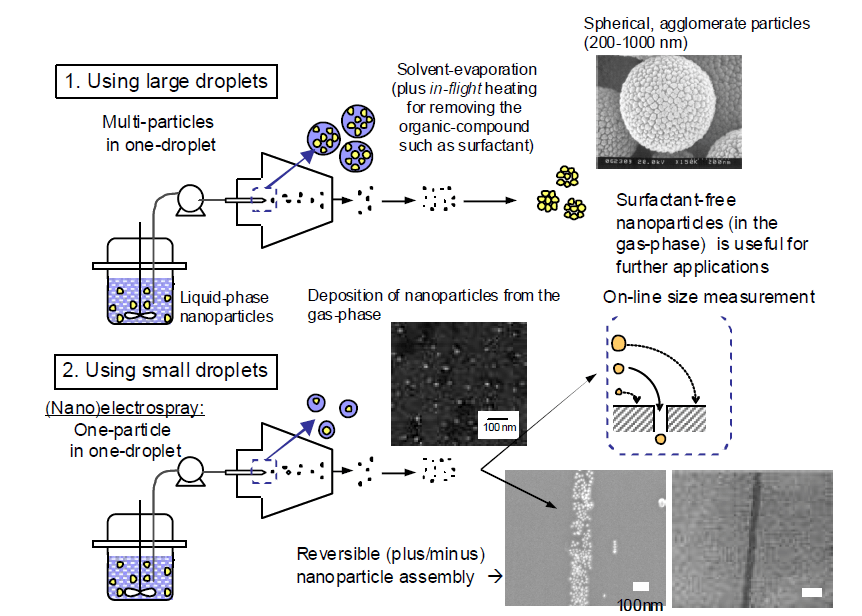
Fig. 1. Transferring liquid-phase nanoparticles into the gas phase using (1) large droplets and (2) small droplets, and the morphology of the particles derived from them and their further applications. Spherical agglomerate secondary particles can be used as standard particles, while individual, non-agglomerated nanoparticles can be used for size measurement and particle assembly.
To measure colloidal particles with a DMA system, a method is needed to convert them from the colloid phase to the aerosol phase while preserving the particle size distribution. Traditional atomizers and nebulizers used in spray-drying of nanoparticle sols typically produce nanoparticle agglomerates whose size depends primarily on the spray-drying conditions, so they cannot preserve nanoparticle size distributions. Electrohydrodynamic atomization, more commonly called electrospray, is the only known technique capable of producing monodisperse, submicrometer and nanometer-sized droplets, and it can effectively transfer nanoparticles from the liquid phase to the aerosol phase. We proposed using aerosol instrumentation, with an electrospray to create aerosol particles from colloidal particles, to measure the size distribution of colloidal particles (Fig. 1).
We have used spray methods (aerosol methods based on droplet-to-particle conversion) to prepare spherical particles of various materials [1], and we have extensively investigated the preparation of nanoparticles (particles smaller than 100 nm). From submicrometer droplets, one can expect to generate dry aerosol particles on the order of ten nanometers. To achieve this, an electrospray (ES; an electrostatically assisted spray) system was designed and built to generate droplets smaller than one micrometer.
Possible applications for environment and energy: selective deposition of liquid-phase nanoparticles
Besides the electrostatically assisted gas-phase (aerosol) process, i.e., electrospray, an electrostatically assisted liquid-phase approach based on pulse electrophoresis was designed for depositing TiO2 nanoparticles from an aqueous suspension onto a metal substrate [2]. The suspension was prepared by mixing commercially available nanometer-sized TiO2 powder (P25, Degussa) with an organic surfactant in water. A relatively concentrated suspension (30 wt%) is stable for a few months, so no additional mixing was needed during deposition. We developed a pulsed direct-current (PDC) charging-type electrophoretic method and found that the PDC mode narrowed the size distribution (dispersity) of the TiO2 particles deposited on a stainless-steel electrode. The layer deposited in PDC mode had a finer morphology than that deposited in direct-current (DC) mode (Fig. 2). Since the TiO2 particles used were made by gas-phase synthesis and therefore have high photocatalytic activity, it may be possible to fabricate solar-cell devices with higher energy efficiency from particle layers (with finer morphology) made by our approach.
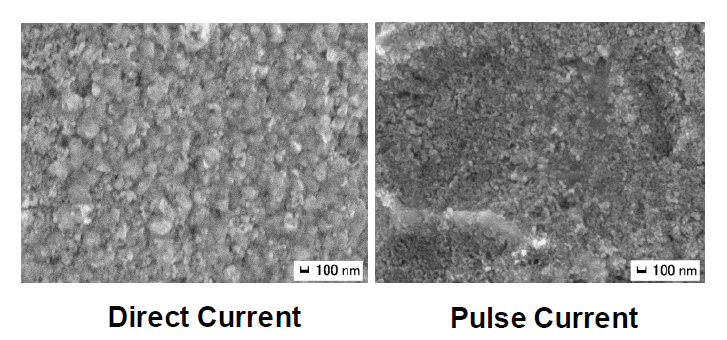
Fig. 2. Morphologies of TiO2 nanoparticle layers made by electrophoretic deposition with the conventional direct-current method (left) and the newly developed pulsed-current method (right). Both structures were obtained from the same sample (P25, Degussa) with the same deposition time. Note that the pulsed current produced a finer morphology. Scale bars: 100 nm.
Possible applications for healthcare: measuring non-spherical nanoparticles in the gas phase
Electrospray served as a stepping stone for the further development and application of aerosol nanoparticles. I have developed a technique for online measurement of liquid-phase nanoparticles (Fig. 1) [3]. Liquid-phase nanoparticles need to be measured in real time and at high resolution. We dispersed the liquid-phase nanoparticles individually into the gas phase as an aerosol via electrospray, followed by evaporation of the solvent. The size distribution of the generated aerosol particles was then determined with a differential mobility analyzer combined with a particle counter. The measured values (10–100 nm) were comparable to results obtained by electron microscopy. We also demonstrated the potential of the electrospray technique for analyzing the structure of non-spherical colloidal particles (Fig. 3).
This study shows that the organic surfactant coating the nanoparticles can be removed, and that non-spherical metal particles become spherical as the temperature is raised during gas-phase dispersion. The thickness of the organic surfactant layer was estimated by comparing theoretical and experimental mobilities. The combination of electrospray and mobility information from a DMA can also be applied to predicting the molecular weight distribution and/or density of water-soluble polymers, and to determining the non-volatile residue (ratio) in water samples (as a novel monitoring tool).
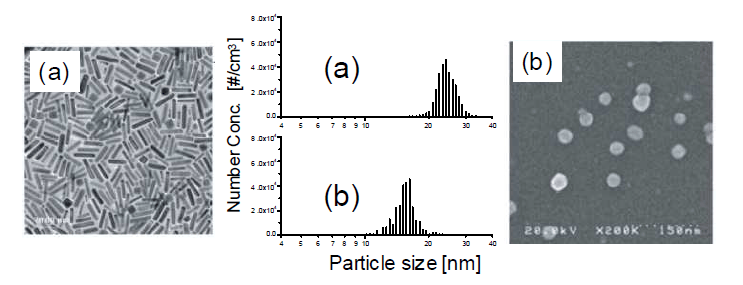
Fig. 3. Morphology and size distribution of aerosol particles of gold (Au) after transferring liquid-phase nanorods into the gas phase with (a) room-temperature drying and (b) in-flight heating (800 °C). Non-spherical gold became spherical through in-flight heating, and its smaller particle size was detected well by the newly developed aerosol measurement system.
There are only a few studies on determining the size of non-spherical particles in the gas phase (as well as in the liquid phase). Our approach to sizing non-spherical particles has received many citations from other researchers in Japan and abroad. This may also be because non-spherical airborne materials such as asbestos are becoming one of the most important issues for human health in the workplace.
In 2006–2007 we were involved in the national project on Health Risk Assessment of Nanomaterials (Project Leader: Dr. Junko Nakanishi, AIST) and were charged with developing a novel spray method for converting liquid-phase nanoparticles into the gas phase at high concentration. We succeeded in transferring liquid-phase particles with an average size of 120-140 nm into three chambers (20 rats per chamber) via the gas phase. Our medical collaborator (University of Occupational and Environmental Health) detected the particles inside the rats and calculated their residence time in the lung [4]. This was one of the first studies in which particles transferred via the gas phase were inhaled by rats through their normal respiration. We are now designing a novel spray generator for another inhalation exposure system.
Potential impact on the environment: a novel thermal analysis method for nanoparticles
An electrospray–furnace–scanning mobility particle spectrometer (SMPS) system was developed that can rapidly and accurately measure the size distributions of colloidal nanoparticles [3]. Many colloidal suspensions require nonvolatile surfactants for stabilization. These nonvolatile materials coat the colloidal particles and form residue particles during electrospraying. A tubular furnace reactor is used to evaporate the residue and the coatings, which allows correct measurement of nanoparticle size. Test suspensions of silver, gold, and SiO2 nanoparticles were measured with the electrospray–furnace–SMPS system, and the SMPS results and field-emission scanning electron microscopy measurements were in excellent agreement for all test suspensions. High-temperature heating in the furnace was also used to evaporate the nanoparticles themselves, which shifted the size spectra to smaller sizes and made it possible to perform thermal analysis on colloidal suspensions in addition to size measurement (Fig. 4).
For example, comparing the results for two different colloids (Fig. 4) shows that colloid B has higher thermal resistance than colloid A. This suggests that a device made from colloid B may perform better (e.g., electrically) than one made from colloid A. Without using large amounts of colloidal raw material to test device performance, our approach, which needs only a small volume of colloid, lets one detect and understand quantitative differences between samples.
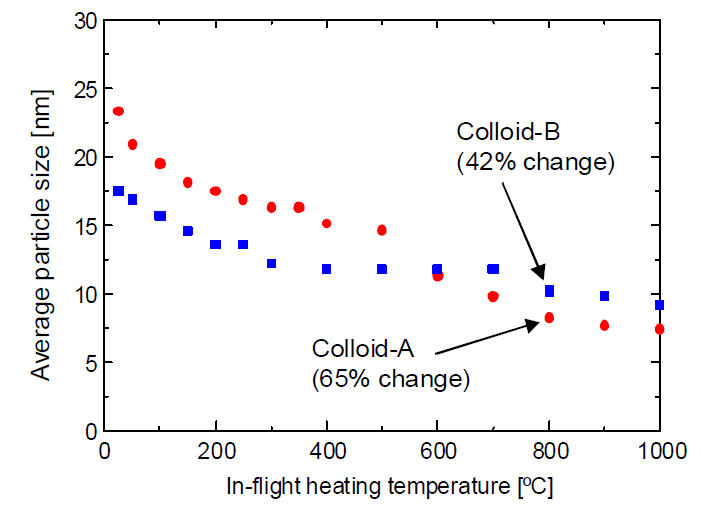
Fig. 4. Changes in the sizes of two colloidal particles as a function of in-flight heating temperature. At 800 °C, the size decreases are 65% (colloid A) and 42% (colloid B). The conventional thermal-analysis system cannot detect this difference. These results show that colloid B has higher thermal resistance than colloid A.
Direct assembly of nanoparticle layers with high crystallinity
Because nanoparticles generated by electrospray are highly charged, one possible application is the formation of nanoparticulate thin films. I have proposed two novel methods: (i) an electrospray–preheating–deposition method and (ii) an electrospray-based selective deposition method for one-step formation of patterned areas of nanoparticles on a flat surface.
The deposition of monolayers of magnetic FePt nanoparticles by electrospraying, and the magnetic properties of the deposited film, were studied [5]. FePt nanoparticles about 2.5 nm in diameter, prepared by a liquid process, were used as the precursor. The size of the deposited particles can be controlled up to 35 nm by adjusting the droplet size through the precursor concentration and flow rate. The droplets were heated in a tubular furnace at temperatures up to 800 °C to remove all organic compounds and to transform the FePt particles from the disordered face-centered cubic (fcc) phase to the ordered face-centered tetragonal (fct) phase, which has magnetic properties. Finally, the particles were deposited as a monolayer film on a silicon substrate by electrostatic force. The monolayer was obtained owing to the high charge the particles acquire during electrospraying. Magnetic measurements of the monolayer show stronger magnetic properties than the conventional method (heat treatment after pasting the colloidal material on a substrate), as shown in Fig. 5.
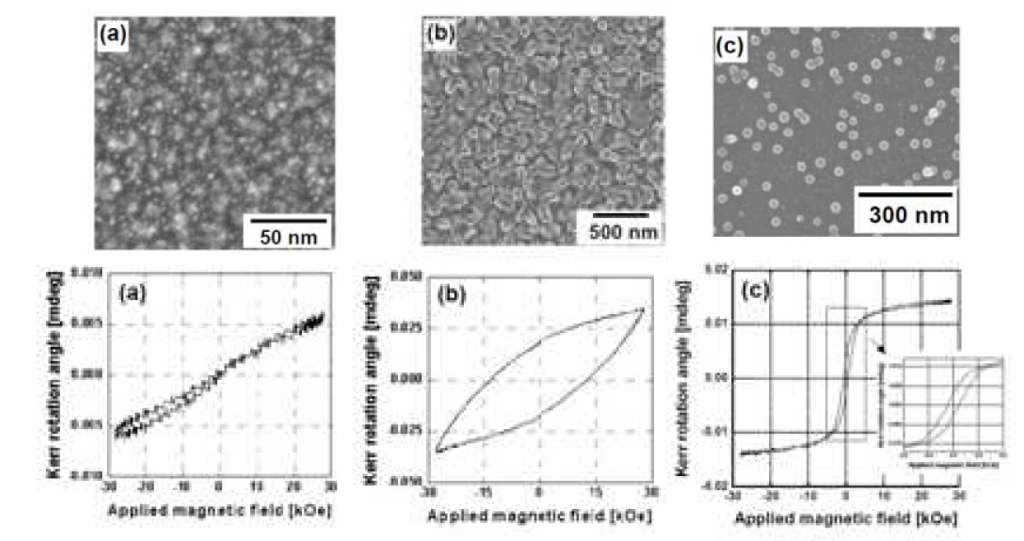
Figure 5 (insert original image)Fig. 5. Morphology and magnetic properties of FePt colloidal particles prepared by different routes: (a) pasting the colloid and drying at room temperature; (b) pasting the colloid and heating to 800 °C; (c) in-flight heating of the colloid and deposition from the gas phase. Note that (c) has the highest magnetic properties.
Direct patterning of nanoparticles without a vacuum system
Using electrospray, we performed selective deposition of metal (Au) and oxide (SiO2) nanoparticles, 10–30 nm in size, on patterned silicon-wafer substrates [6]. The electrical charging characteristics of the particles produced by electrospray, and of the patterned areas created by contact charging of an electrical conductor with non- or semiconductors, were investigated. Colloidal droplets were electrosprayed and dried into individual nanoparticles, which were then deposited on the substrates and observed by field-emission scanning electron microscopy. The number of elementary charges on the particles generated by electrospray was 1-150, and the patterned areas created by contact charging carried enough negative charge to attract multiply charged particles (Fig. 6). The locations where nanoparticles were (reversibly) deposited depended on the voltage polarity applied to the spraying colloidal droplet and the substrate, and on the presence of additional ions, such as those from a stabilizer (surfactant). With this “writing technology” for nanoparticles, no vacuum system is needed, which also saves the extra energy required to maintain a vacuum. Our technique also needs no mask or template for patterning, so mask-less patterning is possible.
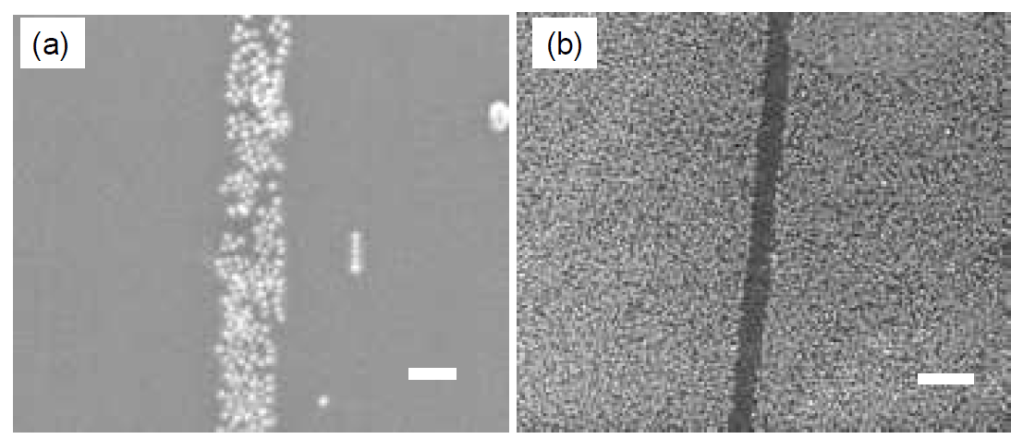
Fig. 6. Colloidal nanoparticles can be dispersed in the gas phase and deposited selectively and reversibly on a patterned substrate by “plus/minus” electrospray and contact charging of the substrate. Scale bars: 100 nm (a) and 2 micrometer (b).
Expected impact on society
We have combined chemical engineering, aerosol technology, and materials science to develop new strategies for particulate materials processing for environmental and energy applications. Several novel methods have been developed, based on electrospray-assisted transport and assembly of nanoparticles from a liquid sample into the gas phase, together with an aerosol measurement technique with sub-nanometer resolution for real-time measurement of particle size distributions. Through our studies of “good” nanoparticles as advanced/functional materials and potentially harmful nanoparticles as size-controlled materials for health-effect studies, we hope that future work will enable us to control nanoparticles in the gas and liquid phases, to better understand the related physical, chemical, and biological phenomena, and to open opportunities for innovative technology as well as fundamental science.
Acknowledgments
Hiroshima members: K. Okuyama, W. N. Wang, Widiyastuti, H. Widiyandari, H. M. Lee, S. G. Kim, I. Matsui, T. Iwaki, F. Iskandar. Fukuoka members: T. Oyabu, Y. Morimoto, I. Tanaka. USA members: J. Fernandez de la Mora, P. Biswas, C. Hogan Jr. Tokyo members: M. N. Naim, M. Kuwata, H. Kamiya. Korea member: T. O. Kim.
Sponsors
New Energy and Industrial Technology Development Organization (NEDO); Ministry of Economy, Trade and Industry, Japan (METI); Japan Society for the Promotion of Science (JSPS); Ministry of Education, Culture, Sports, Science and Technology.
References
- W. N. Wang, W. Widiyastuti, I. W. Lenggoro, T. O. Kim, K. Okuyama, “Photoluminescence optimization of luminescent nanocomposites by spray pyrolysis of a colloid-solution precursor,” Journal of the Electrochemical Society, 154(4), J121–J128 (2007).
- M. N. Naim, M. Kuwata, H. Kamiya, I. W. Lenggoro, “Deposition of TiO2 nanoparticles in surfactant-containing aqueous suspension by a pulsed DC charging-electrophoresis,” Journal of the Ceramic Society of Japan (2008). https://doi.org/10.2109/jcersj2.117.127
- I. W. Lenggoro, H. Widiyandari, C. Hogan Jr., P. Biswas, K. Okuyama, “Colloidal nanoparticle analysis by electrospray size spectrometry with a heated flow,” Analytica Chimica Acta, 585(2), 193–201 (2007).
- T. Oyabu, Y. Morimoto, M. Shimada, W. Lenggoro, K. Okuyama, I. Tanaka, “Biopersistence of inhaled nickel oxide nanoparticles in rat lung,” Inhalation Toxicology, 19(S1), 55–58 (2007).
- H. M. Lee, S. G. Kim, I. Matsui, T. Iwaki, F. Iskandar, I. W. Lenggoro, K. Okuyama, “Monolayer deposition of L10 FePt nanoparticles via electrospray route,” Journal of Magnetism and Magnetic Materials, 313, 62–68 (2007).
- I. W. Lenggoro, H. M. Lee, K. Okuyama, “Nanoparticle assembly on ‘plus/minus’ surfaces from electrospray of colloids,” Journal of Colloid and Interface Science, 303, 124–130 (2006).