経営者とのインタビュー Based on an interview with SERIC’s CEO (original in Japanese)> seric.co.jp/
1. What brought you to study in Japan?
CEO: I understand your decision to study abroad came at a very difficult time, following the loss of your father. Was that a hard decision to make?
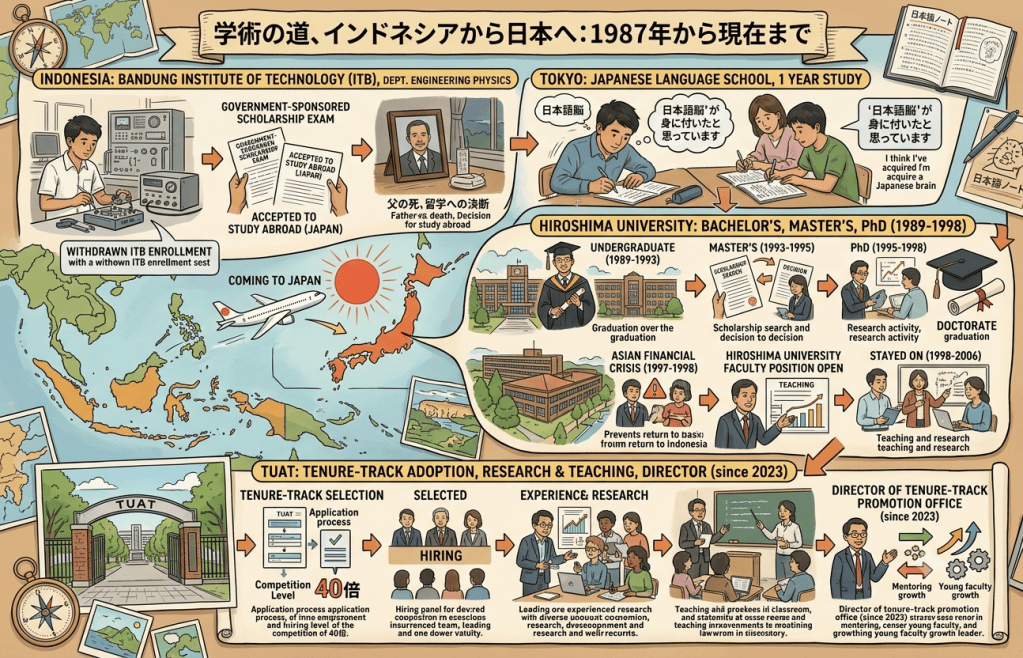
Lenggoro: I originally enrolled in the Department of Engineering Physics at the Bandung Institute of Technology (ITB) in Indonesia. Around that time, I passed a government-sponsored scholarship exam and was accepted to study abroad (finally, in Japan). But just as that was decided, my father passed away. I agonized over whether to go through with it, but in the end I withdrew from ITB and chose to come to Japan.
After arriving, I spent a year studying Japanese at a language school in Tokyo. I then entered Hiroshima University as an undergraduate — by that point my Japanese had improved enough that classmates would copy my notes.
I originally planned to return to Indonesia after graduating (with a bachelor’s degree), but when I learned there were scholarships available for a master’s degree, I decided to continue. In the end, I stayed at Hiroshima University all the way through my PhD. After finishing my doctorate, I intended to finally go home, but the Asian financial crisis made that difficult. Around the same time, a faculty position happened to open up at Hiroshima University, so I stayed on.
Later, I learned about the tenure-track program at Tokyo University of Agriculture and Technology (TUAT) and was fortunate to be selected from a pool with nearly 40 applicants per position. That’s what brought me to TUAT. Today, alongside my own research and teaching, I also support junior faculty as Director of the Tenure-Track Promotion Office.
2. What led you to apply for TUAT’s tenure-track program?
Lenggoro: The tenure-track system is a framework — originally established in the United States and elsewhere — designed to support the independence of young researchers. TUAT was one of the first universities in Japan to adopt it, in 2006.
At the time, I wanted an environment where I could shape the direction of my own research and teaching. The tenure-track program seemed like exactly that kind of environment, so I applied.
3. Could you briefly introduce your research?
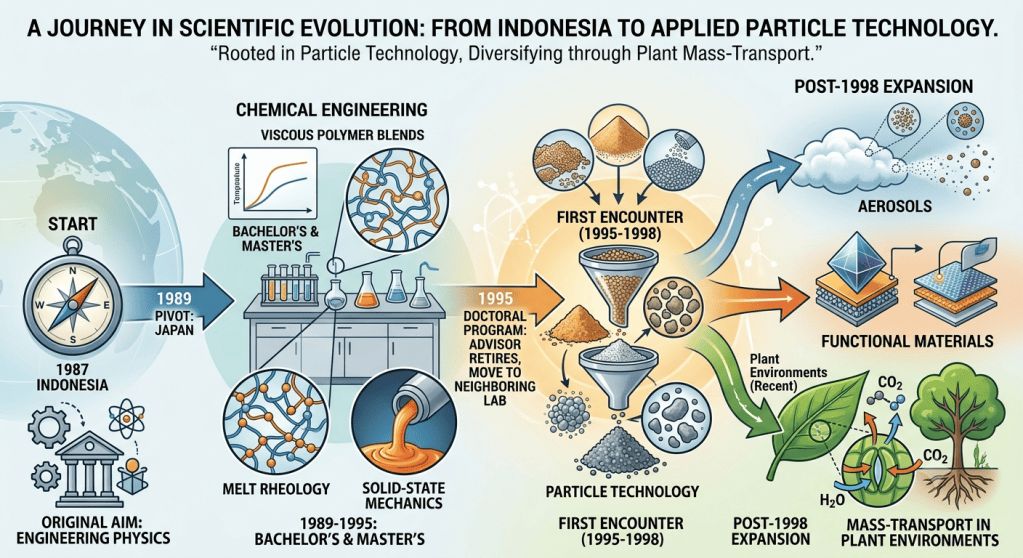
Lenggoro: I originally aimed to study engineering physics back in Indonesia, but in Japan I ended up studying chemical engineering. During my bachelor’s and master’s, I worked on the melt rheology and solid-state mechanics of polymer blends.
Then, when my advisor retired, I moved to a neighboring lab as I entered the doctoral program — and that’s where I first encountered particle technology. That was really the starting point for the research I do now.
Since then, particle technology has been at the core of my work. Over time it branched out into aerosols, functional materials, and — more recently — mass-transport processes in plant environments. Even I find it interesting how diverse the research has become.
4. How did the solar simulator come to play a role in your research?
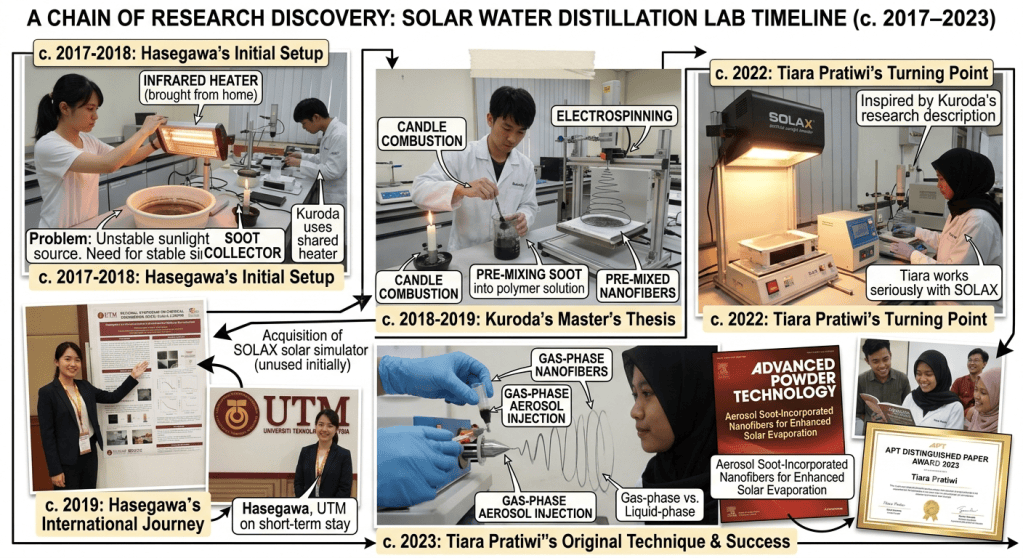
Lenggoro: It was Hasegawa, a student doing her bachelor’s thesis research around 2017–2018, who set things in motion. She was working on distilling contaminated water using sunlight. At the time, she — along with a master’s student named Kuroda, who had brought an infrared heater from his own apartment — was using that heater for their respective experiments. But as her research progressed, Hasegawa began to feel the need for a more stable, artificial sunlight source.
It was Hasegawa who strongly pushed for us to acquire the solar simulator, SOLAX. She later did a short-term stay at Universiti Teknologi Malaysia in 2019, where she also presented her results at the Regional Symposium on Chemical Engineering (RSCE) in Kuala Lumpur.
Around that same time, Kuroda — for his own master’s research — was working on a water-evaporation system using polymer (nano)fibers, mixing soot particles into the polymer solution before electrospinning it. So, little by little, related research was accumulating in the lab.
Here’s the interesting part: we purchased SOLAX around 2018–2019, but for a while, no one made serious use of it.
Tiara Pratiwi, who joined the lab in 2018, didn’t start out using SOLAX either. It was only after I described Kuroda’s master’s thesis to her that she became interested in water-evaporation techniques using polymer fibers — and it wasn’t until 2022 that she began working seriously with SOLAX.
What she came up with was a genuinely original idea: rather than mixing soot particles into the polymer solution beforehand (as Kuroda had done), she injected aerosolized soot particles — generated by candle combustion — directly into the air stream while the polymer solution was being electrospun. Mixing in the liquid phase versus mixing in the gas phase, in real time, during fiber formation: a completely different approach. That work was published in 2023 in the international journal Advanced Powder Technology, and went on to receive the APT Distinguished Paper Award 2023.
In my research group, buying an expensive instrument doesn’t mean someone will start using it right away — and I think that’s fine. Part of my role is to wait for a student to pick it up and generate an idea none of us could have predicted. Research equipment isn’t just a measuring tool; it can also be a seed for a whole new research theme.
5. What are your thoughts on using the solar simulator, and any requests going forward?
Lenggoro: Having such a stable illumination environment made a real difference to our results — I’d like to express my thanks again for that.
Even after the solar-distillation work wound down, other students have continued to use the solar simulator. In my lab, roughly once every two or three years a student chooses a research theme that draws on solar energy — and I think that’s precisely because the equipment is there. In fact, a master’s student is using it again this year, for a study on water movement in soil.
I give very little detailed direction to bachelor’s or master’s students about their research topics. Instead, I try to help them find their own direction through dialogue and questions — I believe that’s what nurtures diversity of thought and self-determination in young people. For doctoral students, it’s a bit different: since many projects involve collaboration with companies, the general direction of the research is often set to some degree from the start.
I also don’t think of “Failure” as simply failing. I see it as important information for deciding what to try next — so I want students to take on challenges without fearing it.
Students explore the lab’s various instruments and start imagining, “Maybe I could do something with this.” The solar simulator is one of those instruments. Just having it there naturally sparks ideas for how it might be used.
So, to me, research equipment is never just a measuring device — it’s also a trigger for new research themes and ideas. In that sense, I think the value the solar simulator has brought to our lab has been substantial.
6. What are your goals going forward?
Lenggoro: I believe research exists for the sake of education. For me, the process matters more than the output.
Students thinking up their own research questions, deciding on them themselves, and experiencing the process firsthand — that, to me, is the single most important part of raising truly independent people.
I want to keep building an environment where, through this kind of learning, students can arrive at the realization — on their own — that “the sun is the source of energy,” and where they can pursue that insight as far as it takes them.
These days I also have a fair amount of work outside the lab — academic society activities both in Japan and abroad, collaborations with companies — but I still have eight years until retirement. I’d like to keep doing what I can, one thing at a time.
Editor’s Note (the interviewer)
Professor Lenggoro spoke with such enthusiasm that our interview ran well over its scheduled time. Even so, there was so much more I wanted to ask.
After the interview, he kindly showed me around the lab and spoke passionately about the equipment and the current research. The students I met there were remarkably self-directed, and each explained their own research clearly, even to an outside visitor like me — a small but telling glimpse of Professor Lenggoro’s impact as an educator.
He’s a genuinely engaging, passionate, and energetic person, and I hope to have the chance to speak with him again before too long.
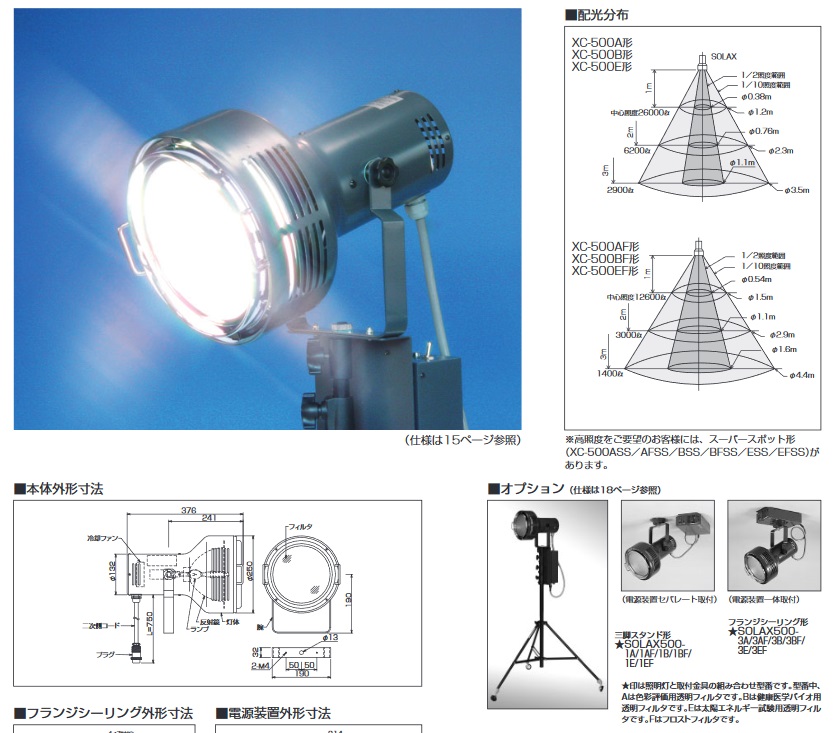
- Product installed: Solar Simulator “Super Spot” XC-500EFSS × 1 unit (SOLAX)
- Application: Research on water-movement phenomena using simulated solar light
- Location: Koganei Campus, Tokyo University of Agriculture and Technology
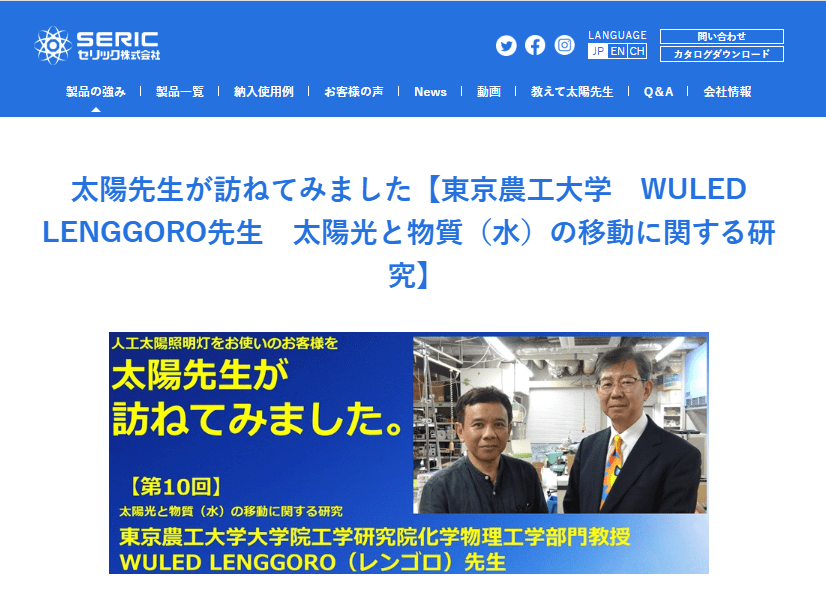
Wuled Lenggoro Professor, Division of Applied Physics and Chemical Engineering, Institute of Engineering, Tokyo University of Agriculture and Technology (TUAT); Director, Tenure-Track Promotion Organization of TUAT
Research on Solar Light and the Movement of Matter (Water)
wp.me/p10HOa-9Od

