Share Link – Anyone clicking on this link before February 04, 2026 will be taken directly to the final version of article. https://authors.elsevier.com/c/1mHKyx-vuf-mO
エネルギー需要の増加に伴い、二酸化炭素(CO₂)排出量の削減は世界的な課題となっています。CO₂回収・貯留(CCS)技術は気候変動対策の鍵となりますが、従来の手法は高価な材料や、多くのエネルギーを消費する化学吸収プロセスに依存しているという課題がありました。
欧州化学工学連盟(EFCE)の国際誌 Chemical Engineering Research and Design に掲載された私たちの最新論文では、身近な資源である「土壌」を活用した解決策を提案しています。
As global energy demands rise, so do carbon dioxide (CO₂) emissions. While Carbon Capture and Storage (CCS) is a critical technology for mitigating climate change, current methods often rely on expensive materials or energy-intensive chemical absorption processes.
In our latest paper, published in Chemical Engineering Research and Design (European Federation of Chemical Engineering), we investigate a solution utilizing a resource: Soil.
KOHによる土壌の活性化 The Innovation: KOH-Activated Soil
土壌はシリカや粘土鉱物を含む複雑な多孔質材料ですが、そのままでは工業用吸着材として十分な表面積を持ちません。そこで、私たち(マレーシア工科大学・Dr. Khairunnisa(農工大博士修了生)、室蘭工業大学・山中教授、Lenggoro研究室を中心とする研究チームは、マレーシアで採取された土壌(泥炭および粘土質)に対し、水酸化カリウム(KOH)を用いた賦活処理を行うことで、その機能を「スーパーチャージ」する方法を開発しました。
Soils are complex, naturally porous materials containing silica and clay minerals. However, raw soil lacks the surface area required to be an efficient industrial adsorbent. To overcome this, our team—led by Dr. M. P. Khairunnisa (UTM faculty & TUAT alumna)—developed a method to “supercharge” soils collected from Malaysia (specifically peat and clay varieties) using Potassium Hydroxide (KOH) activation.
Key Findings
実験の結果、土壌の物理的・化学的性質が大きく変化し、CO₂回収能力が飛躍的に向上することが確認されました。
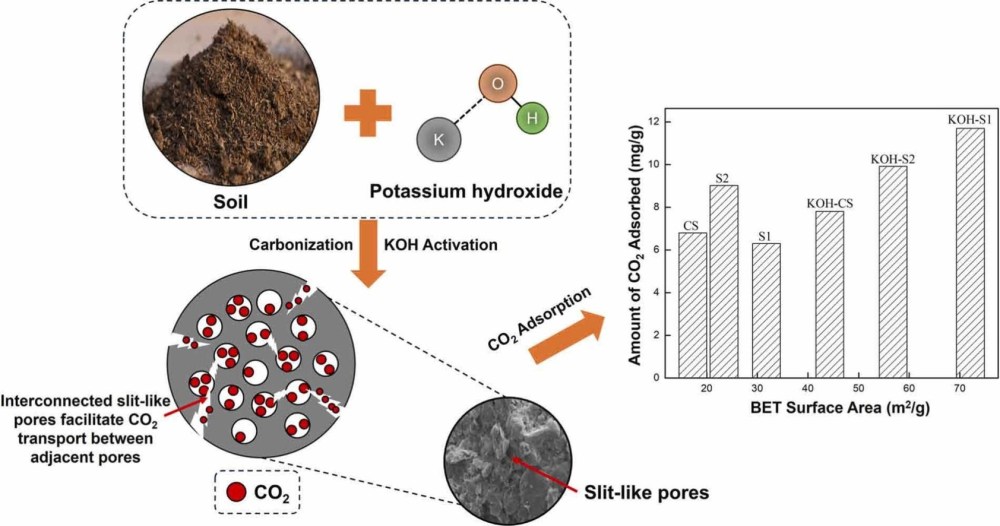
- 比表面積の劇的な増大: KOH賦活処理により土壌内部に多孔質構造が形成され、未処理の土壌と比較して大幅に高い 72.08 m²/g の比表面積を達成しました。
- 細孔容積の向上: 「スリット状」のミクロ孔およびメソ孔が形成され、細孔容積は 0.106 cm³/g に達しました。
- 高い吸着容量: 処理された土壌は、11.7 mg/g という優れたCO₂吸着容量を示しました。
The study focused on transforming the properties of the soil to maximize CO₂ uptake. The results were promising:
- Drastic Surface Area Increase: The KOH activation process successfully developed a porous structure within the soil, achieving a surface area of 72.08 m²/g—a significant improvement over untreated soil.
- Enhanced Pore Volume: The process created “slit-like” micropores and mesopores, achieving a pore volume of 0.106 cm³/g.
- High Adsorption Capacity: The activated soil demonstrated a CO₂ adsorption capacity of 11.7 mg/g.
本研究の意義 Why This Matters
解析の結果、CO₂の吸着挙動は「擬二次速度モデル(pseudo-second-order model)」に適合しており、単なる物理的な閉じ込めではなく、土壌表面での化学吸着によってCO₂が捕捉されていることが示唆されました。
本研究は、合成ゼオライトや活性炭の代替として、安価で豊富な天然資源を利用できる可能性を示しています。特にマレーシア産の土壌を活用することで、よりアクセスしやすく、コスト効率の高いCO₂回収技術への道を開くものです。
Our analysis confirmed that the adsorption kinetics fit the pseudo-second-order model, suggesting that the CO₂ is being trapped via chemisorption (chemical reaction with the surface) rather than just physical trapping.
This research opens the door to using abundant, low-cost natural resources as a sustainable alternative to synthetic zeolites or activated carbons. By utilizing Malaysian soils, we are paving the way for more accessible and cost-effective carbon capture technologies.
論文情報 / Publication Details
- Title: Potassium Hydroxide Activated Porous Soils from Malaysia on Carbon Dioxide Adsorption
- Journal: Chemical Engineering Research and Design (Available online 9 December 2025)
- Authors: M.P. Khairunnisa, Muliani Mansor, Nuraisyah Selamat, Nurfatehah Wahyuny Che Jusoh, Nor Ruwaida Jamian, Shinya Yamanaka, I. Wuled Lenggoro.
- DOI: https://doi.org/10.1016/j.cherd.2025.12.014
 "Particles & Transfer" Lab.