「本研究では、2025年に“濃度依存性”から最適濃度(1 ppm)を解明し、植物種を跨いだ“グリーン合成法によるナノ粒子による「プライミング技術」の有効性を報告してきたが、2026年1月の研究では、同じ chitosan–iron oxide ナノ粒子を用い、最適“処理時間”を体系的に明らかにすることで、プライミング技術の実装に向けた重要な欠落要素を補完した。“Led primarily by the research team at Universiti Teknologi MARA (UiTM), we previously reported throughout 2025 the concentration‑dependent behavior and crop‑specific benefits of chitosan‑stabilized iron oxide nanoparticles, identifying 1 ppm as the optimal nanoparticle (suspension) concentration. Building upon these findings, the January 2026 study further advances the field by systematically determining the optimal priming duration, filling a crucial missing element needed for the practical implementation of sustainable nanoparticles-used priming technologies.”
2026/Jan: (Chemistry and Biodiversity) Optimizing Nanopriming Duration: Chitosan-Stabilized Iron Oxide Enhances Lettuce Seedling Performance and Cost-Effectiveness (キトサンで安定化した酸化鉄ナノ粒子を用いた処理の最適化:レタス苗の生育および費用効果の向上) https://doi.org/10.1002/cbdv.202502426
(2025/Aug): Environmental Research. Green synthesis of chitosan-stabilized iron oxide nanoparticles using Christia vespertilionis extract for sustainable nano-priming of Brassica rapa subsp. chinensis and Spinacia oleracea seeds 「トウカイオトギリソウ(弟切草)抽出物を用いたナノ粒子プライミングのためのキトサン安定化酸化鉄ナノ粒子の合成:ハクサイおよびホウレンソウ種子への応用」DOI: 10.1016/j.envres.2025.122644
2025/June) ナノ粒子プライミング技術によるレタス種子の発芽促進効果の解明
マレーシア(MARA工科大)とインドネシア(Bandung工科大)と日本(農工大)の研究グループは、キトサンで安定化した酸化鉄ナノ粒子(CS-FeNPs)を用いた種子のナノ粒子プライミング技術が、レタス(Lactuca sativa)の発芽と初期成長に与える影響を調査し、最適なナノ粒子濃度を明らかにした。
Concentration-driven effects of chitosan-stabilized iron oxide nanoparticles on seed nanoparticle priming and germination performance of lettuce
A research team (from Malaysia, Indonesia, and Japan/TUAT) has published a study investigating how chitosan-stabilized iron oxide nanoparticles (CS-FeNPs) enhance seed germination and seedling growth in lettuce (Lactuca sativa) through nanoparticle priming, identifying the optimal nanoparticle concentration for best results.
研究背景
農業生産性の向上は重要な課題です。種子の発芽と初期成長を促進する技術として、種子プライミング(Seed Priming)があります。これは、種子を水や特定の溶液に浸すことで、発芽直前の生理状態に準備させる前処理技術です。https://en.wikipedia.org/wiki/Priming_(agriculture)
近年、このプライミング技術の進化形として、ナノ粒子プライミング(Nanoparticle Priming)が注目されています。これは、ナノ粒子(NPs)が持つ高い表面積対体積比、反応性、および細胞構成要素とナノスケールで相互作用する能力を利用し、水の吸収、栄養素の取り込み、ストレス耐性を高めることで種子の性能を向上させます。特に、鉄は植物の成長に不可欠な元素であり、酸化鉄ナノ粒子は植物代謝に有益な効果をもたらします。しかし、コーティングされていない酸化鉄ナノ粒子は凝集しやすく、その効果が低下するという課題がありました。
Background
With the increasing global population, improving agricultural productivity is a critical challenge. Seed priming is a pre-sowing treatment that involves hydrating seeds in water or specific solutions to bring them to a physiological state just before germination, thereby enhancing their potential for uniform germination and growth.
More recently, an advanced form of this technique, nanoparticle priming, has gained prominence due to the remarkable properties of nanoparticles (NPs). Nanoparticles, with their high surface area-to-volume ratio, enhanced reactivity, and ability to interact with cellular components at the nanoscale, can improve seed performance by enhancing water uptake, nutrient absorption, and stress resistance in plants. Iron oxide nanoparticles (FeNPs) are particularly promising due to iron’s essential role in plant metabolic processes. However, uncoated FeNPs tend to agglomerate, forming larger particles that lose their unique nanoscale properties and reduce their efficacy in seed priming.
研究内容
- ナノ粒子の合成と安定化
低分子量(約1000 g/mol)のキトサンを用いて酸化鉄ナノ粒子を安定化し、凝集を防止しました。 - 濃度依存性の評価
1, 25, 50, 75, 100 ppmのCS-FeNPs濃度でレタス種子をナノプライミングし、発芽率、根の伸長、茎の成長を比較しました。 - 最適濃度の発見
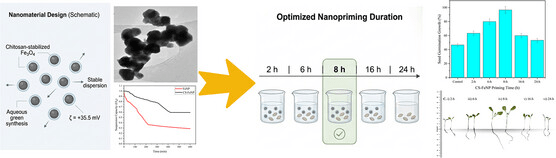
1 ppmのCS-FeNPsが最も安定に分散し、発芽率と初期成長を有意に向上させました。高濃度では凝集が進み、効果が低下しました。
Study Details
- Synthesis and Stabilization
Iron oxide nanoparticles were stabilized using low molecular weight (∼1000 g/mol) chitosan to prevent aggregation. - Concentration-dependent Evaluation
Lettuce seeds were nano-primed with CS-FeNPs at concentrations of 1, 25, 50, 75, and 100 ppm, and germination rate, root elongation, and shoot growth were measured. - Optimal Concentration Identified
At 1 ppm, CS-FeNPs showed superior dispersion and significantly enhanced germination and seedling growth. Higher concentrations caused aggregation, reducing bioavailability and efficacy.
研究の意義
本研究は、ナノ粒子の適切な濃度設定が農業におけるナノ粒子プライミングの効果を最大化し、環境安全性を確保する上で重要であることを示しました。CS-FeNPs 1 ppmは、費用対効果が高く、持続可能な農業技術として、環境に優しいナノテクノロジーを通じて農業生産性を向上させる可能性を秘めています
Significance
This study underscores the importance of determining optimal nanoparticle concentrations to maximize the agricultural benefits of nanoparticle priming while ensuring environmental safety. CS-FeNPs at 1 ppm are positioned as a cost-effective and sustainable nanoparticle priming agent, with implications for enhancing agricultural productivity through eco-friendly nanotechnology.
使用した技術
- 透過型電子顕微鏡(TEM)による粒子形態観察
- 走査電子顕微鏡(FE-SEM)による表面形態解析
- 動的光散乱(DLS)による粒子サイズと分散性評価
- X線回折(XRD)と赤外分光法(FTIR)による構造解析
Techniques Used
- Transmission Electron Microscopy (TEM) for particle morphology
- Field Emission Scanning Electron Microscopy (FE-SEM) for surface structure
- Dynamic Light Scattering (DLS) for particle size and dispersion
- X-ray Diffraction (XRD) and Fourier Transform Infrared Spectroscopy (FTIR) for structural analysis
今後の展望
本技術は他の作物への応用や、環境負荷の低減を目指した持続可能な農業技術の開発に貢献すると期待されます。
Future Perspectives
This technology is expected to contribute to sustainable agriculture by applying nano-priming to other crops and reducing environmental impact.
論文情報
Concentration-driven interactions of chitosan-stabilized iron oxide nanoparticles in seed nano-priming and germination performance of Lactuca sativa
- 掲載誌: Nanotechnology for Environmental Engineering (2025) Springer-Nature
- DOI: https://doi.org/10.1007/s41204-025-00443-7
Paper Information
- Title: Concentration-driven interactions of chitosan-stabilized iron oxide nanoparticles in seed nano-priming and germination performance of Lactuca sativa
- Journal: Nanotechnology for Environmental Engineering (2025)
- DOI: 10.1007/s41204-025-00443-7
- Authors: Nurfarwizah Adzuan Hafiz, Anca Awal Sembada, Mohamed Syazwan Osman, Noor Fitrah Abu Bakar, Mohamad Sufian So’aib & I. Wuled Lenggoro.
- Institution: EMZI-UiTM Nanoparticles Colloids & Interface Industrial Research Laboratory (NANO-CORE) Faculty of Chemical Engineering, Universiti Teknologi MARA, Cawangan Pulau Pinang, Permatang Pauh Campus, 13500, Permatang Pauh, Pulau Pinang, Malaysia; School of Life Sciences and Technology, Bandung Institute of Technology, Jl. Ganesa No. 10, Bandung, 40132, Indonesia; Research Center for New and Renewable Energy, Inter-University Center, Bandung Institute of Technology, Bandung, 40132, Indonesia; Faculty of Chemical Engineering, Universiti Teknologi MARA, 40450, Shah Alam, Selangor, Malaysia; Department of Applied Physics and Chemical Engineering, Graduate School of Engineering, Tokyo University of Agriculture and Technology, 2-24-16 Nakacho, Koganei, Tokyo, 184-8588, Japan
Previous studies (from TUAT):
Sembada AA, Lenggoro IW (2024) Nanopriming of Tomato (Solanum lycopersicum) Seeds Against Heavy Metal Stress During Germination and Seedling Formation. In: BIO Web of Conferences (Vol. 91, p. 01005). EDP Sciences., https://doi.org/10.1051/BIOCONF/20249101005.
Sembada AA, Maki S, Faizal A, Fukuhara T, Suzuki T, Lenggoro IW (2023) The role of silica nanoparticles in promoting the germination of tomato (Solanum lycopersicum) seeds. Nanomaterials 13(14):2110. https://doi.org/10.3390/NANO13142110
Sembada AA, Lenggoro IW (2023) Comparative analysis of germination performance from several species of seeds under influence of silica nanoparticles. In: IOP Conference Series: Earth and Environmental Science (Vol. 1271, No. 1, p. 012085). https://doi.org/10.1088/1755-1315/1271/1/012085.
Sembada AA, Fukuhara T, Suzuki T, Lenggoro IW (2024) Stem cutting: A novel introduction site for transporting water-insoluble particles into tomato (Solanum lycopersicum) seedlings. Plant Physiol Biochem 206:108297. https://doi.org/10.1016/J.PLAPHY.2023.108297
Sembada AA, Harada R, Maki S, Fukuhara T, Suzuki T, Lenggoro IW (2024) Candle soot colloids enhance tomato (Solanum lycopersicum) seed germination and seedling quality. Discov Agric 2(1):1. https://doi.org/10.1007/S44279-024-00011-8
Short URL of this website: https://wp.me/p10HOa-8jw
 "Particles & Transfer" Lab. 粒子・移動現象研究室