News: 2023年度(第22回)粉体工学会APT賞を受賞しました!Selected for the 22nd Advanced Powder Technology (Elsevier) APT Distinguished Paper Award (Society of Powder Technology, Japan)! >> More.
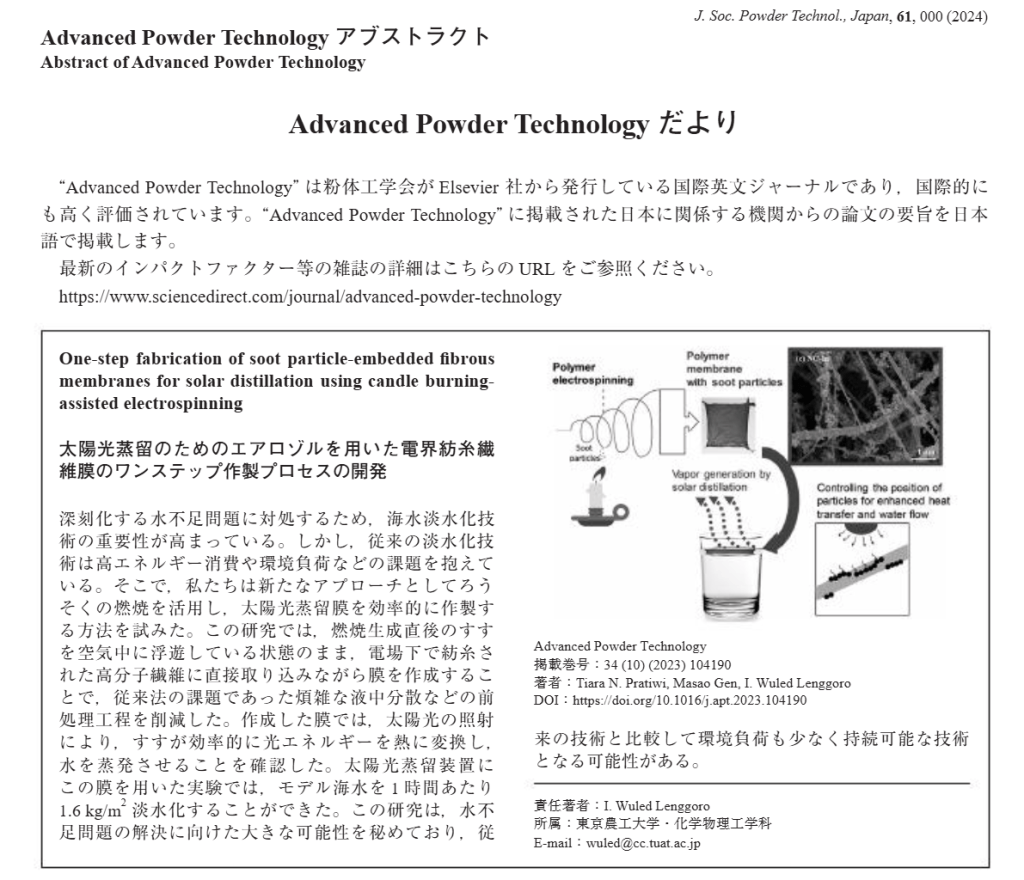
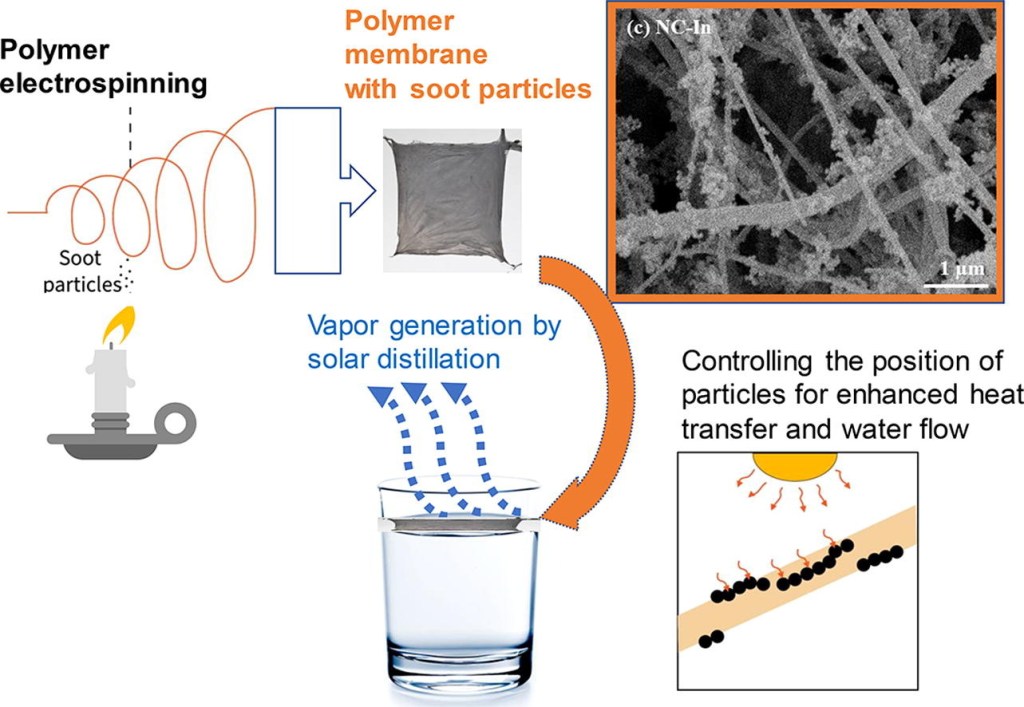
水不足問題(太陽光蒸留技術)の解決に向け、当研究室は「FlameSpin AeroFusion (FSAF)」と名付けた「繊維に微粒子を埋め込む技術」を開発しました。これは、ろうそく等の有機物の燃焼と高分子の電界紡糸を融合させ、煤(すす)粒子を埋め込んだ高効率な蒸留膜をワンステップで作製する技術です。 To address critical water scarcity (via solar distillation technology), our lab has developed a technology named “FlameSpin AeroFusion (FSAF).” This world-first method merges candle (or other organic materials) burning with electrospinning to fabricate highly efficient, soot particle-embedded membranes for solar distillation in a single step.
The Challenge & Our Innovation
海水淡水化は重要ですが、既存技術はエネルギー消費と環境負荷が高いという課題を抱えています。太陽光蒸留は有望ですが、高効率な光熱変換材料が必要です。 While desalination is crucial, existing technologies face high energy consumption and environmental impact. Solar distillation offers promise but requires highly efficient photothermal materials.
【FlameSpin AeroFusion (FSAF)】私たちは、ろうそく燃焼直後のすす粒子を、空気中に浮遊する状態で電界紡糸中の高分子繊維に直接取り込むことで、液中分散などの煩雑な前処理工程を完全に回避するワンステップ製造プロセスを確立しました。これにより、すす粒子を内部または外部に埋め込んだ高分子繊維膜を効率的に作製します。We established a one-step manufacturing process that entirely bypasses cumbersome pre-treatment steps (e.g., liquid dispersion). This is achieved by directly embedding freshly formed soot particles, still suspended in the air from candle burning, into electrospun polymer fibers. This method efficiently produces polymer fibrous membranes with soot particles embedded either internally or externally.
Key Features & Achieved Results
- ワンステップ製造: ろうそく燃焼と電界紡糸を同時に行い、すす粒子入り光熱変換膜を効率的に作製。One-step Fabrication: Efficiently produces photothermal membranes with embedded soot particles by simultaneous candle burning and electrospinning.
- 熱局在の大幅な向上: 太陽光エネルギーの熱変換効率を最大194.5%向上。Significant Heat Localization Enhancement: Achieved up to 194.5% improvement in solar energy to heat conversion efficiency.
- 高い蒸発・淡水化率: *1 sun太陽光照射下で水蒸留率1.60 kg m−2 h−1、淡水化率1.55 kg m−2 h−1を達成。High Evaporation & Desalination Rates: Under 1-sun solar irradiation, achieved water distillation rate of 1.60 kg m−2 h−1 and desalination rate of 1.55 kg m−2 h−1.
- 環境負荷の低減: 持続可能な水問題解決への新たな道を開拓。 Reduced Environmental Impact: Opens new avenues for sustainable solutions to water scarcity.
*1 sun = 太陽定数の平均値、1平方メートルあたり約1,366ワット
Future Outlook
- 本研究で提案された手法は、高分子膜の機能化に対する新たな道を開くものであり、水不足問題の解決に向けた大きな可能性を秘めています。従来の技術と比較して環境負荷も少なく、持続可能な淡水化技術としてさらなる発展が期待されます。 The proposed method opens a new route for the functionalization of polymer membranes and holds significant potential for solving water scarcity issues. With a lower environmental footprint compared to conventional technologies, it is expected to further develop as a sustainable desalination technology.
Journal: Advanced Powder Technology (2023) “One-step fabrication of soot particle–embedded fibrous membranes for solar distillation using candle burning–assisted electrospinning” Tiara N. Pratiwi, Masao Gen, I. W. Lenggoro
doi.org/10.1016/j.apt.2023.104190
ABSTRACT: Solar distillation, a promising technique for water purification and desalination, requires photothermal materials to efficiently convert solar energy into heat. In this study, a novel method is proposed wherein fresh carbonaceous (soot) particles, as a photothermal material, are embedded into electrospun fibrous membranes by burning candles (to produce soot) and electrospinning of polymer material simultaneously. The proposed method can produce several types of membranes with various particle positions (interior or exterior) in the polymer fiber. The particle positions were adjusted by changing the introduction points of particles using a polymer jet. Polymer fibers with diameters of several hundred nanometers were fabricated. Experiments revealed that the soot particle position did not influence the photothermal conversion performance of the membranes. The fabricated membrane could improve the heat localization up to 194.5% and exhibited water distillation and desalination rates as high as 1.60 and 1.55 kg m−2h−1, respectively, under 1-sun solar light irradiation. The proposed method opens a new route for the functionalization of polymer membranes.

 "Particles & Transfer" Lab. 粒子・移動現象研究室