Conductive particulate films fabricated by electrospray deposition of candle soot suspensions with acid treatments 酸処理したロウソクの煤(すす)の静電噴霧堆積によって作製した導電性微粒子膜
Permanent Link: https://doi.org/10.1016/j.apt.2023.104107
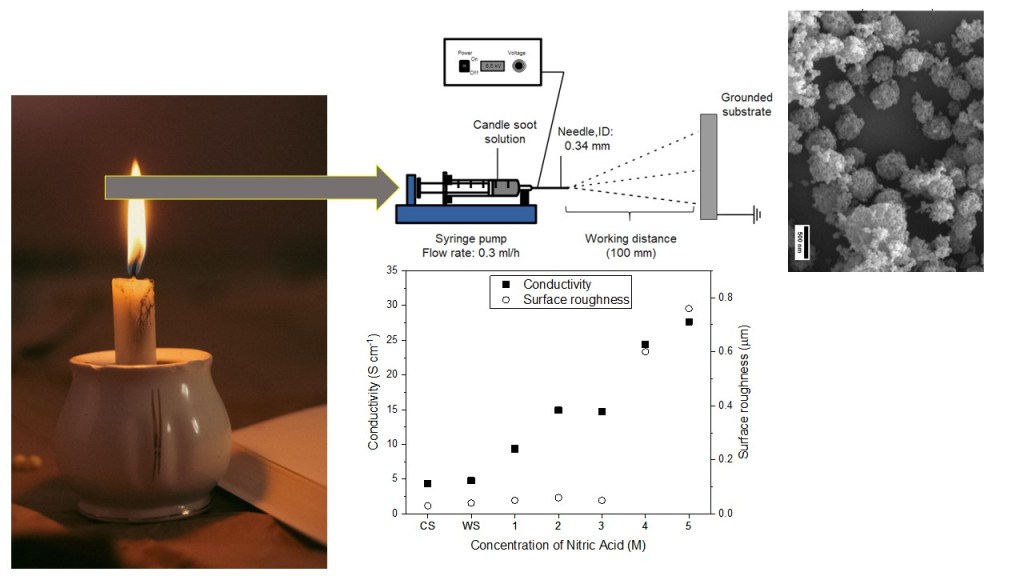
炭素系材料は広く利用されており、その電気的特性にも興味が持たれている。本研究では、ろうそくの煤粒子膜に対する硝酸処理の効果を調べた。煤分散液を静電噴霧法で基板上に堆積させて膜を作製した。膜の導電性は、硝酸濃度とともに増加し、5 M硝酸で処理した膜で27.65 S cm-1の最高値を示した。これは、煤粒子間の結合が改善されたためである。赤外分光法とラマン分光法を用いて、膜中の官能基や結晶欠陥を計測した。
Carbon-based materials are widely used and have interesting electrical properties. We studied how nitric acid treatment affects the soot particle film from a candle. We deposited the film on a substrate by electrostatic spraying of the soot dispersion. The film conductivity increased with the nitric acid concentration. The highest conductivity was 27.65 S cm-1 for the film treated with 5 M nitric acid. This was due to the improved bonding between the soot particles. We used infrared spectroscopy and Raman spectroscopy to examine the functional groups and crystal defects in the films.
Journal: Advanced Powder Technology (2023)
Authors: Nur Atiqah Surib, M.P. Khairunnisa, I. Wuled Lenggoro *, Shahira Liza, Yew Hoong Wong
This report was made through a collaborative project between: Department of Chemical and Environmental Engineering, Malaysia – Japan International Institute of Technology (MJIIT), Universiti Teknologi Malaysia (UTM), Kuala Lumpur, Malaysia; Department of Applied Physics and Chemical Engineering, Tokyo University of Agriculture and Technology, Koganei, Japan; Department of Mechanical Precision Engineering, MJIIT, UTM, Kuala Lumpur, Malaysia; Department of Mechanical Engineering, Faculty of Engineering, Universiti Malaya, Kuala Lumpur, Malaysia
 "Particles & Transfer" Lab. 粒子・移動現象研究室