Don’t Chase the Impact Factor: Focus on the Quality of the Question
A single-author case study using my own publications (Google Scholar citation counts; journal IFs are approximate recent values, see the note at the end).
Researchers are often told to aim for high-impact journals: higher IF, more visibility, more citations. I checked this against my own record. The link exists, but it is weaker than commonly assumed, and it is far from the whole story.
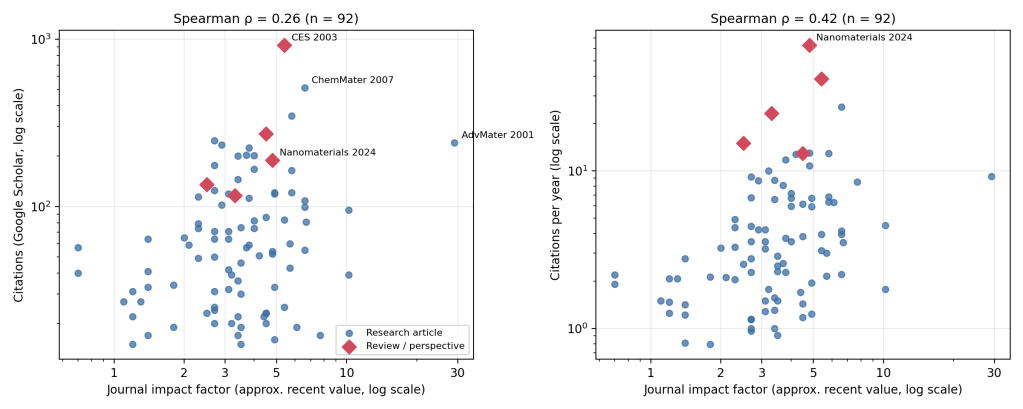
What the data show. For 92 of my journal papers, journal IF and citations are only weakly correlated (Spearman ρ = 0.26). Counting citations per year, to correct for age, the correlation is moderate (ρ = 0.42). So a higher-IF journal does tend to go with more citations, but IF explains only a small part of the differences between papers (Fig. 1).
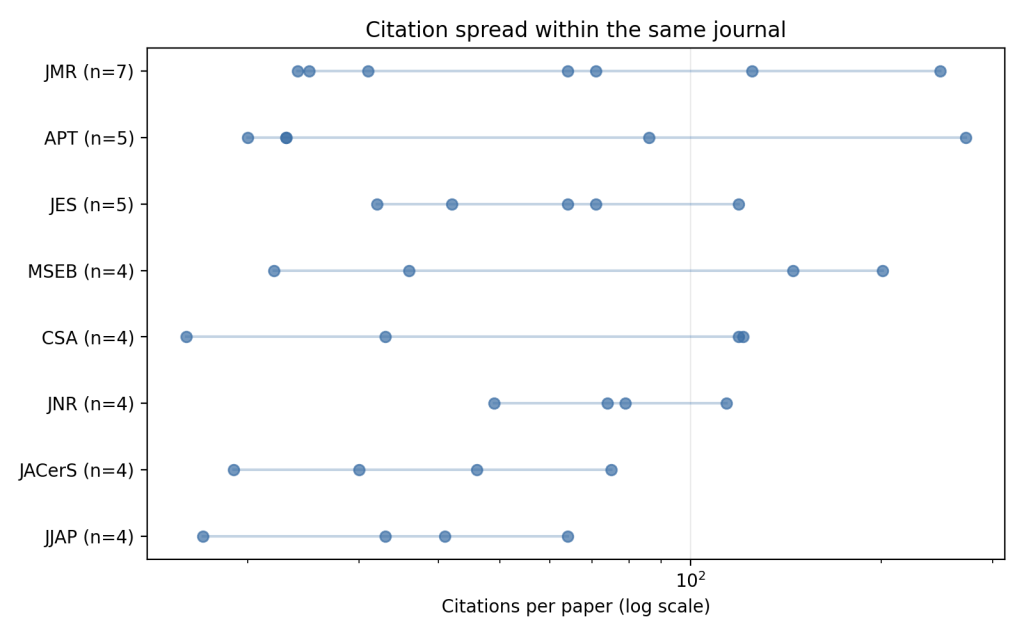
1. The same journal gives very different outcomes. Papers in the same journal differ by an order of magnitude. In Journal of Materials Research, my seven papers range from 24 to 248 citations. In Advanced Powder Technology they range from 20 to 272 (Fig. 2). If the journal determined a paper’s impact, the points in Fig. 2 would sit close together.
2. Article type matters at least as much as the journal. My five review or perspective papers have a median of 189 citations, against 55 for research articles, and about 23 citations per year against 3. My most-cited paper, a 2003 review in Chemical Engineering Science (921 citations, IF ≈ 5), is one of them. So is my fastest-growing recent paper, a 2024 review in Nanomaterials (189 citations, IF ≈ 4.8). Neither is in a top-tier journal. By contrast, my Advanced Materials paper (2001, IF ≈ 29) has 240 citations, a very good number, but about a quarter of the review’s.
3. Most of my top papers are not in top-IF journals. Of my ten most-cited papers, seven are in journals with IF ≤ 5.5 and only one is in a journal with IF above 10.
Why IF predicts so little. IF is the average of a very skewed citation distribution, so a few papers drive the value, and it counts citations in only a two-year window. It describes a journal, not a typical paper in it. A journal’s reputation is also built partly from the highly cited papers it publishes, so IF is better read as a lagging, journal-level summary than as a cause of a paper’s success.
What drives a paper’s impact: quality and novelty; relevance and timing of the topic; fit with the right audience; and article type and time scale (slow-burn versus short-lived attention).
For early-career researchers. I know hiring and grant panels still look at IF, and a good journal can offer rigorous review and readership. But IF is one piece of information, not a verdict on your work. Prioritize meaningful questions, rigorous and clear work, and contributions useful to your field.
Good research comes not from high-IF journals, but from good questions.
Numbers behind the text
- n = 92 journal papers (patent, chapters, conference items and the domestic journal excluded).
- IF vs citations: Spearman ρ = 0.26. IF vs citations per year: ρ = 0.42.
- Top 10 papers: 7 of 10 are in journals with IF ≤ 5.5, and only 1 (Adv. Mater.) has IF > 10.
- Reviews: the 5 review/perspective papers have a median of 189 citations (research articles: 55) and 23 citations per year (research articles: 3).
- Spread within one journal: J. Mater. Res. (7 papers) runs from 24 to 248 citations, Adv. Powder Technol. (5) from 20 to 272 (the top one is a review), Mater. Sci. Eng. B (4) from 22 to 201, and Colloids Surf. A (4) from 16 to 121.
IFより「問いの質」を重視しよう
私自身の論文を用いた一事例の分析です(被引用数はGoogle Scholar、IFは概算の最近値。末尾の注を参照)。
「IFが高い雑誌に載せれば、注目され、引用も増える」とよく言われます。私自身の論文で確かめたところ、関係はありますが、一般に思われているより弱く、全体像を説明するものではありませんでした。
データが示すこと
ジャーナル論文92報で、IFと被引用数の相関は弱いものでした(スピアマンの順位相関 ρ = 0.26)。発表年の影響を補正するため年あたりの被引用数で見ると、中程度の相関(ρ = 0.42)になります。IFの高い雑誌の論文は引用されやすい傾向がありますが、IFで説明できるのは論文間の違いのごく一部です(図1)。
1. 同じ雑誌でも結果は大きく異なる
同じ雑誌の論文でも、被引用数は桁違いに異なります。Journal of Materials Researchの7報は24〜248回、Advanced Powder Technologyの5報は20〜272回でした(図2)。雑誌が論文の影響力を決めるなら、図2の点は近くに集まるはずです。
2. 雑誌以上に論文の種類が効く
レビュー・perspective論文5報の被引用数の中央値は189回で、研究論文(55回)の約3倍、年あたりでは約23回と約3回です。最多引用のChemical Engineering Scienceのレビュー(2003年、921回、IF約5)がその一つで、最近急速に引用が伸びているNanomaterialsのレビュー(2024年、189回、IF約4.8)もそうです。いずれもトップ誌ではありません。一方、Advanced Materialsの論文(2001年、IF約29)は240回と立派な数字ですが、前者の約4分の1です。
3. 引用上位論文の多くは高IF誌ではない
被引用数上位10報のうち7報がIF 5.5以下の雑誌、IF 10超の雑誌は1報だけです。
なぜIFは個々の論文を予測できないのか
IFは極端に偏った引用分布の平均で、少数の論文が値を左右し、しかも直近2年の引用しか数えません。つまり雑誌の指標であり、そこに載った典型的な論文の指標ではありません。また雑誌の評判は、掲載された被引用数の多い論文の積み重ねによっても築かれます。IFは論文の成功の原因というより、雑誌単位の「後付けの指標」と捉えるのが適切です。
論文の影響力を決めるもの:質と新規性、テーマの時宜性、読者層との適合、そして論文の種類と時間軸(じわじわ型か、一時的な注目か)。
若手研究者の皆さんへ
採用や研究費の審査でIFが参照される現実はありますし、良い雑誌には査読の質や読者数という利点もあります。それでもIFは判断材料の一つにすぎません。意味のある問いを立て、厳密で明快な研究を行い、分野に役立つ成果を出すことを優先してください。
良い研究は、高IF誌から生まれるのではなく、良い問いから生まれる。
“Impact factors used here are approximate recent journal-level values (one value per journal, not the value in each paper’s publication year) and have not all been verified against Journal Citation Reports; citation counts are from Google Scholar, include self-citations, and favor older papers and review articles.”「本稿で用いたインパクトファクターは、各論文の掲載年の値ではなく、ジャーナルごとの最近の概算値(1誌1値)であり、すべてをJournal Citation Reportsで確認したわけではありません。被引用数はGoogle Scholarの値で、自己引用を含み、発表年の古い論文やレビュー論文に有利になります。」
Author: Wuled Lenggoro
Use of AI assistance: This article was prepared with the assistance of an AI tool (Claude, by Anthropic). The AI helped review the draft, compute the statistics (Spearman rank correlations in Python), generate the figures, and draft and translate the text. The research ideas, interpretation and conclusions are the author’s, who reviewed and edited the final text and takes responsibility for its content. Citation counts come from Google Scholar. The journal impact factors were compiled with AI assistance as approximate recent values. 本稿は、AIツール(Anthropic社のClaude)の支援を受けて作成しました。AIは、原稿のレビュー、統計計算(Pythonによるスピアマンの順位相関)、図の作成、文章の下書きと翻訳を支援しました。研究のアイデア、解釈、結論は著者によるもので、最終稿は著者が確認・編集し、内容の責任は著者が負います。被引用数はGoogle Scholarの値です。インパクトファクターはAIの支援により概算の最近値として整理したものです。

