「IDE現代の高等教育」(2026年7月号,No.682, P.36-39)特集「大学教員制度の新局面」において,以下の論文を執筆しました。
本特集では,大学教員制度の再構築や国際比較,若手教員の育成,クロスアポイントメント制度など,現代の大学を取り巻く制度変革について多面的に議論されています。
本論文では,東京農工大学における20年近い実践を背景に,テニュアトラック制度が単なる人材採用制度にとどまらず,大学の組織構造や運営にどのような影響を与えてきたのかを考察しています。
■ An invited paper for publication in: IDE (July 2026 Issue, No. 682)
Special Issue: “New Developments in Faculty Systems” Wuled Lenggoro, “Has the Tenure-Track System Changed Universities?”
This article examines how the tenure-track system, beyond being a recruitment mechanism, has influenced university governance and organizational structures, based on nearly 20 years of experience at Tokyo University of Agriculture and Technology.
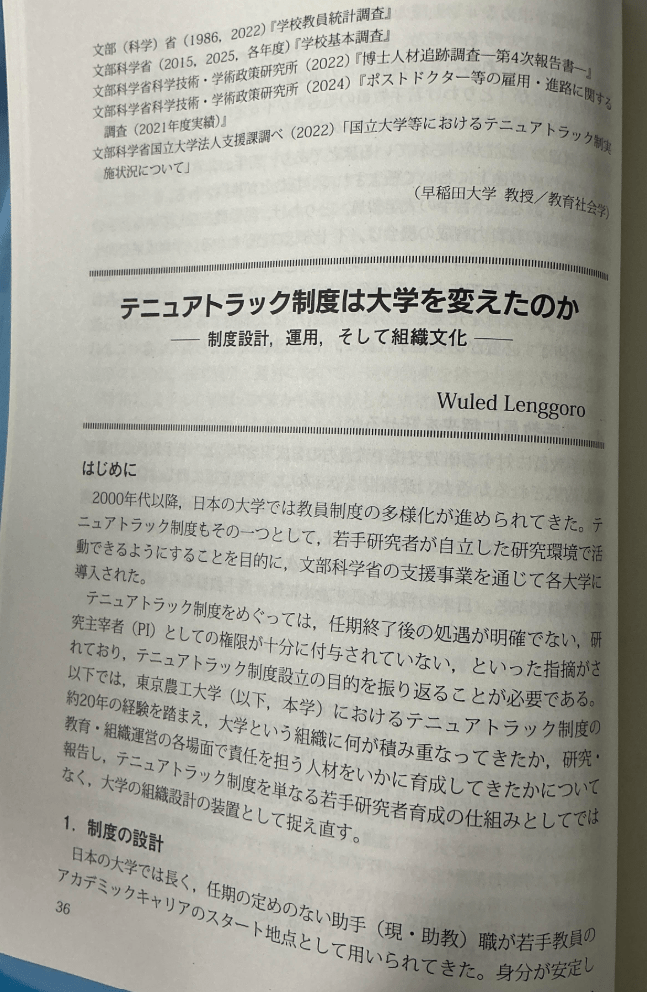
以下は、ウェブサイトに掲載できる英語版ドラフトです。
Has the Tenure-Track System Changed Universities?
Institutional Design, Long-Term Development, and Organizational Culture
Wuled Lenggoro
Director, Tenure-Track Promotion Organization
Professor, Department of Chemical Engineering and Applied Physics
Tokyo University of Agriculture and Technology (TUAT)
Introduction
Since the early 2000s, Japanese universities have introduced various reforms to diversify academic career systems. Among these reforms, the tenure-track system was promoted by the Ministry of Education, Culture, Sports, Science and Technology (MEXT) to provide young researchers with opportunities to develop independent research careers.
Over the years, however, concerns have been raised regarding the ambiguity of post-tenure career prospects and the limited authority granted to tenure-track faculty as principal investigators (PIs). Nearly twenty years after the introduction of the system at Tokyo University of Agriculture and Technology (TUAT), it is worth asking a broader question:
Has the tenure-track system changed universities themselves?
Drawing on two decades of experience at TUAT, this article argues that the tenure-track system should not be viewed merely as a mechanism for supporting young researchers. Rather, it has functioned as a strategic instrument for institutional development and organizational transformation.
1. The Original Design of the System
For many years, “assistant professor” (Joshu or Jokyo) positions in Japanese universities provided a stable starting point for academic careers. Young faculty members benefited from existing facilities, equipment, and research networks, making it relatively easy to accumulate research achievements. At the same time, however, major decisions regarding research directions and evaluation often depended heavily on senior faculty members. Opportunities to act as an independent PI were limited.
My own career illustrates this transition. After completing my doctoral studies in Japan, I initially worked in the same laboratory as an assistant professor (Joshu, a faculty member). In 2006, I joined the first cohort of TUAT’s tenure-track program as a specially appointed associate professor and became responsible for leading my own research group. After a mid-term review, I obtained tenure in 2009.
A distinctive feature of the TUAT model was that, from the beginning, it sought to secure tenure positions for tenure-track faculty members in principle. The program was not designed primarily to eliminate candidates through competition. Instead, the emphasis was placed on helping each faculty member achieve his or her own research goals while receiving institutional support through mentoring and organizational assistance.
The system also made explicit, from the time of appointment, the responsibilities and authority associated with serving as an independent PI, the expectations for tenure review, and the support structures available throughout the process. These elements formed the foundation for faculty autonomy.
Importantly, the program did not remain static. Over time, it expanded across both engineering and agriculture, attracting researchers from diverse disciplinary and international backgrounds. Recruitment mechanisms evolved as well, ranging from conventional open calls to discipline-focused and international searches aligned with the university’s strategic priorities.
2. From Program to Culture
As the program matured, its influence extended beyond research performance. It began shaping educational practices, organizational culture, and interdisciplinary collaboration.
At TUAT, collaborative research between engineering and agriculture researchers has become a routine feature of academic life. Many projects emerged not through formal top-down initiatives but through everyday interactions among faculty members from different backgrounds. The increasing diversity of faculty recruited through the tenure-track system has contributed significantly to this environment.
Internationalization represents another visible impact. Faculty members with overseas experience and international faculty hires have influenced not only research but also education and administrative practices. The increasing use of English in academic communication and specialized undergraduate courses reflects a broader cultural shift within the university. Student participation in English-medium courses has increased substantially compared with fifteen years ago, suggesting that institutional change has influenced learning culture as well.
A key factor behind these developments has been the role of the Tenure-Track Promotion Organization. Rather than serving primarily as an evaluation body, the organization functions as a support structure that connects faculty members across departments and disciplines. Multiple mentors, both inside and outside a faculty member’s department, provide guidance on research, education, laboratory management, and adaptation to university life. Evaluation and support are intentionally separated, helping maintain trust in the system.
The organization itself is governed by a diverse committee composed of academic leaders from engineering and agriculture as well as senior administrative staff. This structure has helped prevent the program from becoming isolated within a single department or academic culture.
Since the program began in 2006, cross-disciplinary exchange activities have also played an important role. Initially organized frequently by young faculty members themselves, these gatherings evolved into platforms for sharing experiences beyond research results alone. Even after shifts to online formats during the COVID-19 pandemic, opportunities for open dialogue and mutual support have remained part of the institutional culture.
3. What Twenty Years Have Revealed
After two decades, the most significant impact of the tenure-track system may be found in the composition of the university itself. Today, more than one-quarter of TUAT’s permanent faculty members have passed through the tenure-track system, while approximately twenty active tenure-track faculty members continue to work across both the engineering and agriculture faculties.
Perhaps even more noteworthy is that several former tenure-track faculty members from the earliest cohorts now serve in major leadership positions, including Executive Vice Presidents and Deans. The participation of individuals who experienced different academic career systems has broadened the perspectives represented within institutional decision-making.
Another lesson concerns the treatment of failure and uncertainty. In recent years, faculty members who completed the tenure-track process have been encouraged to share not only successes but also the revisions, setbacks, and difficult decisions that shaped their careers. Such experiences become organizational knowledge when they are openly discussed and transmitted to younger generations.
This suggests that the tenure-track system should be viewed not simply as a human-resource evaluation mechanism but as a pathway through which faculty members become active participants in the governance and culture of the university.
Concluding Remarks
Universities operating in an increasingly uncertain environment require diversity—not only of disciplines and backgrounds, but also of experiences and perspectives. The tenure-track system represents one method of intentionally designing such diversity into an institution.
At TUAT, the cumulative effect of twenty years of tenure-track appointments has been gradual rather than dramatic. Yet over time, a broad range of researchers, educators, and academic leaders have emerged from the system. Looking back, one may realize that the landscape of the university itself has changed.
The tenure-track system did not merely shape individual careers.
It helped shape the university.
■IDE現代の高等教育 NO.682
2026年7月号(7月1日発行)《大学教員制度の新局面》
| 【巻頭言】 CULCONと国会図書館 | 髙橋 裕子 |
| 《今月のテーマ: 大学教員制度の新局面》 | |
| 大学教授職の再構築 ― 国際比較 | 有本 章 |
| アジア比較からみる大学教員の変容 | 黄 福涛 |
| 大学改革と教員を取り巻く環境変化 | 山本 眞一 |
| 「政策パッケージ」としての大学教員政策 | 藤村 正司 |
| 大学教員の「実像」 | 村澤 昌崇 |
| 若手教員の育成は可能か:近年の教員制度改革 | 吉田 文 |
| テニュアトラック制度は大学を変えたのか | Wuled Lenggoro |
| クロスアポイントメント制度の実践と展望 | 青木 孝文・芳賀 昌史 |
| 実務家教員への期待と育成のあり方 | 飯吉 弘子 |
| 大阪大学における教員人事制度改革の取り組み | 武田 邦宣・中谷 伸二 |
| 専業非常勤講師の労働実態 | 天池 洋介 |
| 教員制度の変遷と柔軟化 | 中島 伊織 |
| 《時の課題》2026 年度(令和8 年度)大学関係予算解説 | 横山 実花 |
| 【一滴】大学不信 | |
| 取材ノートから | 増谷 文生 |
| 2025 年度 第2回IDE高等教育研究フォーラム報告 | 小林 雅之 |
wp.me/p10HOa-9Gl

