What’s the challenge?
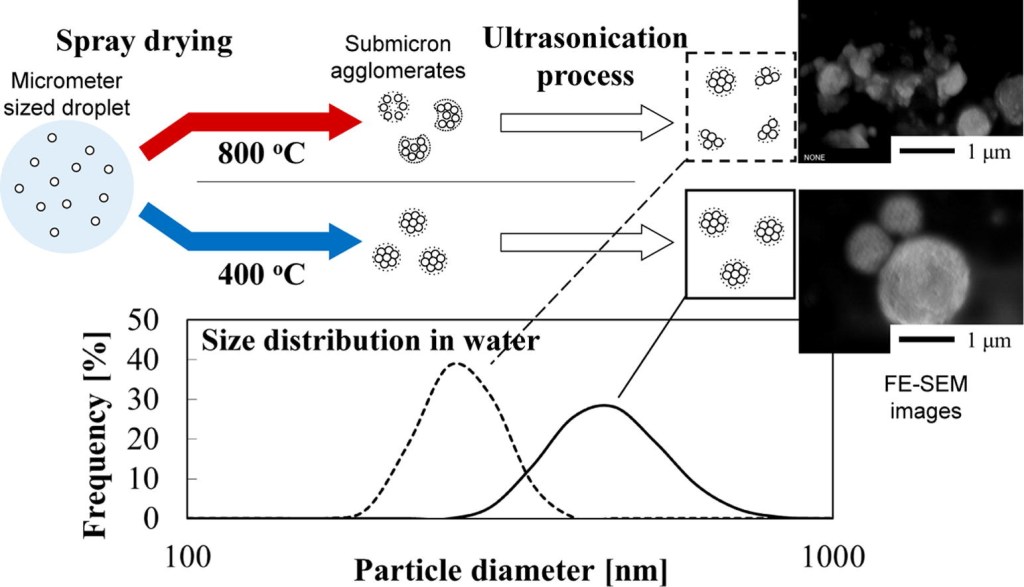
When nanoparticles are dried into powder, they often stick together and form agglomerates—clumps that are hard to break apart. ナノ粒子を乾燥して粉末にすると、粒子同士が強く結合し、凝集体(かたまり)になります。これを壊すのは難しい。
Our breakthrough
We were the first to show that a low-power ultrasonic cleaner (like those used for jewelry) can break apart these clumps in water. The device uses sound waves to create collapsing bubbles (cavitation) that release energy strong enough to shake particles loose. 市販の低出力超音波洗浄機で水中の凝集体を壊せることを示しました。超音波によるキャビテーション気泡の崩壊が強いエネルギーを生み、粒子を分散させます。
Key findings
- Shape matters:形状がカギ
- Spherical clumps resist breaking. 球状の凝集体は壊れにくい
- Dent- or doughnut-shaped clumps break easily. くぼみやドーナツ状は壊れやすい
- Cavitation energy distribution depends on agglomerate shape. 気泡崩壊のエネルギー分布は形状に依存します。
Why it matters なぜ重要?
- Simple, eco-friendly method for powder processing. 簡単で環境に優しい粉体処理法
- Useful for pharmaceuticals, ceramics, nanotechnology. 医薬品、セラミックス、ナノテク分野に応用可能
(Advanced Powder Technology, DOI: https://doi.org/10.1016/j.apt.2022.103543)
Download: Full article (著者の最終原稿)
第1著者が在学生で、インドネシアのパジャジャラン大学(UnPad)物理学科教員になった卒業生、マレーシア工科大学(UTM)環境化学工学科教員になった卒業生との共同研究の成果です。The first author was a student, and this was the result of joint research with a graduate who became a faculty member of the Department of Physics at Universitas Padjadjaran (Indonesia) and a graduate who became a faculty member of the Department of Environmental Chemical Engineering at Universiti Teknologi Malaysia.
Download: Full article (authors’ final version)
Advanced Powder Technology https://doi.org/10.1016/j.apt.2022.103543
Deagglomeration of spray-dried submicron particles by low-power aqueous sonication
(This article was invited for Virtual Special Issue of APT2021: the 8th Asian Particle Technology Symposium)
Sound-Powered Particle Control: Breaking Clumps with Cavitation”「音の力で粒子を制御:キャビテーションで凝集体を破壊」
Summary: We developed a method to break submicron particle clumps using a simple ultrasonic cleaner in water. This eco-friendly approach uses cavitation bubbles to fragment agglomerates, revealing how particle shape influences energy balance. Applications span pharmaceuticals, ceramics, and advanced materials.
 "Particles & Transfer" Lab. 粒子・移動現象研究室