SAUC Technology (Soot-Assisted Ultrasonic Collector) World’s First: Sub-micron Particle Recovery Using Ultrasonic Treatment”
世界初:すす懸濁液を用いた超音波処理によるサブミクロン粒子の基板からの回収技術
私たちの研究グループは、固体基板に付着した微細な粒子を液体中へ効率的にはく離・回収する、”simple”方法を開発しました。この技術は、低出力の超音波と、「ろうそくのすす」を混ぜた懸濁液を組み合わせることで、従来法よりも優れた粒子のはく離と回収を可能にします。
【研究のきっかけ】
この研究の最も重要な核となる「すす懸濁液を用いる」というアイデアは、当研究室の学部学生(卒論)によるひらめきから生まれました。この独創的な発想が、その後の研究開発の出発点となっています。
この研究が解決する課題
シリコンウェハーやフィルターなどに付着した数百ナノメートル(サブミクロン)サイズの微粒子を、傷つけずに効率的にはがし、液体中に回収することは、様々な産業や分析現場で重要な課題です。私たちは、この課題に着目しました。
革新的な方法:すす懸濁液の利用
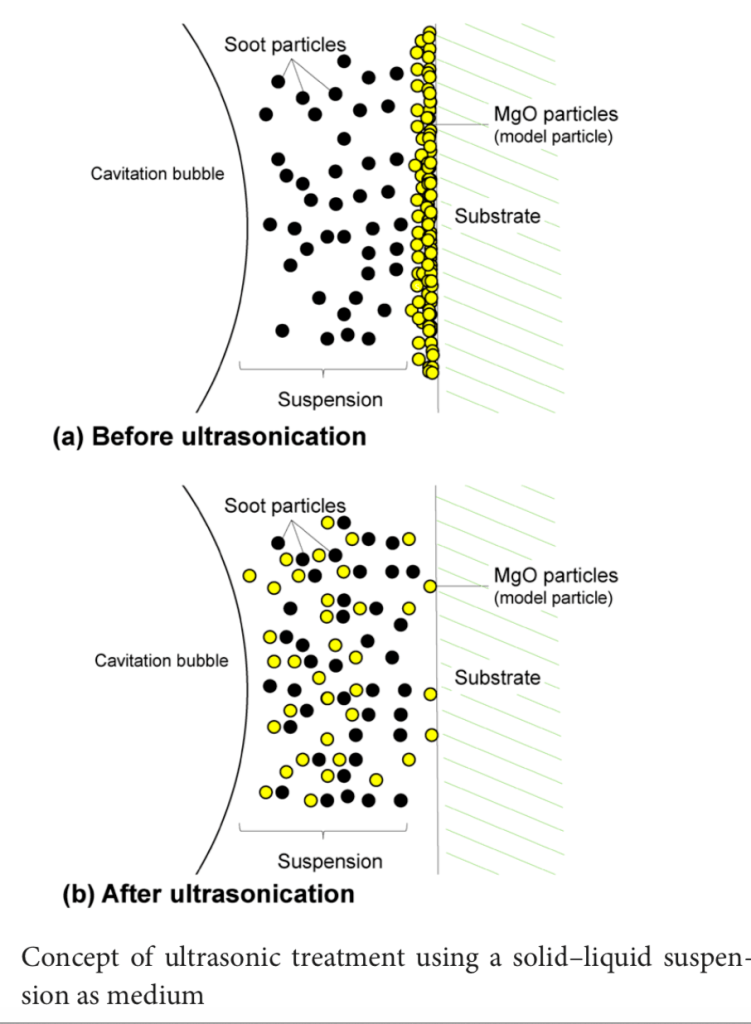
従来の超音波洗浄では、界面活性剤が使われてきました。私たちの方法では、これらに代えて「すすの微粒子が分散した液体(すす懸濁液)」を超音波の伝播媒体として使用します。
超音波により液体中で発生する「キャビテーション気泡」が振動・崩壊する際のエネルギーが、すす粒子を基板方向に押し出します。このすす粒子がハンマーのように、基板に付着した目的の粒子(本研究では酸化マグネシウム)をたたいてはく離する、という新しいメカニズムを提案しています。
研究成果:すすがはく離効率を飛躍的に向上
- すすを加えることで、シリコンウェハーや粗さの異なるアルミナシートなど、様々な基板ではく離効率が向上しました。
- すすの濃度には「最適値」が存在し、濃すぎても薄すぎても効果が低下することが明らかになりました。これは、すす粒子が多すぎると超音波のエネルギーを吸収してしまうためと考えられます。
- はく離された粒子は、すす懸濁液中で良好に分散され、その後の分析や材料としての利用に適した状態で回収できました。
今後は?
この方法は、半導体のように「無菌・無粒子」が要求される洗浄には向かないかもしれません。しかし、「付着した粒子自体を回収したい」場面では極めて有効です。
応用例:
- 環境調査でフィルターに捕集した微粒子の分析
- 触媒や機能性材料を作る工程の中間段階での粒子回収
- 文化財の洗流において、表面から剥離した有害粒子を液体中に封じ込める
まとめ
私たちは、超音波洗浄の常識を変える、「すす懸濁液」を用いた新しいサブミクロン粒子のはく離・回収技術を開発しました。学部学生のひらめきから始まったこの世界初のアプローチは、粒子の再利用や高度な分析を必要とする、様々な研究開発や産業分野に新たな可能性を提供するものと期待しています。
Full paper: doi.org/10.1252/jcej.16we319
A World First: Recovery of Submicron Particles from Substrates Using an Ultrasonic Method with a Soot Suspension
Our research group has developed a groundbreaking method to efficiently detach and collect fine particles from solid substrates into a liquid medium. This innovative technique combines low-power ultrasound with a “candle soot suspension” to achieve superior particle detachment and collection compared to conventional methods.
【Origin of the Idea】
The core idea of “using a soot suspension” – the most crucial aspect of this research – was originally sparked by an undergraduate student in our lab. This creative insight became the starting point for our subsequent research and development.
The Problem We Aimed to Solve
Efficiently and gently detaching submicron-sized particles (hundreds of nanometers) from substrates like silicon wafers or filters without causing damage, and collecting them in a liquid, is a significant challenge in various industries and analytical fields. This research addresses that challenge.
The Innovative Method: Utilizing a Soot Suspension
While conventional ultrasonic cleaning uses water or surfactant solutions, our method employs a “liquid dispersed with fine soot particles (a soot suspension)” as the ultrasonic propagation medium.
We propose a new mechanism: the energy from the vibration and collapse of “cavitation bubbles” generated by ultrasound pushes the soot particles towards the substrate. These soot particles then act like tiny hammers, knocking the target particles (in this study, magnesium oxide) off the substrate.
Key Findings: Soot Dramatically Enhances Detachment Efficiency
- The addition of soot improved detachment efficiency across various substrates, including silicon wafers and alumina sheets with different roughness levels.
- We discovered an “optimal concentration” for the soot. Both higher and lower concentrations reduced the effect, likely because excessive soot absorbs ultrasonic energy.
- The detached particles were well-dispersed in the soot suspension, allowing them to be collected in a state suitable for subsequent analysis or use as material.
Future Applications Unlocked by This Technique
Probably, this method is not suitable for cleaning requiring absolute purity, like in semiconductor manufacturing. However, it is highly effective for scenarios where “the adhered particles themselves need to be collected.”
Potential Applications:
- Analysis of fine particles collected on filters in environmental monitoring.
- Recovery of particles at intermediate stages in the production of catalysts or functional materials.
- Conservation of cultural properties, where harmful particles detached from surfaces can be trapped in the liquid.
Conclusion
We have developed a world-first, novel technique for detaching and collecting submicron particles using an ultrasonic method with a soot suspension, challenging the conventional wisdom of ultrasonic cleaning. We believe this new approach holds great promise for various R&D and industrial fields that require particle reuse or advanced analysis.

Collaborator in this study: Prof. Koji Masuda. 桝田教授(生体医用システム工学科)Department of Biomedical Engineering TUAT https://web.tuat.ac.jp/~biome/lab_Masuda.htm
Short Introduction of our other papers – 研究室が発表した論文の紹介 (empatlab.net)
 "Particles & Transfer" Lab. 粒子・移動現象研究室