🌿植物の気孔サイズの謎と、新しい粒子浸透技術 ESPI の発見
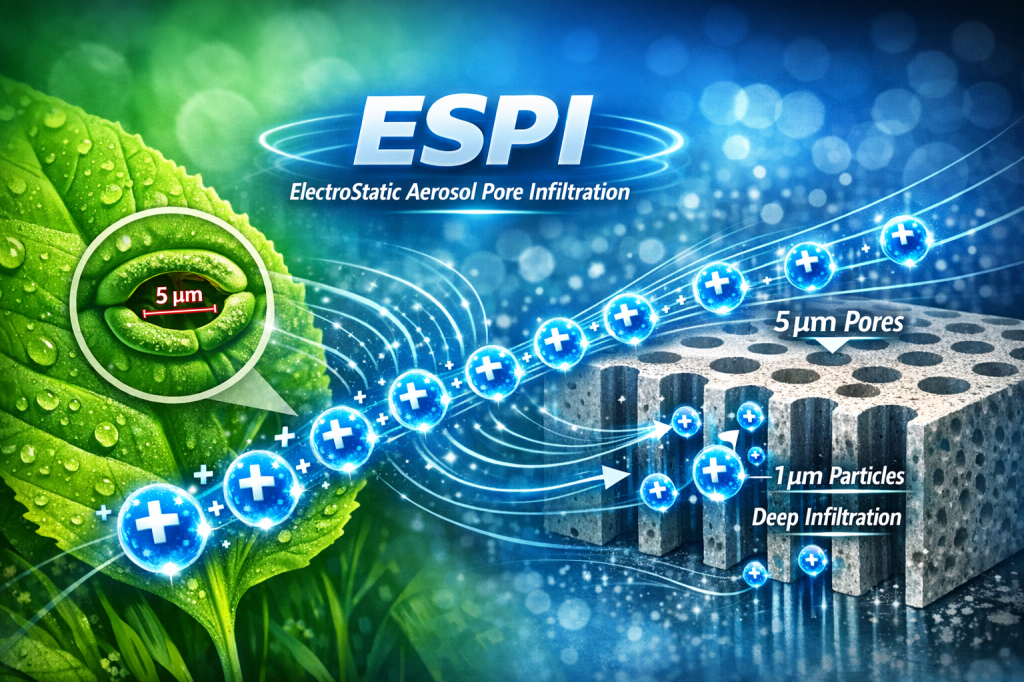
Lenggoro研究室は、植物葉の気孔(stomata)が 微小粒子(1 µm以下)を通さない理由を解明するとともに、その研究過程で 新しい粒子浸透技術「ESPI(ElectroStatic Aerosol Pore Infiltration / 静電エアロゾル細孔浸透技術)」 を発見しました。
■ 植物の“2つの謎”
植物の気孔は 約 5 µm の大きさですが、大気中には非常に多くの1 µm未満の粒子(PM1)が存在しています。
それにもかかわらず、
- 葉の内部から PM1 が検出された例がほとんどない
- 気孔サイズの生物学的意味が十分に説明されていない
という疑問が長年残されていました。
■ 研究で明らかになったこと
静電エアロゾル技術を使った実験により、以下が判明しました:
- 強い電荷を帯びた ~1 µm 粒子だけが、気孔相当サイズ(約 5 µm)の穴に侵入する
- しかし自然界には、そのような 高電荷の粒子は存在しない
- したがって 大気中の微小粒子が気孔内部に入ることは起こらない
結果として、
気孔はガス交換のために最適化されており、粒子の入口ではない
という明確な物理的結論に到達しました。
さらに、もし気孔が 1 µm 程度まで小さく進化していた場合、水滴の表面張力により気孔が塞がり、植物が“呼吸不能”になる可能性があることも示唆されました。
■ 新技術:ESPI(静電エアロゾル細孔浸透技術)の誕生
この研究を進める中で、チームは次の重要な発見に至りました:
- 高電荷 1 µm 粒子は、人工の多孔質材料(AAO)の 5 µm 細孔の奥深く(~130 µm)まで到達する
- この現象を制御すれば、粒子をマトリックス内部へ能動的に組み込む「新しい材料プロセス」になる
この成果が ESPI(ElectroStatic Aerosol Pore Infiltration)=静電エアロゾル細孔浸透技術 という新しい技術概念につながりました。
ESPI は、金属・セラミックス・高分子など様々な材料に応用可能で、微粒子の深部組み込み、複合材料の創製、多孔質構造の精密加工といった技術への展開が期待されます。
■ 本生物学と材料科学の境界領域にまたがる成果となりました。
🌿 Solving the Mystery of Stomatal Size—and Discovering a New Technology (ESPI)
A research team led by Prof. Lenggoro has solved a long‑standing question in plant biology: Why do submicron atmospheric particles never enter plant leaves, even though stomatal pores are much larger (around 5 µm)?
During this investigation, the team also discovered a new particle‑infiltration technology,
ESPI: ElectroStatic Aerosol Pore Infiltration, which enables micrometer‑scale particles to penetrate deep into micrometer‑sized pores.
■ Two Mysteries in Plant–Aerosol Interaction
- Stomata ≈ 5 µm
- Atmospheric fine particles (PM1) < 1 µm
Yet:
- No PM1 particles have ever been found inside leaves, and
- The functional meaning of stomatal size has remained unclear.
■ Key Discovery: Only Highly Charged 1‑µm Aerosols Can Enter the Pores
Using an electrospray‑based aerosol system, the team demonstrated:
- Only strongly charged ~1 µm particles can enter a 5 µm pore (stomata‑sized opening)
- Such highly charged particles do not exist in the natural atmosphere
- Therefore, submicron particles cannot penetrate stomata in nature
This leads to the fundamental conclusion:
Stomata are evolutionarily optimized for gas exchange—not for particle entry.
The study also suggests that if stomata were as small as ~1 µm, surface‑tension effects from water droplets could block the pores, preventing gas exchange and respiration, which would threaten plant survival.
■ Discovery of ESPI: A Novel Material‑Processing Technology
An unexpected breakthrough emerged during the experiments:
- Highly charged 1‑µm particles can penetrate deeply (up to ~130 µm) into 5‑µm pores of anodic aluminum oxide (AAO)
- This behavior can be intentionally controlled
This led to the proposal of a new aerosol‑based materials technology:
ESPI – ElectroStatic Aerosol Pore Infiltration
A technique for assembling micrometer‑scale particles deep inside micrometer‑sized porous matrices
ESPI offers new possibilities for:
- creating advanced composite materials
- designing functional porous structures
- embedding particles in metal/ceramic/polymer matrices
■ This study not only clarifies the biological meaning of stomatal size but also introduces a novel particle‑assembly technology (ESPI) that bridges plant physiology, aerosol science, and materials engineering.
さらに本研究(Kusdianto et al., 2014)は、仮に気孔が ~1 µm 程度まで小型化していた場合、水滴の表面張力が強く作用して開口部が容易に封止(ピン止め)され、気体拡散が実質的に止まることを物理的に示唆する。ミクロ開口における液滴の広がり・後退・ピン止めは表面張力主導であり、数 µm スケールでは封止が生じやすいことが微小液滴と粗面(微細構造)界面の研究から示されている。 その結果としてCO₂ 取り込みと蒸散が抑制され、葉のガス交換が機能不全に陥る。モデル・生理学研究は、わずかな水理的・機械的制約でも気孔コンダクタンスが急減しうることを示しており、微小化した気孔ほどリスクが高い。 したがって、典型的な 5 µm 前後の気孔サイズは、ガス交換効率を確保しつつ水滴による機械的閉塞を回避するという進化的な最適化の産物と考えられる。
Moreover, our study suggests that if stomata were as small as ~1 µm, surface‑tension forces would dominate at that scale, pinning or sealing a water film over the pore and effectively halting gas diffusion. Experiments and simulations on micrometer‑scale droplets interacting with micro‑rough surfaces show that spreading, retraction, and pore blocking are strongly governed by surface tension at micrometer dimensions. Consequently, CO₂ uptake and transpiration would be suppressed, leading to gas‑exchange failure. Plant physiological and modeling work further indicates that even modest hydraulic or mechanical limitations can rapidly reduce stomatal conductance—a risk that would be amplified for ultra‑small pores. Taken together, the typical ~5‑µm stomatal size appears to be an evolutionary optimization that preserves gas‑exchange capacity while avoiding water‑induced mechanical blockage.
Reference (for example) after this study (Kusdianto et al., 2014):
- Long Ke Jon, Stomatal Regulation: Control of Gas Exchange and Water Loss, Cell & Developmental Biology, Volume 13, Issue 4, No:1000359 (2024). open-access 10.35248/2168-9296.24.13.359
- Jiao, Q., Bai, H., Zada, A. et al. Intrinsic Signaling Pathways and key Regulatory Factors of Stomatal Development. J. Plant Biol. 67, 185–194 (2024). https://doi.org/10.1007/s12374-024-09427-7
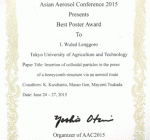
2015 June:
Best Poster Award at 9th Asian Aerosol Conference
Insertion of colloidal particles in the pores of a honeycomb structure via an aerosol route (気中に分散した液中微粒子のハニカム型多孔質体細孔内への沈着)
K. Kusdianto, M. Gen, M. Tsukada, W. Lenggoro
Related journal paper: https://doi.org/10.4164/sptj.51.759 エアロゾル法によるハニカム型多孔質体細孔内への粒子沈着

この研究のきっかけは、大気中に浮遊した微粒子が植物の葉の気孔に「詰まる」現象に着目した時。粒子径との気孔のサイズとの関係やその輸送の推進力について仮説が必要でした。大気中の微粒子の輸送において、私たちは「静電気力」も大事な推進力であることを提案しています。
A spray-based gas-phase method was proposed to insert presynthesized particles into a honeycomb structure. The fabricated structure, based on anodic aluminum oxide (AAO), had pores with an average diameter of 5.5 μm. When the structure was conductively coated and connected with a negative voltage, the positively charged (~1 μm) particles were located deep inside the pore canal (with a depth up to 130 μm) of the structure. Numerical simulations also showed that the electrostatic effect is the main driving force for inserting the particles. 帯電エアロゾルを噴霧する気相法が提案され、ハニカム構造内に合成前の粒子を挿入した。陽極酸化アルミニウムをベースとして作製した構造体は、平均直径5.5μmの細孔を有していた。作製した構造体を導電性コーティングし、負電圧で接続すると、正に帯電した(~1μm) 粒子は、構造体の細孔管(深さ130μmまで)の奥深くに位置していた。構造体の細孔管深部(深さ130μmまで)に存在した。これらの挿入は走査型電子顕微鏡で観察され、蛍光顕微鏡でも確認された。数値シミュレーションでも、静電効果が粒子挿入の主な駆動力であることが示された。
植物環境における粒子状物質の輸送現象に関する研究 (東京農工大学(研究活動 研究要素集 研究要素集)

 "Particles & Transfer" Lab. 粒子・移動現象研究室