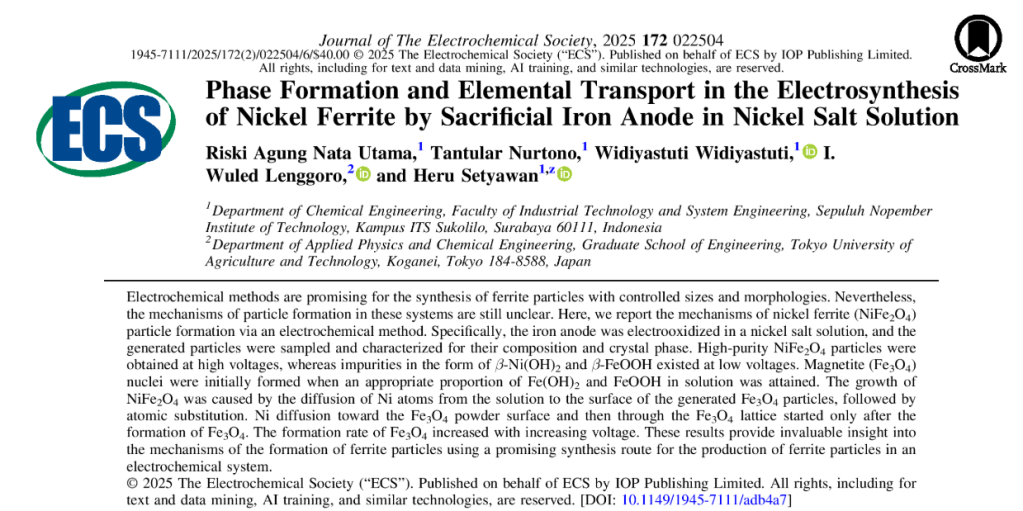
This research explores the electrochemical synthesis of nickel ferrite (NiFe2O4) particles, a process that holds promise for creating particles with controlled sizes and shapes. この研究は、制御されたサイズと形状を持つ粒子を作成するための有望なプロセスである、ニッケルフェライト(NiFe2O4)粒子の電解合成を探求しています。
Key Questions and Findings:
How are high-purity NiFe2O4 particles formed? 高純度のNiFe2O4粒子はどのように形成されるのか?
By electrooxidizing an iron anode in a nickel salt solution, high-purity NiFe2O4 particles were obtained at high voltages. At lower voltages, impurities such as -Ni(OH)2 and -FeOOH were present. 鉄陽極をニッケル塩溶液中で電解酸化することにより、高電圧で高純度のNiFe2O4粒子が得られました。低電圧では、-Ni(OH)2や-FeOOHなどの不純物が存在しました。
What initiates the formation of NiFe2O4? NiFe2O4の形成は何によって開始されるのか?
Initially, magnetite (Fe3O4) nuclei form when the right proportion of Fe(OH)2 and FeOOH is achieved in the solution. The growth of NiFe2O4 occurs as nickel atoms diffuse from the solution to the surface of Fe3O4 particles, followed by atomic substitution. 最初に、溶液中で適切な割合のFe(OH)2とFeOOHが達成されると、マグネタイト(Fe3O4)核が形成されます。NiFe2O4の成長は、ニッケル原子が溶液からFe3O4粒子の表面に拡散し、その後原子置換が行われることで起こります。
How does voltage affect the formation rate? 電圧は形成速度にどのように影響するのか?
The formation rate of Fe3O4 increases with higher voltage, facilitating the subsequent growth of NiFe2O4. Fe3O4の形成速度は電圧の上昇とともに増加し、その後のNiFe2O4の成長を促進します。
This study provides valuable insights into the mechanisms of ferrite particle formation, offering a promising synthesis route for producing high-quality ferrite particles through electrochemical methods. この研究は、フェライト粒子の形成メカニズムに関する貴重な洞察を提供し、電解法を用いた高品質なフェライト粒子の製造のための有望な合成ルートを示しています。
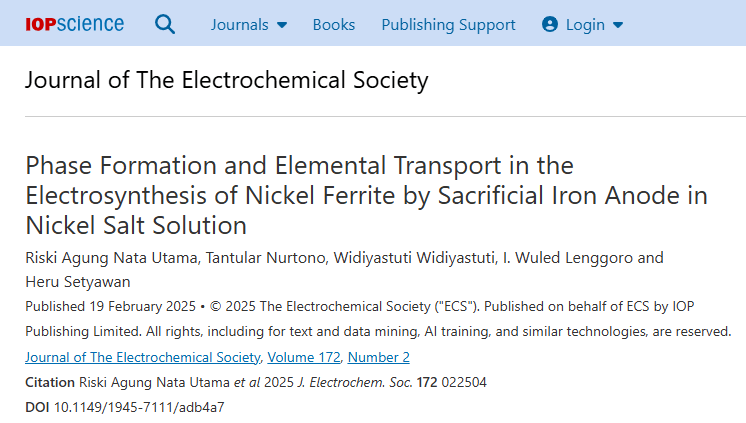
Publication: Phase Formation and Elemental Transport in the Electrosynthesis of Nickel Ferrite by Sacrificial Iron Anode in Nickel Salt Solution
Feb. 2025Journal of The Electrochemical Society DOI.org/10.1149/1945-7111/adb4a7
R. A. N. Utama, T. Nurtono, W. Widiyastuti, I. W. Lenggoro and H. Setyawan
Accepted Manuscript online 11 February 2025 • © 2025 The Electrochemical Society (“ECS”).
R. A. N. Utama was a TUAT visiting fellow (PhD student level) in 2023.
 "Particles & Transfer" Lab. 粒子・移動現象研究室