Researchers (mainly at Univ. Malaysia Sabah) have successfully isolated cellulose nanocrystals (CNCs) from solid seaweed waste (SSW) left over from carrageenan production. This innovative process transforms waste into a valuable nanomaterial with potential applications in various industries. 研究者たちは、寒天生産の副産物である固形海藻廃棄物(SSW)からセルロースナノクリスタル(CNC)の抽出に成功しました。このプロセスは、廃棄物を様々な産業で活用できる貴重なナノ材料に変換します。
Key Findings:
- CNCs were extracted using a modified one-pot oxidative-hydrolysis treatment CNCs は改良された一段階酸化加水分解処理法を用いて抽出されました.
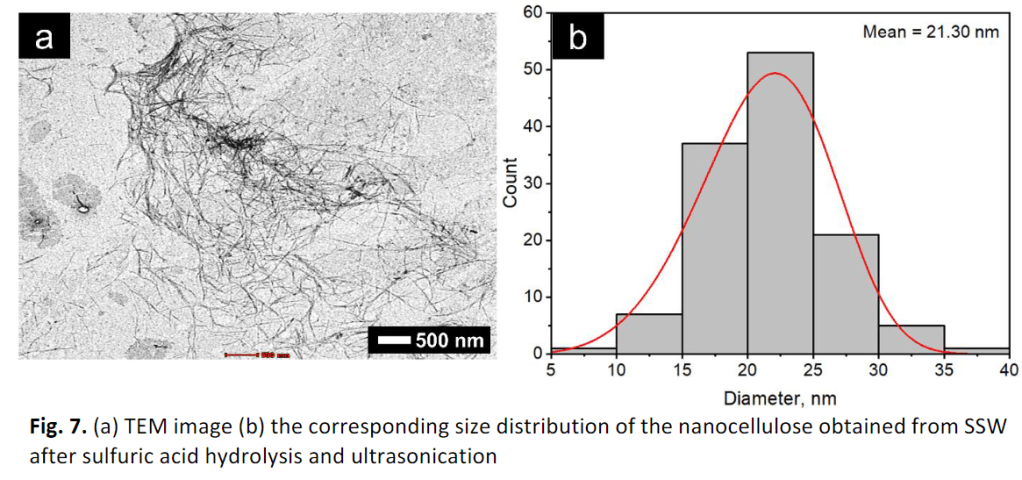
- The resulting CNCs had needle-like shapes ranging from 6 to 35 nm in size 得られた CNCs は針状で、サイズは6〜35 nmの範囲でした.
- Analysis confirmed high crystallinity and cellulose-rich content of the CNCs分析により、CNCs の高い結晶性とセルロース豊富な含有量が確認されました.
Potential Applications:
CNCs from seaweed waste could be used in:
- Flexible electronics フレキシブル電子機器
- Food packaging 食品包装
- Healthcare products ヘルスケア製品
- Construction materials 建築材料
- Automotive and electronics industries 自動車・電子産業
- Paper and textile enhancement 紙・繊維の品質向上
This research demonstrates a sustainable approach to producing nanomaterials from waste, contributing to the circular economy and reducing environmental impact. この研究は、廃棄物からナノ材料を生産する持続可能なアプローチを示し、循環型経済に貢献し、環境への影響を軽減します
https://doi.org/10.37934/armne.28.1.4759
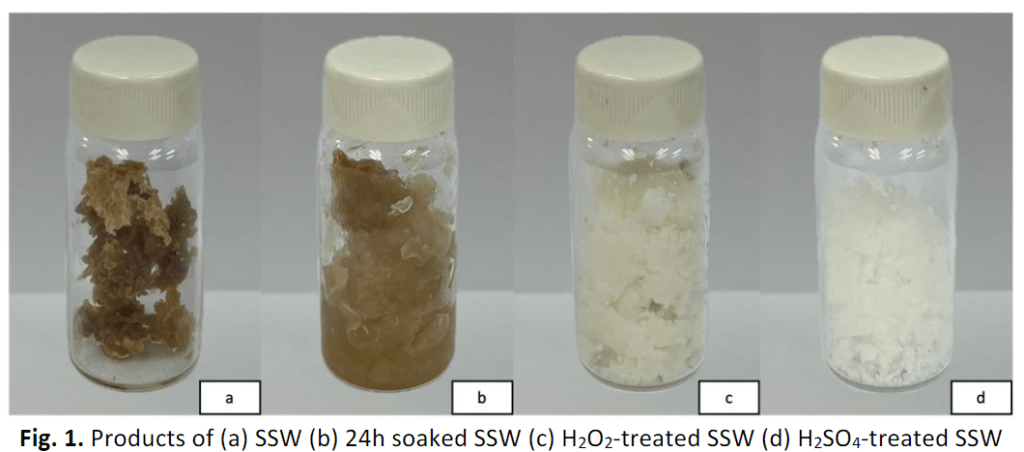
Cellulose nanocrystals (CNCs) are an intriguing class of bio-based nanoscale materials, desirable for a wide range of applications due to their remarkable physicochemical properties which include biocompatibility, biodegradability, renewability, low density, tuneable surface chemistry, optical transparency and improved mechanical properties. In this study, the solid seaweed wastes (SSW) obtained from carrageenan production were utilized to isolate CNCs using a modified one-pot oxidative-hydrolysis treatment. The physicochemical properties of the CNCs were further characterized using various methods including Fourier Transform Infrared Spectroscopy (FTIR), Energy Dispersive X-ray (EDX) analysis, X-ray Diffraction (XRD), Scanning Electron Microscopy (SEM), Transmission Electron Microscope (TEM) and Atomic Force Microscopy (AFM). The spectra analysis from FTIR and EDX reveals the removal of non-cellulosic components from the SSW after hydrolysis, along with high percentages of carbon and oxygen, implying the cellulose-rich content of the CNCs. The SEM, TEM and AFM analysis depicts the needle-like morphologies of CNCs with sizes ranging from 6 to 35 nm. The XRD analysis also reveals the high crystallinity of CNCs, which benefits its mechanical properties. This study demonstrates the potential for exploiting waste products from carrageenan extraction of red seaweed to obtain valuable CNCs which hold great potential for applications in areas such as flexible electronics and food packaging.
Isolation and Characterization of Cellulose Nanocrystals from Solid Seaweed Wastes
Jaffar, S. S., Saallah, S., Misson, M., Siddique, S., Roslan, J., & Lenggoro, W. (2024). Isolation and Characterization of Cellulose Nanocrystals from Solid Seaweed Wastes. Journal of Advanced Research in Micro and Nano Engineering, 28(1), 47–59. https://doi.org/10.37934/armne.28.1.4759
 "Particles & Transfer" Lab.