Enhancing the Photoelectrochemical Activity of CuO/ZnO Junction Photocathodes for Water Splitting
Authors: Riski Agung Nata Utama, Roida Nabila, Tantular Nurtono, W. Widiyastuti, Tiara Nur Pratiwi, I. Wuled Lenggoro, and Heru Setyawan, Langmuir 2024, 40, 52, 27635-27644. doi.org/10.1021/acs.langmuir.4c04163
The main researchers are the members of Institut Teknologi Sepuluh Nopember (ITS, a technological university in Surabaya, Indonesia). Tiara Nur Pratiwi graduated from ITS (Bachelor) and TUAT (Doctoral). Riski Utama was a visiting fellow at TUAT (four months in 2023)
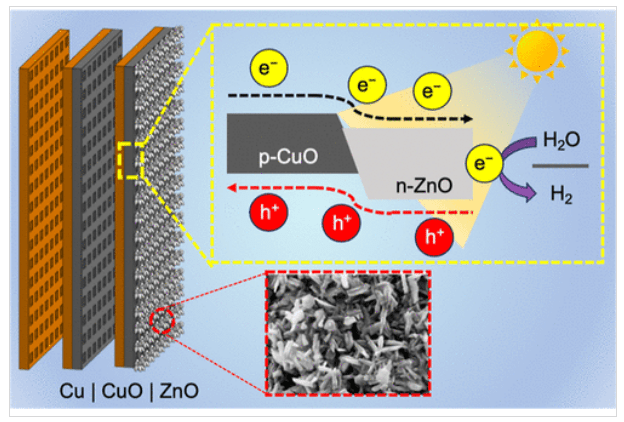
To aid in the fast transfer of photogenerated electrons, the CuO photocathode must be joined with another heterojunction material. This combination also helps keep surface stability. Here, we propose CuO/ZnO heterojunctions as photocathodes for photoelectrochemical (PEC) water splitting. First, CuO was grown on a Cu substrate. The substrate was in the form of foil or mesh gauge. This was done via anodization followed by postheating treatment. Next, ZnO was electrodeposited on the grown CuO. The grown CuO film was composed of two-dimensional nanoplates aligned vertically against the substrate. The film morphology changed to flower-like or nearly spherical when ZnO was deposited by electrodeposition. CuO/ZnO grown on the Cu mesh had a better PEC performance. This was based on its open-circuit potential (OCP), overpotential, and current density. The performance was superior to its counterpart grown on the Cu foil. When the mesh substrate was used, the surface area of the grown nanostructures was high and reached approximately 102.42 m2 g–1. The OCP of the CuO/ZnO mesh reached a low value of approximately −137 mV. This quantified value indicated that its PEC activity was more favorable for the hydrogen evolution reaction (HER). Moreover, for the Cu mesh, the overpotential at the benchmark current density of 10 mA cm–2 was 379 mV. It was lower than those of the other photocathode materials. 電子の高速移動と表面安定性を促進するため、CuO光陰極には別の異種接合材料と結合する必要があります。本研究では、光電気化学(PEC)水分解のためのCuO/ZnO異種接合光陰極を提案します。まず、銅基板(箔またはメッシュゲージ)上に、陽極酸化処理後の熱処理によりCuOを成長させました。次に、成長したCuO上にZnOを電気めっきで堆積させました。成長したCuOフィルムは、基板に対して垂直に配列された二次元ナノプレートで構成されていました。ZnOを電気めっきで堆積させると、フィルム形態は花弾状または近球状に変化しました。開回路電位(OCP)、過電圧、電流密度に基づいて、Cu メッシュ上に成長したCuO/ZnOは、Cu箔上に成長したものよりも優れたPEC性能を示しました。メッシュ基板を使用した場合、成長したナノ構造の表面積は約102.42 m2 g–1に達しました。CuO/ZnOメッシュのOCPは約−137 mVの低い値に達し、これはその水素発生反応(HER)に対する光電気化学活性がより有利であることを定量的に示しました。さらに、基準電流密度10 mA cm–2におけるCuメッシュの過電圧は379 mVであり、これは他の光陰極材料の値よりも低いものでした。
Q1: What is the main focus of the research?
A1: The research focuses on enhancing the performance of copper oxide (CuO) photocathodes for photoelectrochemical (PEC) water splitting by coupling them with zinc oxide (ZnO) to form CuO/ZnO heterojunctions.
Q2: Why is it important to couple CuO with another material?
A2: Coupling CuO with another material, like ZnO, facilitates fast transfer of photogenerated electrons and improves surface stability, which are crucial for efficient hydrogen production.
Q3: How was the CuO/ZnO heterojunction synthesized?
A3: CuO was grown on a copper substrate through anodization followed by post-heating treatment. ZnO was then electrodeposited onto the grown CuO film.
Q4: What notable changes occurred in the morphology of the material during synthesis?
A4: The CuO film initially consisted of vertically aligned two-dimensional nanoplates. After ZnO deposition, the morphology changed to flower-like or nearly spherical structures.
Q5: What were the performance results of the CuO/ZnO heterojunctions?
A5: The CuO/ZnO heterojunctions grown on a copper mesh exhibited better PEC performance compared to those grown on a copper foil, with a significant surface area of approximately 102.42 m²/g.
Q6: What were the key metrics indicating improved performance?
A6: The open-circuit potential (OCP) for the mesh configuration was about -137 mV, indicating favorable conditions for hydrogen evolution reactions (HER). Additionally, the overpotential at a benchmark current density of 10 mA/cm² was recorded at 379 mV, which is lower than that of other photocathode materials.
Q7: What are the implications of this research?
A7: This study suggests that CuO/ZnO heterojunctions could significantly enhance photocathode efficiency in PEC systems, potentially leading to advancements in sustainable hydrogen production technologies.

 "Particles & Transfer" Lab.