ONLINE Presentation the 5th International Conference on Biosciences 2023 (IPB University, Indonesia, August 2-3) /page/icobio
by A. A. Sembada & I. W. Lenggoro
https://doi.org/10.1088/1755-1315/1271/1/012085
Comparative analysis of germination performance from several species of seeds under influence of silica nanoparticles 二酸化ケイ素(シリカ)ナノ粒子: 数種の種子の発芽への影響の比較
We have also investigated: red chili pepper, cayenne pepper, cucumber, eggplant, tomato, carrot. 赤唐辛子、カイエンペッパー(香辛料の一種)、キュウリ、ナス、トマト、ニンジン.
Keywords: コロイド、二酸化ケイ素、セリ科、ウリ科、ナス科
Abstract
The first and most critical phase in growing crops is seed germination. Failure and slower germination process may have an impact on productivity. As a result, numerous strategies are needed to hasten germination and improving the quality of the seedlings. One possible strategy is the use of nanoparticles. This present study used colloidal silica nanoparticles (8 – 10 nm) with concentrations of 0 (control), 100, and 1000 mg/L. Seeds from six different species were used (Capsicum annuum, Capsicum frutescens, Cucumis sativus, Solanum melongena, Solanum lycopersicum, and Daucus carota). Seeds were germinated in dark condition for eight consecutive days. The result showed that the use of silica nanoparticles may shorten the germination time while increasing the germination index and coefficient of velocity of germination in C. annuum, C. frutescens, C. sativus, and S. lycopersicum. However, the observed effect was not very strong compared to the control. This could be due to the seeds utilized were not in dormant stage and had rather high viability. On the other hand, we found that silica nanoparticles could alter the structure of the seed coat, allowing for easier water imbibition for germination.
種子の発芽は、作物を育てる上で最初で最も重要な段階です。失敗や遅い発芽プロセスは生産性に影響を与える可能性があります。そのため、多くの戦略が必要であり、発芽を促進し、苗の品質を向上させることが求められます。その1つの可能性のある戦略は、ナノ粒子の使用です。本研究では、コロイドシリカナノ粒子(8-10nm)を0(対照群)、100、および1000mg / Lの濃度で使用しました。6つの異なる種類の種子を使用しました(Capsicum annuum、Capsicum frutescens、Cucumis sativus、Solanum melongena、Solanum lycopersicum、およびDaucus carota)。種子は、暗い条件下で8日間発芽させました。その結果、シリカナノ粒子の使用は、C. annuum、C. frutescens、C. sativus、およびS. lycopersicumの発芽時間を短縮し、発芽指数と発芽速度係数を増加させる可能性があることが示されました。ただし、観察された効果は、対照群と比較してあまり強くありませんでした。これは、使用された種子が休眠期になく、かなり高い生存率を持っていたためかもしれません。一方、シリカナノ粒子は種皮の構造を変化させ、発芽のための水の吸収を容易にすることができることがわかりました。
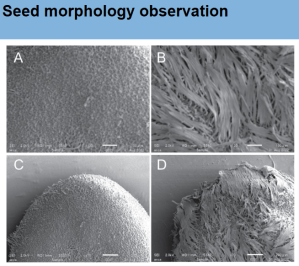
- Paper is published in: IOP Conference Series: Earth and Environmental Science (Scopus Indexed Proceeding) https://iopscience.iop.org/article/10.1088/1755-1315/1271/1/012085
- or https://doi.org/10.1088/1755-1315/1271/1/012085
 "Particles & Transfer" Lab.