English follows Japanese
研究を使った次世代対応型教育へ
日本エアロゾル学会「エアロゾル研究」巻頭言 の原稿) Wuled Lenggoro (2019)
私がエアロゾル(気体中に浮遊する微粒子)の研究と出会ってから約10年が過ぎた頃のことです。国家プロジェクトに関わる中で自分たちが開発する「テクノロジー」はどの国のモノとなるかが気にかかるようになりました。日本から24時間以上離れたある鉱物の採掘現場に足を運んだとき、そこで暮らす人々の生活や環境破壊を目にしました。一方、研究開発サイトである日本では、鉱物成分を用いた材料の性能を向上することであり、そのゴールは自動車や携帯型電子機器の性能向上であるという現状に疑問を感じました。自分が関わっている、生活の利便性を優先しそれが新たな競争を生むという現状の教育システムに、このままでは次の世代の何かが失われていくような気がしました。
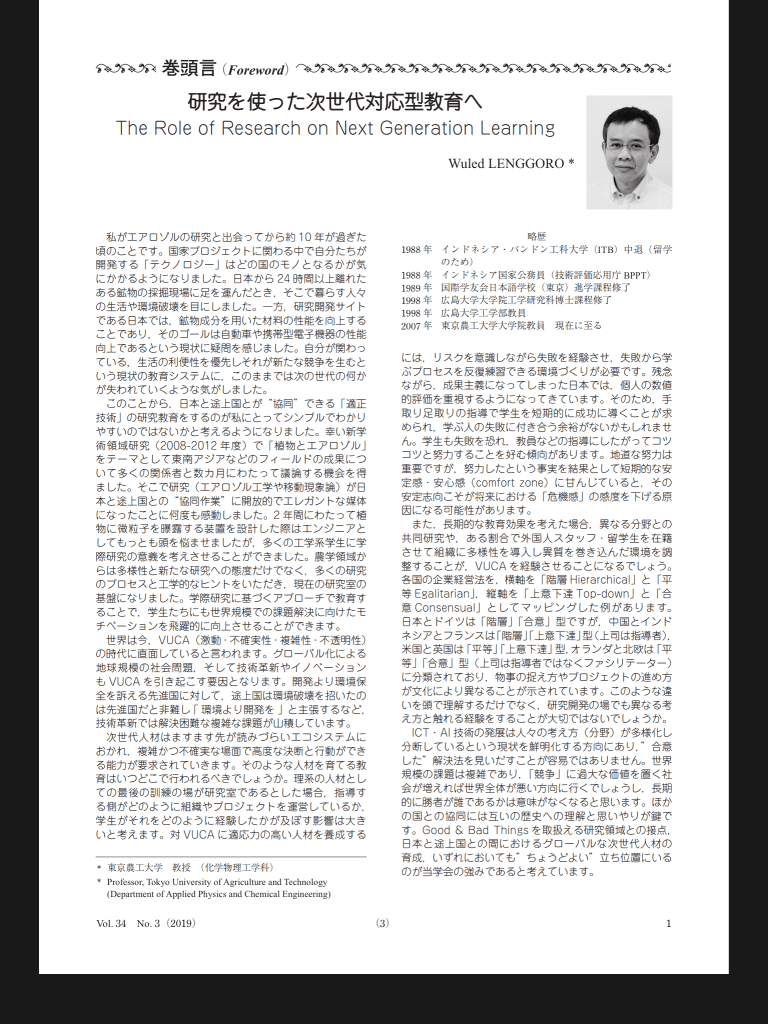
このことから、日本と途上国とが“協同”できる「適正技術」の研究教育をするのが私にとってシンプルでわかりやすいのではないと考えるようになりました。幸い新学術領域研究(2008-2012年度)で「植物とエアロゾル」をテーマとして東南アジア等のフィールドの成果について多くの関係者と数カ月にわたって議論する機会を得ました。そこで研究(微粒子工学や移動現象論)が日本と途上国との“協同作業”に開放的でエレガントな媒体になったことに何度も感動しました。微粒子を植物に暴露するシステムを設計した際はエンジニアとして最も頭を悩ませましたが、多くの工学系学生に学際研究の意義を考えさせることができました。農学領域からは多様性と新たな研究への態度だけでなく、多くの研究のプロセスと工学的なヒントをいただき、現在の研究室の基盤になりました。学際研究に基づくアプローチで教育することで、学生たちにも世界規模での課題解決に向けたモチベーションを飛躍的に向上させることができます。
世界は今、VUCA(激動・不確実性・複雑性・不透明性)の時代に直面していると言われます。グローバル化による地球規模の社会問題、そして技術革新やイノベーションもVUCAを引き起こす要因となります。開発より環境保全を訴える先進国に対して、途上国は環境破壊を招いたのは先進国だと非難し「環境より開発を」 と主張するなど、技術革新では解決困難な複雑な課題が山積しています。
次世代人材はますます先が読みづらいエコシステムにおかれ、複雑かつ不確実な場面で高度な決断と行動ができる能力が要求されていきます。そのような人材を育てる教育はいつどこで行われるべきでしょうか。理系の人材としての最後の訓練の場が研究室であるとした場合、指導する側がどのように組織やプロジェクトを運営しているか、学生がそれをどのように経験したかが及ぼす影響は大きいと考えます。対VUCAに適応力の高い人材を養成するには、リスクを意識しながら失敗を経験させ、失敗から学ぶプロセスを反復練習できる環境づくりが必要です。残念ながら、成果主義になってしまった日本では、個人の数値的評価を重視するようになってきています。そのため、手取り足取りの指導で学生を短期的に成功に導くことが求められ、学ぶ人の失敗に付き合う余裕がないかもしれません。学生も失敗を恐れ、教員等の指導に従ってコツコツと努力することを好む傾向があります。地道な努力は重要ですが、努力したという事実を結果として短期的な安定感・安心感(comfort zone)に甘んじていると、その安定志向こそが将来における「危機感」の感度を下げる原因になる可能性があります。
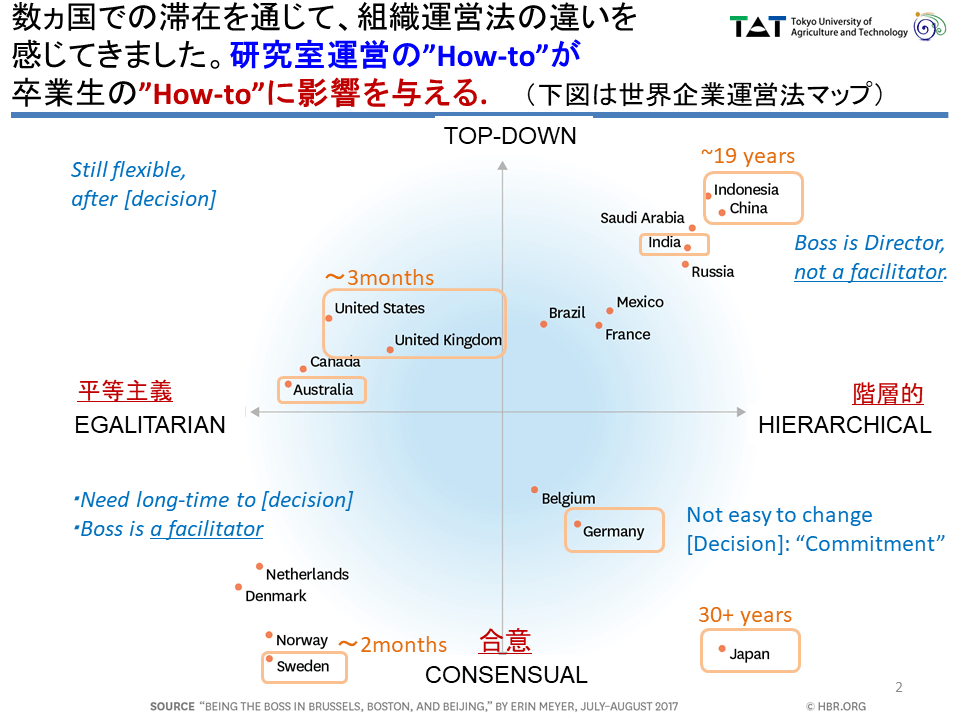
また、長期的な教育効果を考えた場合、異なる分野との共同研究や、ある割合で外国人スタッフ・留学生を在籍させて組織に多様性を導入し異質を巻き込んだ環境を調整することが、VUCAを経験させることになるでしょう。各国の企業経営法を、横軸を「階層Hierarchical」と「平等Egalitarian」、縦軸を「上意下達Top-down」と「合意Consensual」としてマッピングした例(E. Meyer, 2017)があります。日本とドイツは「階層」「合意」型ですが、中国とインドネシアとフランスは「階層」「上意下達」型(上司は指導者)、米国と英国は「平等」「上意下達」型、オランダと北欧は「平等」「合意」型(上司は指導者ではなくファシリテーター)に分類されており、物事の捉え方やプロジェクトの進め方が文化により異なることが示されています。このような違いを頭で理解するだけでなく、研究開発の場でも異なる考え方と触れる経験をすることが大切ではないでしょうか。
ICT・AI技術の発展は人々の考え方(分野)が多様化し分断しているという現状を鮮明化する方向にあり、”合意した”解決法を見いだすことが容易ではありません。世界規模の課題は複雑であり、「競争」に過大な価値を置く社会が増えれば世界全体が悪い方向に行くでしょうし、長期的に勝者が誰であるかは意味がなくなると思います。他の国との協同には互いの歴史への理解と思いやりが鍵です。
(2019/7/ 日本エアロゾル学会会誌「エアロゾル研究」巻頭言へ投稿する予定)
/tag/essay/ (by Wuled Lenggoro)
The Role of Research in Educating the Next Generation
Preface, Journal of the Japan Association of Aerosol Science and Technology (2019)
Wuled Lenggoro
It was nearly ten years after I first encountered aerosol research—studies of fine particles suspended in gases—that I began to ask myself a fundamental question: to which country does the technology we develop ultimately belong?
While participating in a national research project, I visited a mineral mining site located more than twenty-four hours away from Japan. There, I witnessed not only severe environmental degradation but also the daily lives of people whose livelihoods were shaped by that reality. In contrast, back in Japan, research and development focused on improving the performance of materials derived from those minerals, with final goals often linked to automobiles or portable electronic devices. This contrast unsettled me.
I began to sense that an education system—one I myself was part of—that prioritizes convenience, efficiency, and competition might be risking the loss of something essential for the next generation if left unchanged.
This experience led me to believe that engaging in research and education on appropriate technology, in which Japan and developing countries can genuinely collaborate, offered a clear and meaningful direction. Fortunately, through a large-scale government-funded project (2008–2012) focusing on Plants and Aerosols, I had opportunities to spend months discussing field-based research conducted in Southeast Asia with researchers from diverse backgrounds.
During those discussions, I was repeatedly struck by how research—particularly in particle technology and transport phenomena—could function as an open and elegant medium for collaboration between Japan and developing countries. Designing systems to expose plants to aerosol particles posed significant engineering challenges, yet these challenges became powerful educational opportunities. Engineering students were encouraged to confront the value of interdisciplinary research, while insights from agricultural sciences—regarding diversity, research attitudes, and experimental processes—ultimately shaped the foundation of my current research group.
Through education grounded in interdisciplinary research, students’ motivation to engage with global-scale challenges can be profoundly strengthened.
Today, we are often told that we live in an era defined by VUCA—volatility, uncertainty, complexity, and ambiguity. Globalization and rapid technological innovation have intensified social challenges rather than simplifying them. For instance, while developed countries emphasize environmental conservation, developing countries frequently point out that much of the environmental damage was historically caused by industrialized nations and insist on prioritizing development. Such tensions illustrate problems that cannot be resolved by technological innovation alone.
The next generation will increasingly find itself navigating ecosystems that are difficult to predict, requiring sound judgment and decisive action under conditions of uncertainty. This raises an important question: when and where should education for such capabilities occur?
If the final stage of training for science- and technology-oriented professionals takes place within research laboratories (at universities), then the manner in which supervisors manage organizations and projects—and how students experience those environments—has a lasting impact.
To cultivate individuals capable of adapting to VUCA environments, educational settings must allow students to take risks, experience failure, and repeatedly learn from those failures. However, in performance-driven systems such as Japan’s, increasing emphasis is placed on quantitative evaluation. As a result, supervisors are often expected to guide students toward short-term success through highly prescriptive instruction, leaving little room to engage deeply with students’ failures.
Students, in turn, may become risk-averse, preferring steady effort under close guidance. While diligence is undeniably important, excessive comfort derived from short-term stability can dull one’s awareness of future risks. Over time, such stability-oriented thinking may reduce sensitivity to emerging crises.
From a long-term educational perspective, diversity is essential. Collaboration across disciplines, along with the intentional inclusion of international researchers and students, introduces heterogeneity that allows individuals to experience uncertainty firsthand. Erin Meyer’s framework (2017), which maps organizational cultures across dimensions such as hierarchy versus egalitarianism and top-down versus consensual decision-making, illustrates how deeply culture shapes collaboration.
Understanding these differences intellectually is not enough. Meaningful learning occurs when individuals encounter and navigate contrasting perspectives directly within research and development environments.
Advances in ICT and AI technologies have amplified the fragmentation of perspectives across fields and societies, making consensus increasingly difficult to achieve. Global challenges are complex, and societies that place excessive value on competition risk moving in unproductive directions—where even identifying a “winner” becomes meaningless over time.
In this context, genuine collaboration across borders requires not only technical expertise, but also historical understanding and empathy. These qualities, cultivated through research-based education, may be among the most important legacies we pass on to the next generation.

 "Particles & Transfer" Lab. 粒子・移動現象研究室