Highlights:
- Faster Germination: 10⁻³ wt% soot treatment accelerates germination in Capsicum, Tomato, and Eggplant. 煤処理でトウガラシ、トマト、ナスの発芽が加速。
- Water Uptake: Hydrophilic soot layer enhances moisture retention. 親水性のスス層が保湿性を高めます。
- Metabolic Shift: Starch ↓, Soluble Sugar ↑ → Better energy mobilization. 代謝変化:デンプン↓、可溶性糖↑ → エネルギー移動が促進。
- Biocompatibility: No harmful elemental changes in seedlings. 生体適合性:苗に有害な元素変化なし。
- Sustainability: Low-cost, eco-friendly, scalable solution for agriculture. 持続可能性:低コスト・環境に優しく、農業への応用が可能。
煤が種子の成長を助ける?
私たちの最新研究では、キャンドル煤由来の炭素系粒子(煤)が、ナス科の3種(トウガラシ、トマト、ナス)の種子発芽に与える影響を調査しました。
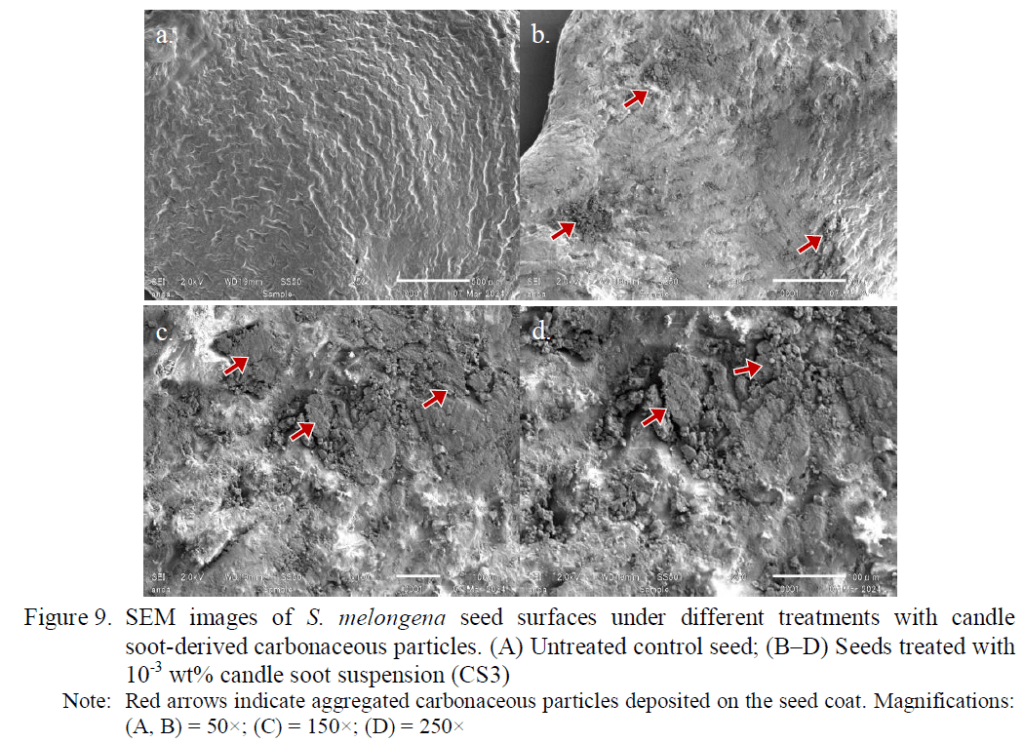
これまでの研究を踏まえ、煤が発芽を促進するだけでなく、水分輸送とデンプン-糖代謝にも重要な役割を果たすことを発見しました。10⁻³ wt%の煤懸濁液で処理した種子は、より早く発芽し、苗の活力も向上しました。電子顕微鏡(SEM)画像では、種子表面に形成された親水性の薄い煤層が、水分保持を助けていることが確認されました。
生化学分析では、煤処理された種子はデンプンをより速く消費し、可溶性糖の生成が増加しました。これは、α-アミラーゼなどの酵素活性や、(活性酸素種)ROSシグナル伝達経路への影響を示唆しています。
さらに、元素分析では苗の生理状態に悪影響がないことが示され、キャンドル燃焼由来煤の生体適合性が確認されました。
この低コストで環境に優しい手法は、循環型経済の理念に合致し、特に資源が限られた地域における有望な種子処理技術となる可能性があります。
Can soot help seeds grow better?
In our latest study, we explored how carbonaceous particles from candle soot influence seed germination in three Solanaceae species: Capsicum annuum, Solanum lycopersicum, and Solanum melongena.
Building on our previous work, we discovered that soot particle not only accelerates germination but also plays a key role in water transport and starch-sugar metabolism. Seeds treated with a 10⁻³ wt% soot suspension germinated faster and showed improved seedling vigor. SEM imaging confirmed that soot particles form a thin hydrophilic layer on seed surfaces, enhancing moisture retention.
Biochemical analysis revealed that soot-treated seeds consumed starch more rapidly and produced more soluble sugars—critical for early seedling energy supply. These findings suggest that soot may modulate enzyme activity, such as α-amylase, and possibly influence ROS signaling pathways.
Importantly, elemental analysis showed no adverse effects on seedling physiology, confirming the biocompatibility of candle soot.
This low-cost, eco-friendly approach aligns with circular economy principles and offers a promising seed treatment strategy, especially for resource-limited regions.
Citation:
Sembada, A. A., Faizal, A., Esyanti, R. R., Indartono, Y. S., & Lenggoro, I. W. (2025). Carbonaceous Particles from Candle Soot Enhance Water Absorption and Modulate Starch‑Sugar Metabolism in Solanaceae Seed Germination. Caraka Tani: Journal of Sustainable Agriculture, 40(4), 473–495. DOI: http://dx.doi.org/10.20961/carakatani.v40i4.95758
 "Particles & Transfer" Lab. 粒子・移動現象研究室