Transport of Nanoparticles into Plants and Their Detection Methods 植物に移動するナノ粒子とその検出方法
Open access: https://doi.org/10.3390/nano14020131
CITATION: https://app.dimensions.ai/details/publication/pub.1167718478
https://encyclopedia.pub/entry/54020
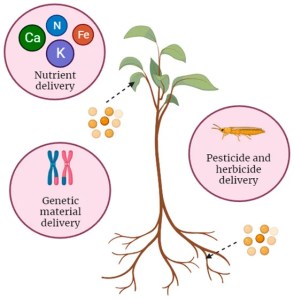
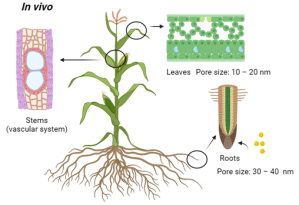
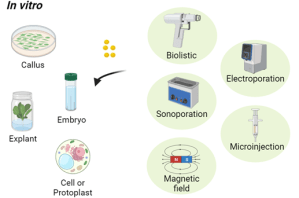
Nanoparticle transport into plants is an evolving field of research with diverse applications in agriculture and biotechnology. This article provides an overview of the challenges and prospects associated with the transport of nanoparticles in plants, focusing on delivery methods and the detection of nanoparticles within plant tissues. Passive and assisted delivery methods, including the use of roots and leaves as introduction sites, are discussed, along with their respective advantages and limitations. The barriers encountered in nanoparticle delivery to plants are highlighted, emphasizing the need for innovative approaches (e.g., the stem as a new recognition site) to optimize transport efficiency. In recent years, research efforts have intensified, leading to an evendeeper understanding of the intricate mechanisms governing the interaction of nanomaterials with plant tissues and cells. Investigations into the uptake pathways and translocation mechanisms within plants have revealed nuanced responses to different types of nanoparticles. Additionally, this article delves into the importance of detection methods for studying nanoparticle localization and quantification within plant tissues. Various techniques are presented as valuable tools for comprehensively understanding nanoparticle–plant interactions. The reliance on multiple detection methods for data validation is emphasized to enhance the reliability of the research findings. The future outlooks of this field are explored, including the potential use of alternative introduction sites, such as stems, and the continued development of nanoparticle formulations that improve adhesion and penetration. By addressing these challenges and fostering multidisciplinary research, the field of nanoparticle transport in plants is poised to make significant contributions to sustainable agriculture and environmental management. 植物へのナノ粒子の輸送は、農業やバイオテクノロジーにおける多様な応用を持つ研究分野として進化しています。本論文では、植物内でのナノ粒子の輸送に関連する課題と展望について概説し、ナノ粒子の植物内での検出方法と輸送手法に焦点を当てています。根や葉を導入部位とする受動的および補助的な輸送方法に加え、それぞれの利点と制限についても議論しています。植物へのナノ粒子の輸送における障壁を強調し、輸送効率を最適化するための革新的なアプローチ(例:新たな認識部位としての茎)の必要性を強調しています。近年、研究の努力が強化され、ナノ材料が植物組織や細胞と相互作用する微妙なメカニズムに関する理解がさらに深まっています。植物内での取り込み経路や輸送メカニズムに関する調査は、異なるタイプのナノ粒子に対する微妙な応答を明らかにしました。さらに、本論文では、植物組織内でのナノ粒子の局在化と定量化を研究するための検出方法の重要性にも言及しています。さまざまな技術が、ナノ粒子と植物との相互作用を包括的に理解するための貴重なツールとして提示されています。研究結果の信頼性を高めるために、複数の検出方法に依存することが強調されています。茎などの代替導入部位の潜在的な利用や、付着と浸透を改善するナノ粒子製剤の継続的な開発など、この分野の将来の展望も探求しています。これらの課題に取り組み、多角的な研究を推進することで、植物へのナノ粒子輸送の分野は持続可能な農業や環境管理への重要な貢献をすることが期待されています。
Lead Author: Anca Awal Sembada (PhD candidate, TUAT)
Keywords: assisted delivery; passive delivery; vascular bundles; localization; quantification;
nanoparticle characterization; detection strategies
支援型デリバリー(Assisted delivery): ナノ粒子輸送のための外部からの刺激や補助(超音波、磁場、高周波など)を用いた手法。
受動型デリバリー(Passive delivery): ナノ粒子自身の特性(サイズ、表面電荷、疎水性など)を利用して植物組織への移行を促す手法。
維管束(Vascular bundles): 植物体内の水分や栄養素を輸送する管状の組織。ナノ粒子輸送経路の一つとして注目される。
局在化(Localization): 植物組織内におけるナノ粒子の分布状況を把握すること。植物の特定部位への標的デリバリーに欠かせない情報。
定量化(Quantification): 植物組織内に取り込まれたナノ粒子の量を正確に測定すること。ナノ粒子デリバリーの効果評価に重要。
ナノ粒子特性評価(Nanoparticle characterization): ナノ粒子のサイズ、形状、表面電荷、表面修飾など、輸送効率や生体適合性に影響する特性を評価すること。
検出戦略(Detection strategies): 植物組織内のナノ粒子を正確に検出するための手法。蛍光顕微鏡、電子顕微鏡、分光分析などさまざまな手法がある。

 "Particles & Transfer" Lab. 粒子・移動現象研究室