TITLE: “Method and System for Purifying Natural Protein Raw Materials” 天然蛋⽩質原料精製⽅法及び天然蛋⽩質原料精製システム
出願番号:2023-193403(出願者:東京農工大学・ペンタリンク株式会社)Applicant: PENTALINK CO LTD, and TOKYO UNIV. AGRIC. & TECHNOL.
JP2025080323 (A) ― 2025-05-26 Priority date: 2023-11-14
To provide a method and system for purifying natural protein raw material, capable of purifying natural protein raw material directly from a worm body without manual operation only by a chemical engineering process.
SOLUTION: The purification method comprises: a pretreatment in which a worm body of a silk worm is pulverized to produce a treatment solution containing a silk gland having a first objective substance and a second objective substance; a first separation treatment in which a sediment mainly containing the silk gland is obtained from the pretreated treatment solution by specific gravity separation and each part of the worm body other than the silk gland is removed; a second separation treatment in which an aqueous solution obtained by eluting the second objective substance from the sediment obtained in the first separation treatment is obtained, and the contents of the silk gland mainly containing the first objective substance and the aqueous solution containing the second objective substance are separately obtained; a first objective substance recovery treatment in which the first objective substance is obtained from the contents of the silk gland mainly containing the first objective substance obtained in the second separation treatment; and a second objective substance recovery treatment in which the second objective substance is obtained from the aqueous solution containing the second objective substance obtained in the second separation treatment.
関連発表:Norihiro Yoshida PhD Thesis, 2025, and a Journal publication: Adv. Powder Tech. 2025: https://wp.me/p10HOa-7QX Sustainable Development of a Non-Cocoon Bombyx mori Silk Gland Route for Scalable Silk Material Fabrication (持続可能な非繭シルク生産:カイコ絹糸腺からの素材製造)
カイコから直接絹糸腺を抽出、サステナブル素材への新たな道
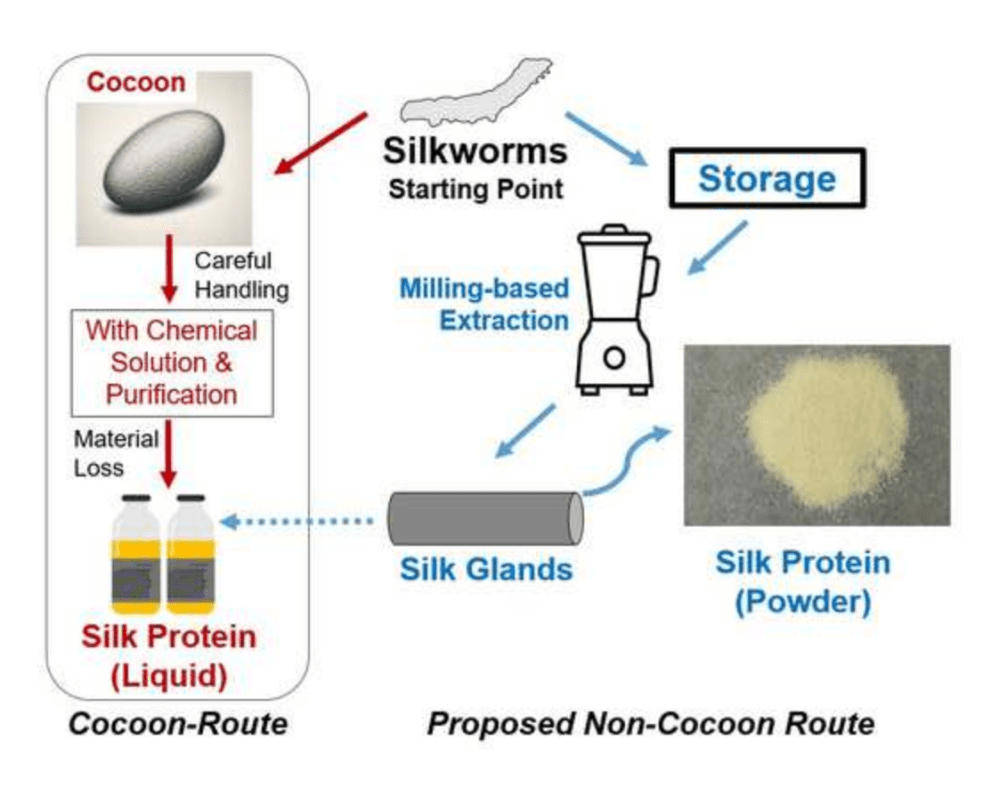
プラスチックに代わるサステナブル(持続可能)な素材の開発が急がれる中、自然の古来からの素材である「絹」に注目が再び集まっています。これまで絹タンパク質を利用するには、繭を煮て解き、化学薬品で溶解するという伝統的な工程が必要でした。私たちは、繭を使わず、カイコそのものから絹の元となる「絹糸腺」を直接取り出す、産業規模に拡張可能な方法を開発しました。
研究のハイライト:
- 繭からの解放: この新しい技術の核心は、「粉砕」というプロセスです。エタノール処理または冷凍処理を施したカイコを粉砕することで、絹タンパク質を生成する器官「絹糸腺」を効率的に抽出します。これにより、煩雑な繭の処理工程が完全に不要になります。
- 「必要な時に」抽出可能に: もう一つの大きな利点は、エタノール液中や冷凍状態でカイコを保存できる点です。これにより、素材が必要な時にいつでも処理を行う「オン・デマンド」生産が可能になり、製造の柔軟性が飛躍的に高まります。
- 2つの処理法、2つの異なる特性: 研究では、前処理の方法が最終的な素材の性質を大きく変えることが明らかになりました。
- エタノール処理を行うと、精製後の絹糸腺は柔らかくなります。
- 一方、冷凍処理を施すと、硬さが増し、多孔質な構造が導入されます。
さらに、これらを粉砕してできる絹粉末も、冷凍処理したものは粒子サイズが大きく、結晶化度が高いという特徴を示しました。
- 持続可能な社会へ向けて: この研究の意義は、単に効率化にとどまりません。産業レベルでの絹素材の生産への道も開きます。化石燃料に依存しない、生分解性の高い絹素材が、プラスチックの代替として医療から光学分野まで、幅広い応用が現実のものとなる可能性を秘めています。
A Silk Revolution: Brewing Biomaterials from Silkworms, Skipping the Cocon Altogether
In the urgent quest for sustainable materials to replace plastics, scientists are looking to nature’s oldest treasures. Silk, long celebrated for its luxurious feel, is now being re-imagined as a advanced biomaterial. But what if we could skip the traditional, time-consuming process of unraveling cocoons entirely? A groundbreaking new study does just that, presenting a method to extract silk glands directly from silkworms in a way that’s scalable for industry.
Key Points:
- Beyond the Cocoon: Traditionally, silk for biomaterials is obtained by dissolving silkworm cocoons in harsh chemicals. This new research bypasses that step completely. It uses a “wet milling” process to efficiently extract the silk glands—the organs where silk protein is produced—directly from the silkworms themselves.
- On-Demand Silk: Imagine being able to “store” silkworms for future processing. This method makes it possible by pre-treating the worms with ethanol or freezing them. This “on-demand” capability is a game-changer for manufacturing logistics.
- Two Paths, Two Properties: The study reveals that the pre-treatment method dramatically alters the final material. Ethanol-pre-treatment results in a softer silk gland after processing. In contrast, freeze-pre-treatment creates a harder, more porous structure. When milled into powder, the freeze-treated silk also has larger particles and higher crystallinity.
- A Green Future for Materials: This isn’t just about making silk production more efficient. By developing a scalable, autonomous process, this research paves the way for silk-based materials to become a truly viable and sustainable alternative to fossil fuel-derived plastics, from packaging to medical devices.
 "Particles & Transfer" Lab. 粒子・移動現象研究室