https://www.plant-climate-feedback.com/conference-youngresearchersmeeting
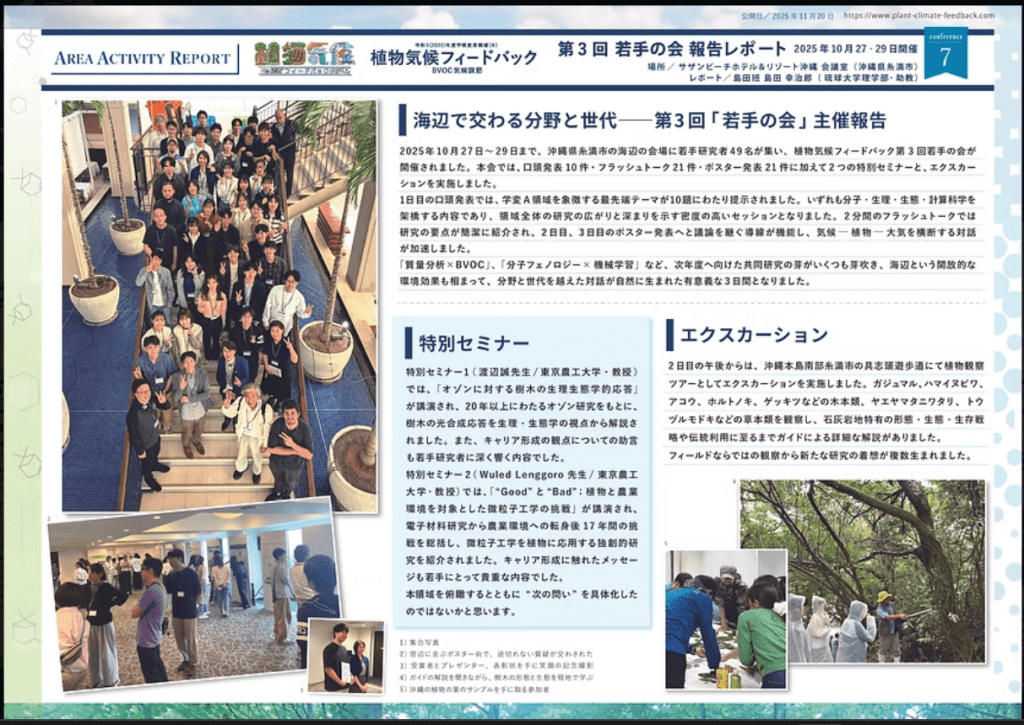
ONLINE: 2025/10/28 (40+20 min). 文部科学省 科学研究費補助金 学術変革領域研究A 「植物気候フィードバック BVOC 気候調節」第3回若手の会特別セミナー
3rd Young Scientists Seminar, Project “Plant Climate Feedback” Grant-in-Aid for Transformative Research Areas (A)
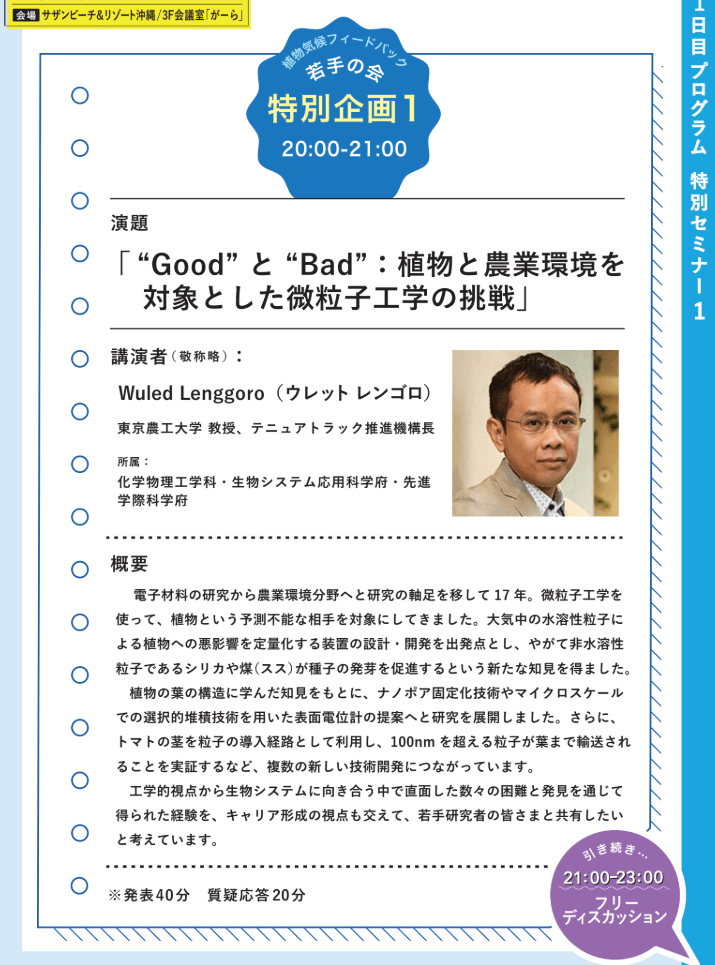
タイトル:“Good” と “Bad”:植物と農業環境を対象とした微粒子工学の挑戦
Wuled Lenggoro(東京農工大学 教授、テニュアトラック推進機構長)
所属:生物システム応用科学府・先進学際科学府・化学物理工学科
【要旨】電子材料の研究から農業環境分野へと研究の軸足を移して17年。微粒子工学を使って、植物という予測不能な相手を対象にしてきました。大気中の水溶性粒子による植物への悪影響を定量化する装置の設計・開発を出発点とし、やがて非水溶性粒子であるシリカや煤(スス)が種子の発芽を促進するという新たな知見を得ました。
植物の葉の構造に学んだ知見をもとに、ナノポア固定化技術やマイクロスケールでの選択的堆積技術を用いた表面電位計の提案へと研究を展開しました。さらに、トマトの茎を粒子の導入経路として利用し、100nmを超える粒子が葉まで輸送されることを実証するなど、複数の新しい技術開発につながっています。
工学的視点から生物システムに向き合う中で直面した数々の困難と発見を通じて得られた経験を、キャリア形成の視点も交えて、若手研究者の皆さまと共有したいと考えています。
“Good” and “Bad”: Challenges in Particle Engineering for Plant and Agricultural Environments
Wuled Lenggoro, Professor, Tokyo University of Agriculture and Technology
Affiliation: Graduate Schools of Bio-Applications and Systems Engineering & Advanced Interdisciplinary Studies; Department of Applied Physics and Chemical Engineering
Head/Director, Tenure Track Promotion Organization
Abstract:
Seventeen years have passed since I shifted my research focus from electronic materials to agricultural environments. Using particle engineering, I have been working with plants—unpredictable partners in science. My journey began with the design and development of a device to quantify the negative effects of water-soluble atmospheric particles on plants. This eventually led to new insights: insoluble particles such as silica and soot were found to promote seed germination.
Building on knowledge gained from studying the structure of plant leaves, the research extended to the development of novel technologies, including nanopore immobilization techniques and a surface potentiometer based on microscale selective deposition. Furthermore, we attempted to introduce particles into plants (tomatoes) by cutting the stem, and successfully demonstrated that particles larger than 100 nm can be transported toward the leaves. These efforts have led to the development of multiple new technologies.
Throughout this process, I encountered numerous challenges and discoveries while approaching biological systems from an engineering perspective. In this talk, I will share these experiences—alongside reflections on career development—with young researchers engaged in interdisciplinary challenges.
 "Particles & Transfer" Lab. 粒子・移動現象研究室