Progress of Catalyst Layer Coating Techniques for Polymer Electrolyte Membrane Fuel Cell Performance: A Review
May 2025
Full citation details, e.g. volume and/or issue number, publication year and page numbers, will be added when the final version becomes available.
The publisher (Elsevier) has created a Share Link – a personalized URL providing 50 days’ free access to the article. Anyone clicking on this link before July 15, 2025 will be taken directly to the latest version of your article on ScienceDirect, which they are welcome to read or download. No sign up, registration or fees are required.
Personalized Share Link:
https://authors.elsevier.com/c/1l9hr,RuCBYYne
Authors: Muliani Mansor, Khairunnisa Mohd Paad, Azran Mohd Zainoodin, Nurfatehah Wahyuny Che Jusoh, Shinya Yamanaka, Wuled Lenggoro
Show more
Abstract
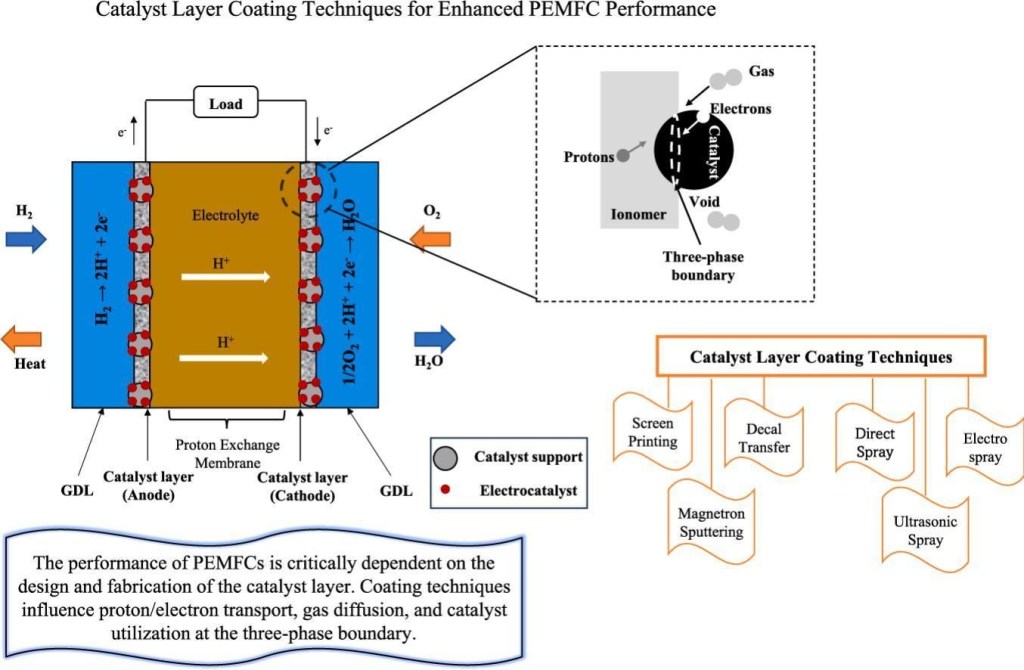
The nanostructure-engineering of catalyst layers signifies a fundamental technology in the fabrication of membrane electrode assemblies (MEAs) for polymer electrolyte membrane fuel cells (PEMFCs). Firstly, the design and working principles of MEAs for PEMFCs are elaborated briefly. Specifically, the porous media, membrane, and catalyst layer (CL) are further explained in the literature to understand the principal functions of MEAs. This review paper describes and summarizes the progress and developments of CL coating techniques, with an emphasis on their impact on transport properties and overall cell performance. The transport of protons, electrons, reagents, and products is heavily influenced by the process parameters adopted during the preparation of CLs. This work aims to facilitate process selection through evaluation of a variety of coating techniques for alternative power sources of PEMFCs. Lastly, this paper highlights that future progress will be facilitated by an understanding of how coating techniques have evolved in response to challenges and how they can be further developed to reach high PEMFC performance through fabrication CL to pave way for commercialization. The results of this work demonstrate that during the CL coating process, catalyst ink dispersion, platinum (Pt) usage, and agglomeration of catalyst particles must be carefully addressed. These findings can be useful for both academic and industrial researchers to ensure high-quality control in electrode fabrication.
https://doi.org/10.1016/j.jiec.2025.05.041
固体高分子形燃料電池(PEMFC)用触媒層のナノ構造工学:課題と展望
膜電極接合体(MEA)の製造において、触媒層(CL)のナノ構造制御は基盤技術です。本(解説)論文では、まずPEMFC用MEAの設計原理と、多孔質媒体・固体高分子膜・触媒層の機能を解説します。続いて、触媒層のコーティング技術の進展を総括し、それらが物質輸送特性や電池性能に与える影響を分析しました。
特に、プロトン・電子・反応試薬・生成物の輸送は、触媒層製造時の「分散条件」「白金(Pt)使用量」「触媒粒子の凝集抑制」などの工程パラメータに強く依存します。本レビューでは、多様なコーティング手法を評価し、PEMFCの高性能化・商業化に向けた最適プロセス選択を支援します。
今後の発展には、3つの鍵が必要です:
触媒インクの均一分散技術
白金使用量の低減
ナノスケールでの粒子凝集制御
これらの知見は、アカデミアと産業界の双方が、再現性の高い電極製造を実現するための指針となります。持続可能なエネルギー社会の実現に向け、材料工学とプロセス工学の連携が不可欠です。
用語補足:
固体高分子形燃料電池(PEMFC):水素と酸素の化学反応で電気を生む装置。自動車や家庭用電源への応用が期待。
触媒層(CL):反応を促進する白金粒子を含む層。ナノレベルでの設計が性能を左右します。
凝集:粒子が塊になる現象。反応効率を低下させるため抑制が必要。
 "Particles & Transfer" Lab. 粒子・移動現象研究室