Our study revealed that water insoluble silica particles can boost the germination and vigor of tomato seeds. …私たちの研究では、水に溶けないシリカ粒子がトマトの種子の発芽と生育を促進することが明らかになりました…
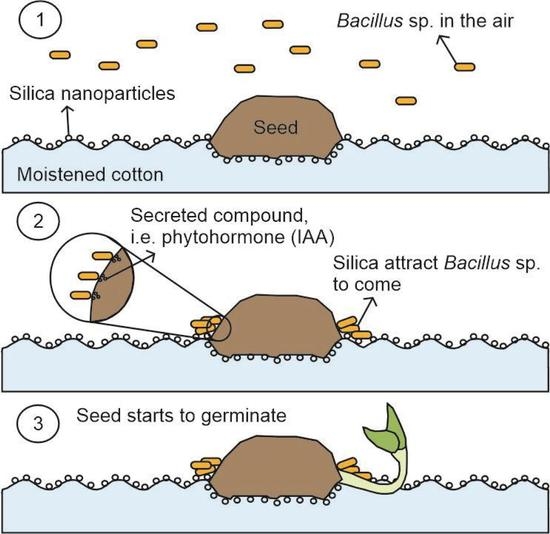
Bacteria (Bacillus sp.), which are found in the air, could interact with silica to promote germination … 空気中に浮遊する細菌 (Bacillus sp.) がシリカ微粒子と相互作用して発芽を促進する可能性があります。水稲などの植物は、シリカが必須ではないにもかかわらず、シリカに依存して生長することが知られています。
Although silica is not essential for plants, it is known that rice and other plants depend on silica for their growth. This discovery may provide a clue to explain why… この発見は、その理由を解明する手がかりになるかもしれません。
The lead author of this study is a doctoral student at TUAT and an alumnus of ITB School of Life Sciences & Technology
doi.org/10.3390/nano13142110 Open Access (July 2023)
We found that adding silica colloidal particles to an aqueous growth medium in which tomato seeds were germinated shortened the mean germination time from 5.24 ± 0.29 days to 4.64 ± 0.29 days and improved seedling vigor (seedling size, health, and growth rate). The smaller size of particles (10–17 nm) was more effective than the larger size (110–120 nm) in promoting seed germination and growth. The presence of particles in the seedlings was assessed using an X-ray fluorescence spectrometer. These findings suggest that silica particles can be used as an eco-friendly solution for faster and stronger seed germination in aquatic environments. トマトの種子を発芽させるための水を用いた培地に、シリカ微粒子を加えると、平均発芽時間が5.24±0.29日から4.64±0.29日に短縮され、苗の活力(サイズ、成長率)が向上することがわかりました。粒子の小さいサイズ (10–17 nm) は大きいサイズ (110–120 nm) よりも種子の発芽と成長を促進するのに有効でした。蛍光X線元素分析法により、実生中のシリカ微粒子の存在を評価しました。これらの発見は、シリカ微粒子が水生環境でより速くより強い種子発芽のための「環境に優しい」解決策として使用できることを示唆しています。
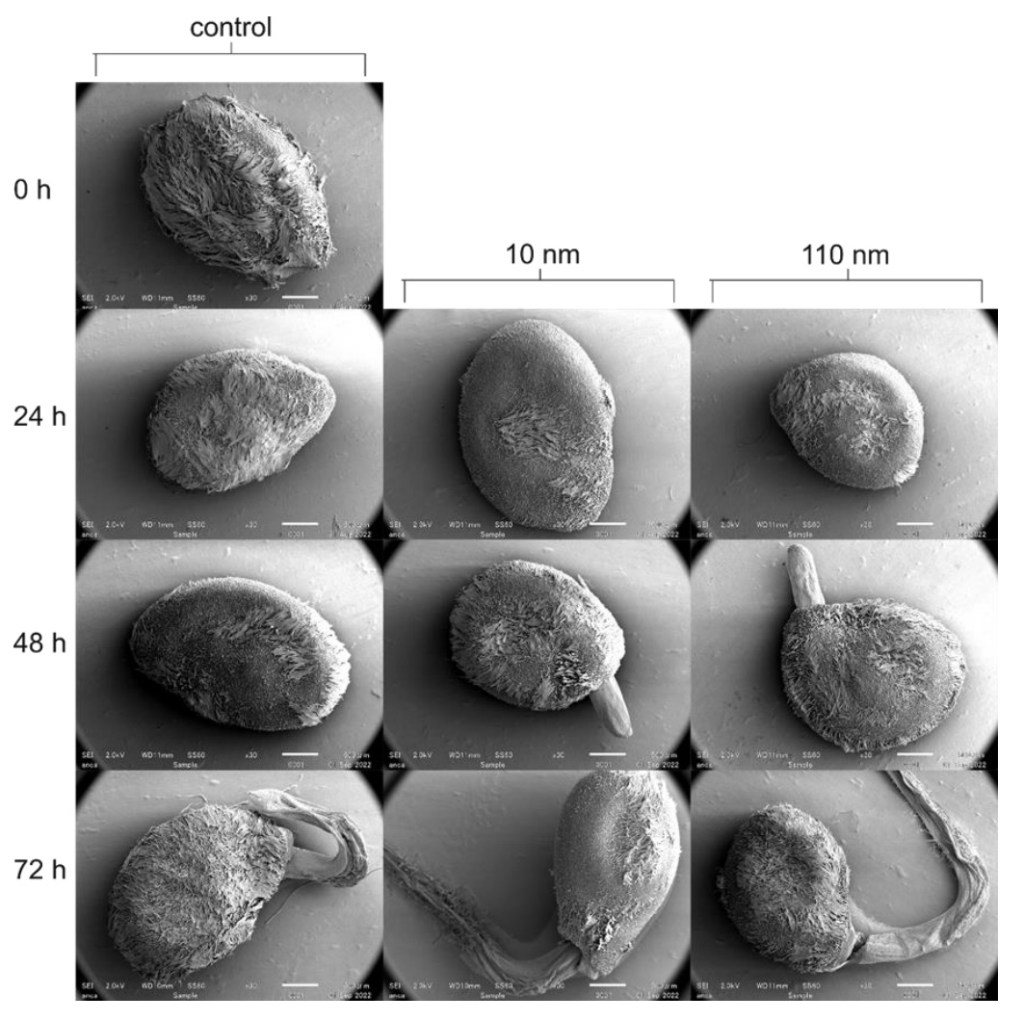
Scanning electron microscopy (SEM) revealed changes in the seed coat during germination, many of which were only observed in the presence of nanoparticles. Soil bacteria affect germination; specifically, Bacillus sp. may promote germination. The number of Bacillus sp. changed in the germination medium with SiNPs compared to the control. This suggested that these bacteria could interact with SiNPs to promote germination. 走査電子顕微鏡 (SEM)」を用いて、種皮の変化を観察し、微粒子を添加する場合にのみ、発芽中の種皮の変化が観察されたことがわかりました。また、土壌細菌「特にBacillus sp.」が発芽を促進する可能性があることも示されました。シリカ微粒子を含む発芽培地でBacillus sp.の数が変化したことから、これらの細菌がシリカ微粒子と相互作用して発芽を促進することが示唆されました。
The Role of Silica Nanoparticles in Promoting the Germination of Tomato (Solanum lycopersicum) Seeds トマト種子の発芽促進におけるシリカ微粒子の役割
Anca Awal Sembada, 牧 慎也 (Shinya Maki), Ahmad Faizal, 福原 敏行 (Toshiyuki Fukuhara), 鈴木 丈詞 (Takeshi Suzuki), I. Wuled Lenggoro.
Chemical Engineering Program, Graduate School of Engineering, Tokyo University of Agriculture and Technology, Japan 東京農工大学・工学府・システム化学工学専修
Department of Science of Technology Innovation, Nagaoka University of Technology, Japan 長岡技術科学大学・技術科学イノベーション専攻
School of Life Sciences and Technology, Institut Teknologi Bandung (ITB), Indonesia バンドウン工科大学・生命工学部
Department of Applied Biological Science, Graduate School of Agriculture, Tokyo University of Agriculture and Technology, Japan 東京農工大学・農学部・応用生物科学科
Graduate School of Bio-Applications & Systems Engineering, Tokyo University of Agriculture and Technology, Japan 東京農工大学・大学院生物システム応用科学府
Department of Applied Physics and Chemical Engineering, Tokyo University of Agriculture and Technology, Japan 東京農工大学・工学部・化学物理工学科
 "Particles & Transfer" Lab. 粒子・移動現象研究室
2 Comments Add yours