This article was made “automatically” using a database (64 articles, in 41 Journals, Web of Science, 2007/1-2025/8, TUAT Lenggoro)
From Particles to Sustainability: 18 Years of Research at TUAT
Prof. Lenggoro’s career has traced a wide arc. It began in Hiroshima (1998-2006) exploring the building blocks of materials like ceramics and phosphors. A new chapter started at TUAT where particle technology became tools for biology, environment, and society. What began as questions of optical material etc. grew into solutions for clean water, healthy plants, and sustainable systems. His research story is not focused on just a single field. Instead, it follows particles wherever they could “serve” people and the planet. レンゴロ教授の歩みは、前職の広島大学でセラミックスや蛍光体といった微粒子材料の基礎研究に取り組んだ時代から始まりました。2007年に東京農工大学へ移ってからは、微粒子の研究を生物や環境、社会の課題解決へと広げてきました。
The TUAT Period (2007-Present) began with a Transition Phase (c. 2007-2012), where he applied his expertise in advanced aerosol and colloidal synthesis to create high-performance functional materials (e.g., dielectric particles). A significant “Bio-Application” Pivot (c. 2013-2018) followed, where these core particle engineering techniques were applied to entirely new domains: immobilizing enzymes, studying particle deposition on plant leaves, and fundamentally (discovering and) characterizing novel materials like candle soot. This led to the current Sustainability-focused Phase (c. 2019-Present), where the lab’s work is now fully geared towards creating system-level solutions for global challenges. Chemical Engineering and Environmental/Plant Sciences now lead his output. His societal goal has shifted from Energy to Health and Clean Water. As a result, his impact has transformed; his work is now cited by researchers using particle technology to solve practical problems in water purification, agriculture, and environmental conservation.
東京農工大学(2007年以降)では、まず「移行期」(2007-2012年)から始まり、高度なエアロゾル・コロイド合成技術を駆使して高性能な機能性材料(誘電体ナノ粒子等)を創製しました。その後、大きな「生物・環境応用への転換期」(約2013-2018年)を迎え、基盤となる微粒子工学技術を酵素の固定化、植物葉上への粒子沈着、そして新規材料としての煤(スス)の発見および特性評価といった全く新しい領域へと展開しました。これが現在の「サステナビリティ(持続可能性)への注力期」(約2019年以降)へと繋がり、研究室の活動は地球規模課題に対するシステムレベルの解決策創出へとシフトしています。現在の論文発表は化学工学や環境・植物科学が主導し、社会貢献の目標も「エネルギー」から「健康・福祉」や「きれいな水」へと変化しました。その結果、研究のインパクトも変容し、現在では微粒子工学等を用いて農業、環境保全といった実用的な課題を解決する研究者たちに最も多く引用されています。
Phases Timeline
- 2007-2012 (Phase 1: Advanced Synthesis):
- Keywords: Spray Methods, BaTiO₃, Magnetite
- 2013-2018 (Phase 2: Bio/Enviro Pivot):
- Keywords: Enzymes, Biomolecules, Atmospheric Aerosols, Plant Leaves, Candle Soot
- 2019-2025 (Phase 3: Sustainability Solutions):
- Keywords: Solar Distillation, Seed Germination, Water Treatment, Cellulose, Soil
Research Area

研究領域 (2007-2025)

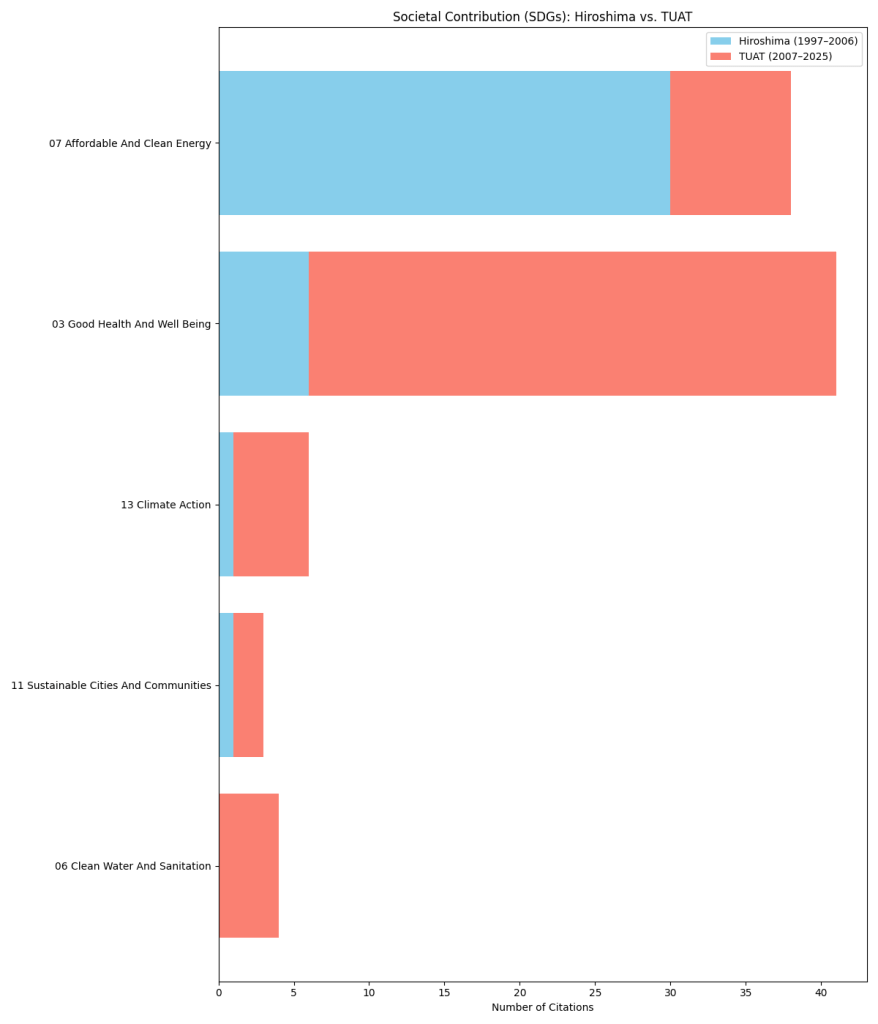
SOCIETAL CONTRIBUTION (SDGs) From Energy to Water & Health
Our focus has shifted from energy to broader health and environmental goals, especially water and agriculture
Sustainable Delevopment Goals (SDGs) (2007-2025)
- 03 Good Health And Well Being: 35 保健と福祉
- 07 Affordable And Clean Energy: 8 安価でクリーンなエネルギー
- 13 Climate Action: 5 気候変動対策
- 06 Clean Water And Sanitation: 4 安全な水と衛生
- 11 Sustainable Cities And Communities: 2 持続可能な都市とコミュニティ
SDGs (1997-2006)
- 07 Affordable And Clean Energy: 30
- 03 Good Health And Well Being: 6
- 11 Sustainable Cities And Communities: 1
- 13 Climate Action: 1
- 「Good Health」 は2007年以降に大幅に増加。
- 「安価で(Affordable & Clean Energy)」 は1997–2006年に多く、近年は減少傾向。
- 新たに 「Clean Water」 が2007年以降に登場。
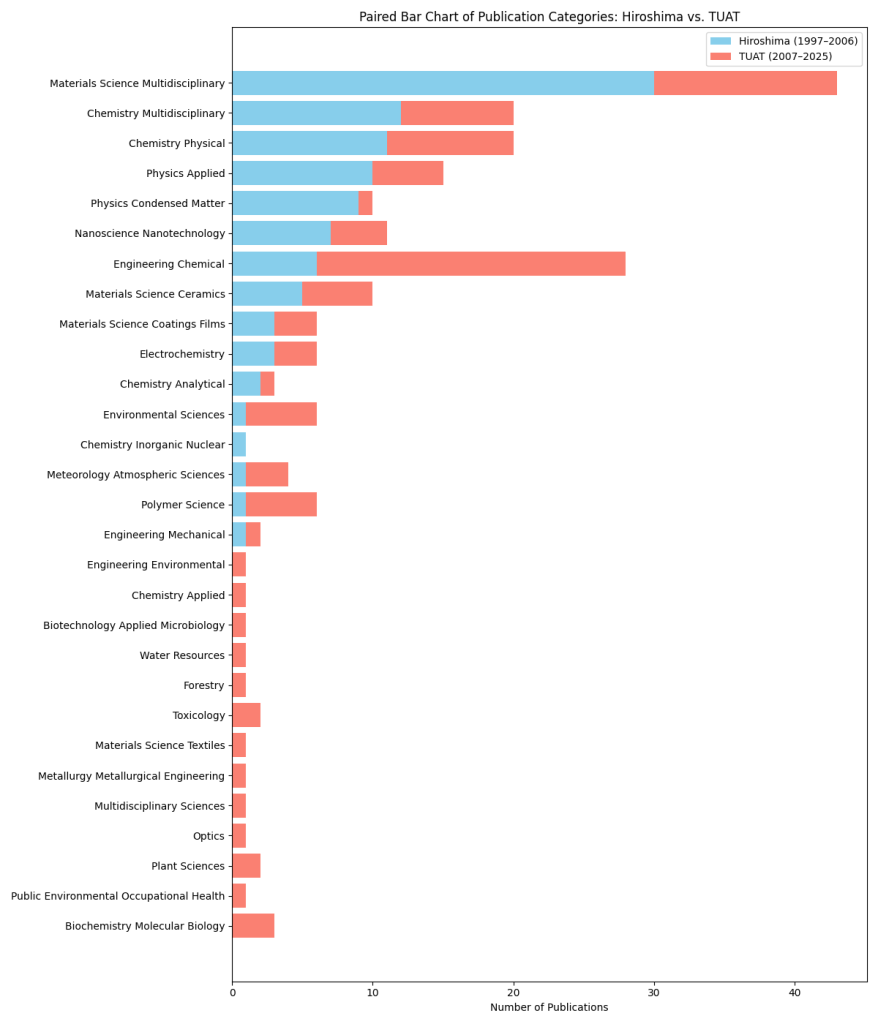
The Diversity 多様性の拡大
以下は、研究領域カテゴリーのデータです:左側(青):前職・広島大(1997–2006)、科学分野(Materials Science, Chemistry, Physics)が中心。右側(赤):東京農工大(2007–2025)、工学分野(Engineering Chemical)へのシフトが明確。多様性の拡大:右側には新しいカテゴリ(Forestry, Toxicology, Opticsなど)が多数登場。
Research Impact: 1997–2006 vs. 2007–2025 引用トピックの比較
This detailed list shows the specific research areas that have cited our work since 2007. The top two, Nanoparticles (& Nanofibers), highlight the core technologies our lab provides to the scientific community.
- 「Nanoparticles」 と 「Nanofibers, Scaffolds & Fabrication」 が2006年以降に急増。
- 一方で、「フォトルミネッセンス(Photoluminescence)」 や 「セラミックス(Ceramics)」 は以前の期間に多く見られました。
- 新しいトピック(例:Forestry, Water Treatment, Microfluidics, Imaging)が2006年以降に登場。
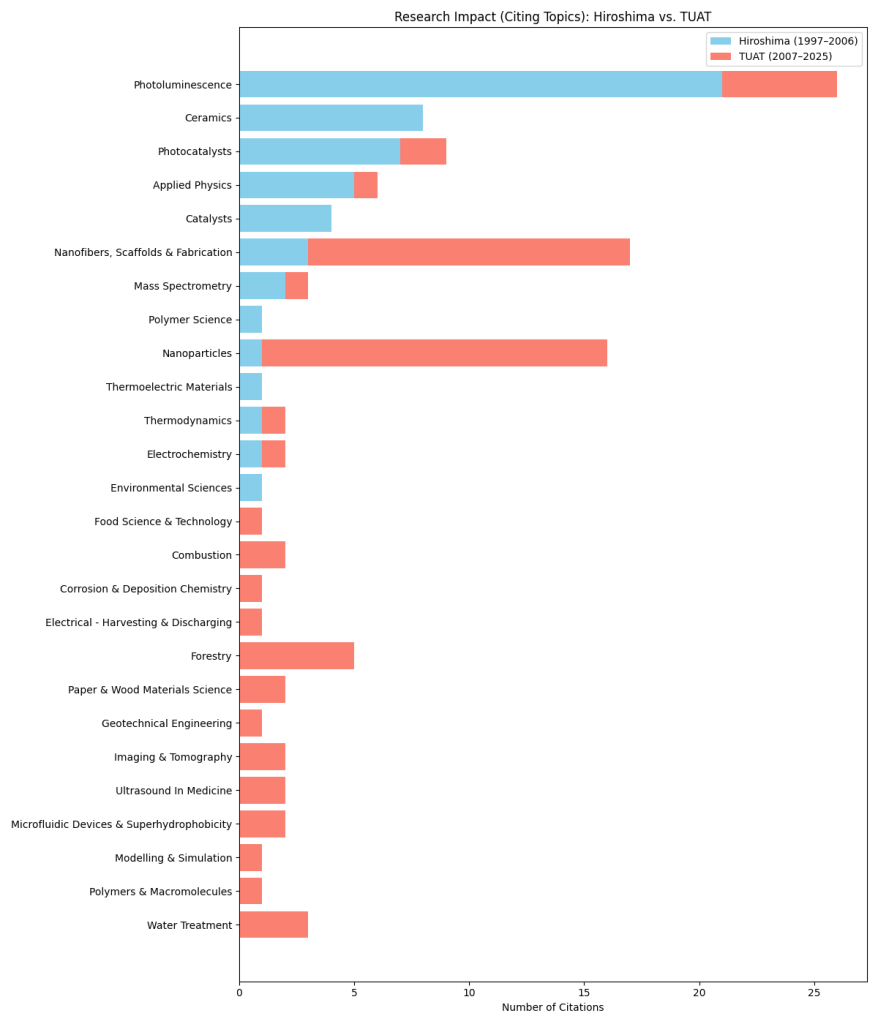
Citation Topics (2007-2025)
- 2.67 Nanoparticles: 15
- 2.165 Nanofibers, Scaffolds & Fabrication: 14
- 2.78 Photoluminescence: 5
- 3.40 Forestry: 5
- 2.90 Water Treatment: 3
- 1.254 Ultrasound In Medicine: 2
- 2.160 Microfluidic Devices & Superhydrophobicity: 2
- 2.74 Photocatalysts: 2
- 3.87 Paper & Wood Materials Science: 2
- 5.250 Imaging & Tomography: 2
- 7.177 Combustion: 2
- 2.210 Corrosion & Deposition Chemistry: 1
- 2.211 Mass Spectrometry: 1
- 2.53 Polymers & Macromolecules: 1
- 2.62 Electrochemistry: 1
- 3.85 Food Science & Technology: 1
- 5.77 Applied Physics: 1
- 7.133 Geotechnical Engineering: 1
- 7.251 Electrical – Harvesting & Discharging: 1
- 7.57 Modelling & Simulation: 1
- 7.70 Thermodynamics: 1
Journals Published (2007-2025)
- ADVANCED POWDER TECHNOLOGY: 12
- COLLOIDS AND SURFACES A PHYSICOCHEMICAL AND ENGINEERING ASPECTS: 4
- JOURNAL OF THE ELECTROCHEMICAL SOCIETY: 3
- NANOMATERIALS: 3
- ATMOSPHERIC ENVIRONMENT: 2
- JAPANESE JOURNAL OF APPLIED PHYSICS: 2
- JOURNAL OF THE AMERICAN CERAMIC SOCIETY: 2
- JOURNAL OF THE CERAMIC SOCIETY OF JAPAN: 2
- PARTICUOLOGY: 2
- AEROSOL AND AIR QUALITY RESEARCH: 1
- ANALYTICA CHIMICA ACTA
- CHEMICAL ENGINEERING SCIENCE
- CHEMISTRY OF MATERIALS
- COLLOID AND POLYMER SCIENCE
- ENZYME AND MICROBIAL TECHNOLOGY
- FORESTS
- INDUSTRIAL ENGINEERING CHEMISTRY RESEARCH
- INDUSTRIAL HEALTH
- INHALATION TOXICOLOGY
- INTERNATIONAL JOURNAL OF BIOLOGICAL MACROMOLECULES
- JOURNAL OF AEROSOL SCIENCE
- JOURNAL OF ALLOYS AND COMPOUNDS
- JOURNAL OF CHEMICAL ENGINEERING OF JAPAN
- JOURNAL OF FIBER SCIENCE AND TECHNOLOGY
- JOURNAL OF MAGNETISM AND MAGNETIC MATERIALS
- JOURNAL OF MATERIALS RESEARCH
- JOURNAL OF NANOPARTICLE RESEARCH
- JOURNAL OF PLANT RESEARCH
- JOURNAL OF THE EUROPEAN CERAMIC SOCIETY
- JOURNAL OF WATER PROCESS ENGINEERING
- KONA POWDER AND PARTICLE JOURNAL
- LANGMUIR
- MEMBRANES
- MOLECULES
- OPTICAL REVIEW
- PARTICULATE SCIENCE AND TECHNOLOGY
- PLANT PHYSIOLOGY AND BIOCHEMISTRY
- POLYMER BULLETIN
- RESEARCH ON CHEMICAL INTERMEDIATES
- ROYAL SOCIETY OPEN SCIENCE
- RSC ADVANCES
Global Collaborations (2007-2025)
Our collaborations span Asia, with increasing links to global partners.
- JAPAN: 64
- MALAYSIA: 20
- INDONESIA: 13
- SOUTH KOREA: 2
- USA: 2
- ENGLAND: 1
- PEOPLES R CHINA: 1
 "Particles & Transfer" Lab. 粒子・移動現象研究室